Showing posts with label Nanga Parbat. Show all posts

The Adventure Podcast Episode 8: More Adventure News!

The latest episode of The Adventure Podcast is now available for download. Like last week, this is a solo effort that strays from our usual format. It is also shorter than most of our other episodes as well, concentrating on just four or five important news stories that took place in the past week.

As usual, you can listen to the show online, or find it on Apple Podcasts, Google Play, and Stitcher. I've also embedded the episode below for those who don't use any of those formats. We're currently working on getting the show syndicated in Spotify too, but we are still in the process of getting approval.

Last week our show as an abbreviated one because my co-host Dave Adlard had a few things to deal with on his end. This week, I have been dealing with some family issues as well, which prevented us from being able to record at our regular time. Next week, both of us will be traveling, but we may do yet another short "news" episode before hopefully getting back to our regular routine after that. Thanks for your patience and for listening.

The Adventure Podcast Episode 7: Adventure News

Just a quick note to let everyone know that the latest episode of The Adventure Podcast is now available for download. As usual, you'll find it on the web, Apple Podcasts, Google Play, and Stitcher. I've also embedded the show in this post so you can listen to it as well.

In this episode I am flying solo, so rather than boring everyone too much, we just picked a few important adventure news items from the past week or so and shared them with listeners. This is a much shorter episode  than usual too, running just 17 minutes in length. Next week, we'll be back to the usual format, before we goin on hiatus for a bit while I travel and Dave takes care of a major project on his end too.

As always, thanks for listen. If you have any feedback, be sure to drop us a note at theadventurepod@gmail.com or follow us on Facebook and Twitter.


Pakistani Officials Weigh in on Nanga Parbat Rescue Controversy

The rescue operation that took place on Nanga Parbat a few weeks back continues to be a source of frustration and controversy. While climbers from K2 were able to rescue Elisabeth Revol, they weren't able to climb higher to save Tomek Mackiewicz, which has created a contentious environment to say the least. Revol has expressed her anger over how slowly the operation came together, saying more than once that Tomek could have been saved had search and rescue teams responded more expediently. She has even said the company operating the helicopter raised the price of the flight in an effort to make more money off of the situation. While that remains under investigation, Pakistani officials have responded to criticism not just from Revol but the media as well, providing some insights into their side of the story.

In a post made to the Pakistan Mountain News page on Facebook officials made four points that they thought were important enough to share. Those points were as follows:
1. First, Pakistan is a developing economy and ‘Tourism’ sector receives much less attention. Despite, it has world’s best wonders. Neither there are institutions for high-demanding-skills rescue operation on mountain nor has it modern resource and equipment.
2. Second, these mountaineers go on Nanga Parbat at very economical package. Such economical packages do not cover many essentials. It is only their bravery and audacity that make them to summit in the winter.
3. Third, Askari Aviation does not have high-tech helicopters that can hover around in inclement weather condition. As it was coordinated rescue operation, nobody could help Tomek and Elisabeth in private capacity.
4. Lastly, Poland or French official authorities did not contact State of Pakistan officially after this rescue. However, Eisabeth was given utmost care and attention. The Chief Secretary of Gilgit-Baltistan enquired after her in hospital. She did not utter a word.
While some will probably look at this list and see a set of excuses, these are all very important things to keep in mind. Pakistan is indeed a developing country that doesn't have the resources of some other nations when it comes fountaining these kinds of operations. It is also true that Tomek and Elisabeth's expedition was a low-budget affair, leaving little room for error and not much in the way of a safety net if things went wrong. Unfortunately, things went very wrong, and they also didn't have the resources for a rescue.

Askari Aviation is the company that has received a lot of venom for not reacting quicker and potentially trying to bilk more money out of the operation. But it is also probably true that they don't have very sophisticated helicopter designed for use in the high mountains.

In other words, there are always multiple sides to a story and it is clear that we understand all of the variables at play. Clearly this is a complicated situation with a lot to think about. Sadly, Tomek lost his life, and because of that this will likely be a divisive topic for a long time to come.

Thanks to Alan Arnette for sharing this story.

Could Tomek Mackiewicz Have Been Saved on Nanga Parbat?

When it comes to mountaineering, second guessing is often a sport unto itself. Such is the case with the recent tragedy on Nanga Parbat, where Polish climber Tomek Mackiewicz lost his life, but a team of climbers on K2 risked their own to rescue French alpinist Elisabeth Revol. But now that the dust has settled, and the operation is being examined, Revol herself is lashing out at authorities in Pakistan, which she says didn't do enough to help save her friend. 

In an interview conducted on Wednesday, Revol said that she feels a lot of anger over the situation. She believes that Mackiewicz could have been saved had officials in Pakistan worked faster and been more forthright in their actions. The French climber says that she sent out an SOS to her husband, Tomek's wife, and Ludovic Giambiasi, who was helping coordinate the expedition from back home. Those three jumped into action to try to get help for Revol and Mackiewicz, but were met with resistance and stalling on the part of the Pakistanis. 

Perhaps the most disturbing element to the story is how the Pakistani helicopter rescue team began negotiating the price of starting the operation. According to reports, they initially wanted $15,000 to fly to Nanga Parbat to rescue Elisabeth and Tomak. But as things progressed, that price rose to $40,000 in cash and in advance, before the flight would ever leave the ground. 

It should be also noted that while high altitude rescues have become fairly common on Everest and other big Nepali peaks, in Pakistan they remain fairly rare. The pilots and SAR teams don't have much experience conducting such operations, which also makes them hesitant to go too high. Tomek was stranded at 7200 meters (23,622 ft), while Revol was told to descend down to 6300 meters (20,669 ft) to meet a rescue team. When she did that however, no one arrived to lend a hand and she was forced to spend another night exposed to the elements in a crevasse. This eventually led to her pulling her boots off while hallucinating, causing severe frostbite. 
Knowing these circumstances, it is easy to understand why Elisabeth feels such anger. She says that she only left Tomek behind because she was instructed to do so and was told that rescuers would go up to retrieve him. Obviously now she feels regret at that decision, although it most likely saved her life in the long run. 

Considering the description of the symptoms that Tomek was experiencing at the time, it seems unlikely that he was going to survive the expedition after making a late summit, but spending a night in a crevasse. Revol says that when she woke up the next morning, Mackiewicz was bleeding from the mouth and was unconscious, sure signs of altitude sickness. Unable to move himself, she really had no choice but to descend, and the hard reality is that her companion was quite possibly too far gone at that point regardless.

On the other hand, the fact that another 24 hours passed before anyone came to help leaves room to wonder. Had the Pakistanis reacted much more quickly, could they have saved Tomek too? For their part, the Polish team from K2 put in a heroic effort, climbing as fast as humanly possible considering the terrain and altitude. In the end though, poor weather moved in preventing them from going any higher.

The entire situation will no doubt spur a lot of debate within the mountaineering community. In the end, we'll never know for sure, but it is clear that if you're climbing in Pakistan it is important to understand all of the risks you could face. 

Nanga Parbat Debrief: More Details Emerge on Tragic Expedition

A week ago, the mountaineering world stood still as we all watched the events that were unfolding on Nanga Parbat as they occurred in realtime. It was a scary, crazy situation that played out like a movie, with a result that was both triumphant and tragic at the same time. Now that we've allowed a bit of distance to pass, we're learning more about exactly what happened as survivor Elisabeth Revol shares her story.

According to Revol, she and Tomek Mackiewicz set out for the summit late last week as expected, The duo were attempt to become just the second team to climb Nanga Parbat during the winter, a project that Tomek had been focused on for more than seven years. The two climbers were successful in that venture, reaching the top of the 8125-meter (26,526 ft) peak late in the day. But, they had pushed their luck too far and arrived around 6:00 PM local time, which meant that they couldn't spend much time at all on the summit.

To make matters worse, as they turned to go back down Tomek revealed that he had lost his eye site. Revol says that he hadn't used a mask during the ascent because of the hazy conditions, and after hours of exposure he was suffering from snow blindness. The two carefully made their way back down the mountain with the Frenchwoman leading the way and her Polish climbing partner handing on to her shoulder.

From there, Mackiewicz's condition only continued to deteriorate. His breathing started to become irregular and both climbers were suffering from frostbite. With exhaustion setting in, they knew they wouldn't be able to reach their high camp, so they sought shelter at 7200 meter (23,622 ft) to try to wait out the night.

By dawn, Tomek was bleeding from the mouth and had mostly slipped into unconsciousness. It was then that Elisabeth called for help and was told that if she descended to 6000 meters (19,685 ft) rescuers could come get her and they could go up to retrieve Mackiewicz too. So, she moved the Polish climber into a crevasse for protection from the wind and started down the mountain.

But help didn't come that day, and both climbers were forced to spend another night outdoors. It was then that Revol began to hallucinate believing that someone had come to bring her hot tea. She says that she believed that in order to repay them she needed to give them her shoes, so she removed her boots. She wandered around barefoot for more than five hours, which induced severe frostbite, the damage from which is still being assessed.

Eventually she was able to descend into one of the team's campsite and as she arrived she saw two headlamps coming through the night. They belonged to Polish climbers Denis Urubko and Adam Bielecki who had flown by helicopter from Base Camp on K2, and put in their own superhuman effort to get up the mountain and locate Revol. They got her into a tent as soon as possible and began treating her for exposure.

The rescue team was also faced with a tough decision at that point. They had stabilized Elisabeth but she was still in danger, meanwhile Tomek was still further up the mountain and likely in critical condition if not already dead. If they went up to find him, there was a good chance they wouldn't locate him at all, plus poor weather was setting in. They made the tough choice to stay with the Frenchwoman to ensure that she survived and got down safely.

Currently, Elisabeth is in a hospital in France where she is recovering and the damage from the frostbite is being assessed. There could be amputations still coming, although doctors are hoping to save her fingers and toes. A decision is expected on that process within a day or two.

As you can imagine, she is extremely emotional and still suffering from exhaustion and exposure. The entire expedition has been a challenge and at the end she was forced to make what is likely the toughest decision of her life. Leaving her friend behind was incredibly difficult and she will no doubt carry the emotions of that for a long time to come.

You can read more about the story here.

Tomek Mackiewicz Perishes on Nanga Parbat Following Heroic Rescue Attempt

While I was away at Winter Outdoor Retailer last week, one of the biggest stories in recent memory from a mountaineering aspect was unfolding on Nanga Parbat. The massive peak known as "the Killer Mountain" amongst alpinist was the backdrop for a dramatic rescue attempt that left one climber dead, while rescuing another.

When last we checked in on the winter climbing expeditions, Tomek Mackiewicz and Elisabeth Revol were in Camp 3 on Nanga Parbat waiting out poor weather conditions. They had planned to move up to C4 later in the week and then make an attempt on the summit on Thursday or Friday. Unfortunately, things didn't go as planned and they found themselves in trouble when descending from the 8000-meter (26,246 ft) mark.

Eventually the duo were able to descent to 7400 meters (24,278 ft) where they huddled in the tent. It was at that point that Revol discovered that her climbing mate was suffering from severe frostbite and snow blindness. Eventually, Tomek would slip into unconsciousness as well, leaving the Frenchwoman to make what was probably the hardest decision of her life. With things looking very grim, she made a call to inform their support team to the situation and began descending the mountain on her own. She had no food or water and had been high on the mountain for several days.

When the Pakistani government received word of the situation they contacted the Polish team attempting the first winter ascent of K2 to see if they could help. The rescue operation was delayed due to poor weather, but on Friday Denis Urubko, Adam Bielecki, Piotr Tomala and Jarek Botor were picked up by helicopter in K2 Base Camp and flown to Nanga Parbat to launch a rescue operation.

Urubko and Bielecki were the tip of the spear in that operation, setting off at lighting quick speed to go up the mountain in an attempt to bring Tomek and Elisabeth down. They flew up the Kinshoffer Route covering an astounding 1250 meters (4101 ft) in seven and a half hours. That is an amazing pace considering how technical the route is and the fact that they were climbing at night.


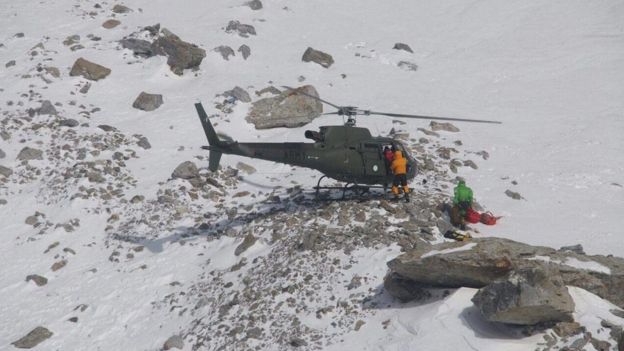
Eventually, Denis and Adam were able to locate Elisabeth, but the weather began to deteriorate at a rapid rate and they were forced to turn back down. She was suffering from frostbite and hadn't had any water or food for more than two days. But, they were able to get her safely down from the mountain where she was taken by helicopter to Islamabad for medical attention. Unfortunately, the poor conditions prevented anyone from being able to climb up to Tomek's position, and the Polish climber is now believed to have died on the mountain.

One of the key aspects of this story is that the mountaineering community from around the world rallied together to raise the necessary funds to mount the rescue operation in the first place. Hiring a helicopter in Pakistan is not cheap or easy, and the Nanga Parbat expedition was a low-budget affair. But, when word of the situation reached the rest of the world, a fundraiser was launched to help with the process. That fundraiser is still going on, with the money now being directed to Tomek's wife and three children.

This is a sad story all around. Tomek has been obsessed with climbing Nanga Parbat for the better part of the past decade, spending seven winter seasons in his attempt to reach its summit. Finally he is at rest on the mountain that he had spent so much time trying to crack. Elisabeth reportedly has severe frostbite on three of her toes and is in a weakened state, but is otherwise in good condition. She will likely fly home in a few days time, although she will no doubt be haunted by the experience for years to come.

The Poles on K2 put up a heroic effort and will now return to Base Camp on that mountain as well. They'l resume their expedition there and will continue the pursuit of the first winter ascent of K2 in the days ahead.

Our condolences go out to Tomek's friends and family. It is a terrible loss and he will indeed be missed.

Winter Climbs 2018: Summit Bid on Nanga Parbat, Updates From K2 and Everest

More new from the major winter climbing expeditions this season with progress on just about every front. Lets get into the latest updates from all over.

We'll start today on Nagna Parbat, where it appears that Tomek Mackiewicz and Elisbeth Revol are preparing to make an attempt on the summit. The duo arrived on the mountain just after Christmas, and have been acclimatizing there ever since, but for the past two weeks they've been bogged down with high winds. Yesterday, those winds subsided at last, and they now report good conditions. After making a gear deposit at 6700 meters (21,981 ft), they now report that they are going for the summit.

If they launched that bid yesterday, and everything goes exactly right, they may top out as early as Sunday or Monday of this coming week. It is a tough ascent, and snow and ice don't make it any easier, but it is definitely possible for them to complete the climb in that time frame depending on the conditions. In winter however, deep snow could slow their progress. For now, we'll just have to wait and hope that the weather window stays open long enough for them to reach the summit.

Over on K2, the winds have died down as well. The Polish Ice Warrior team had expected conditions to be bad for several more days at the least, but the weather has improved dramatically. This has allowed them to begin sending gear up to their first campsite, which will actually be in what is traditionally C2, located at 6200 meters (20,341 ft).


After scouting the mountain and having a look at the conditions there, the team has elected to try the ÄŒesen Route rather than the Abruzzi. As Alan Arnette reports, this is a steeper route, but has some serious advantage, namely it will allow the strong Polish climbers to cover more ground at a faster pace. It also avoids some of the more technical rock climbing sections that can slow climbers down tremendously.

Finally, the Everest winter team of Alex Txikon and Muhammad Ali Sadpara have left Base Camp, but aren't heading back up the mountain. Instead, they'll jump over to nearby Pumori for some much needed acclimatization before going higher on the Big Hill. The reason for the shift is to avoid going through the dangerous Khumbu Icefall too often. On Pumori they can go up and down the mountain much more safely, at least to Camp 2. Higher than that they run the risk of serious avalanches, although I haven't seen a report on the snow conditions on that mountain this season, so it is possible they will head up to the summit if it is safe to do so.

After they've done a few acclimatization rotations on Pumori, they'll head back to Everest and resume their operations there. For now though, they're content with getting their bodies ready for higher altitude on a generally safer peak.

More to come soon.

Winter Climbs 2018: Into the Icefall on Everest, Poles in BC, and a Death on Lobuche

The winter climbing season is starting to pick up steam as the climbers continue to get settled on their respective mountains and prepare for the challenges ahead. But while two major expeditions start to take shape, we get the tragic news of a death on Lobuche East as well.

We'll start with an update from Alex Txikon on posted news on Facebook a few days back that he and his team have started their foray into the Khumbu Icefall on Everest. As many of you know, this is one of the most treacherous segments of the climb from the South Side, requiring patience, stamina, and a nerves of steel. In the video below, you'll see why this is such a dramatic section as we watch Alex work his way across open crevasses while dragging a large duffel bag and having a ladder strapped to his back. Those ladders are place over the crevasses in order to form makeshift bridges that the climbers will walk across on their way up to Camp 1. It is all a bit unsettling, but just another day at the office on Everest.

After working hard in the icefall on Tuesday, the team took yesterday off, and will resume their work today. Alex has vowed to not push it too hard in the early days of the expedition however, learning from last year that it is best to save your strength for the work yet to come.


Meanwhile, the Polish Ice Warriors team that has set its sights on K2 this winter has also shared an update with the news that they have now arrived in Base Camp. According to a blog post to the team's website, they reached BC at 5000 meters (16,404 ft) on Tuesday afternoon and have been getting settled there ever since. They hope to begin actual climbing operations within the next few days.


Already things have been more challenging than expected for the Poles. The 100 km (62 mile) trek to the base of the mountain was made more difficult by colder temperatures, heavy cloud cover, and some snow. But, now that they are in camp, things have improved some. Now, they will begin the work of establishing the route up to Camp 1, which will sit at 5900 meters (19,356 ft).

Tomek Mackiewicz and Elisabeth Revol continue their attempt at a winter summit of Nanga Parbat, but there has been little word on their progress since it was reported that they had acclimated above 6000 meters (19,685 ft) last week. A message posted from Tomek's home team indicates that there is limited connectivity in Base Camp, so it is difficult to share progress reports. But, the duo are reportedly waiting out heavy winds in BC before heading up once again.

Finally, sad news out of Nepal today where it has been revealed that Austrian climber Markus Schett has died on Lobuche East. Schett was there making a late autumn summit attempt on the mountain when he went missing back on December 19. He was last seen by his support team on that date, when he and his Sherpa guide launched a summit bid. The duo separated at some point higher on the peak, with the Austrian making an attempt to summit without his assigned guide, who ended up waiting for him to return for hours.

Schett's fate was unknown until another team spotted his body high on the slopes on December 29. Markus' family was later informed of his death and they asked to leave his body on the mountain, but that is now prohibited by law, so Nepali authorities are working out the logistics of trying to bring him down.

Our condolences go out to his friends and family.

Video: Concordia - The Throne Room of the Mountain Gods

Earlier today when posting about the Polish winter K2 team I wrote that they had reached Concordia, which is close to where they will establish Base Camp on the mountain. If you're not familiar with this place, this video will give you a sense of what they are seeing. It is a spectacular point with amazing views of the surrounding mountains, including four 8000-meter peaks – K2, Broad Peak, Nanga Parbat, and Gasherbrum I. Check it out below.

More Teams Prepare for Winter Ascents

Winter will officially arrive in the Northern Hemisphere tomorrow, December 21. That means that for any teams planning a winter ascent in the Himalaya or other big mountains are now on the clock, giving them until March 20 to complete their expeditions. Of course, that is still plenty of time acclimate and prepare for a challenging ascent, which will ultimately be dictated by the weather. As the new season dawns, it now appears as if there are a couple of other major peaks to keep an eye on this season.

We already know that the Polish team led by Krzysztof Wielicki is preparing to head to K2 this winter for what promises to be the most challenging and difficult climb of them all. K2 is the only 8000-meter peak that remains unclimbed in winter and it isn't likely to give up its summit easily. The talented and experienced squad is expected to arrive in Pakistan after Christmas and begin the arduous task of climbing one of the most difficult peaks in the world, during the most difficult season.

The Poles won't be alone in Pakistan. Their fellow countryman Tomek Mackiewicz is already there, as is his climbing partner Elisabeth Revol. The duo are going back to Nanga Parbet, a mountain that Tomek has struggled with for sometime. The 8126 meter (26,660 ft) mountain has been the Pole's white whale over the past few years, allowing him to get incredibly close, but still not granting access to its summit. The duo are reportedly in Islamabad now, but are preparing to leave for Skardu and Base Camp within a few days.


Finally, there has been plenty of speculation that Alex Txikon is headed back to Everest this winter, but this time he may not be going alone. The Spaniard struggled mightily to make a winter ascent of the world's highest peak last winter, only to come up just short. He has hinted that he would go back for another go this year, but there hasn't been any official announcements yet.

Perhaps more intriguing is that he may be bringing a couple of strong climbers to come along for the ride. There are a few hints that Simone Moro and Tamara Lunger may be a part of this year's expedition, bringing perhaps the most experienced winter climber in the world onto the project. Moro has four first ascents of 8000-meter peaks under his belt, and his wisdom and experience would be invaluable. Lunger also came within 70 meters of the summit of Nanga Parbat back in 2016 before having to turn back due to illness, so she brings plenty of experience too.

Of course, we'll be keeping an eye on these expeditions as the winter unfolds, with regular updates to come.

Major Winter Expeditions Aiming at Big Mountains in 2018

With the autumn climbing season in the Himalaya all but over, we'll now turn our attention to the winter ahead. While there are never a large number of expeditions that take place during that season, the ones that do are usually incredibly interesting to follow. This year looks like it, will be no different as it is already shaping up to be a challenging one.

The big focus for the winter will no doubt be on K2, where the Polish Ice Warrior squad have set their sights on the only 8000-meter peak that remains unclimbed during the toughest, most dangerous season of all.

As we all know, K2 is an incredibly challenging mountain to climb under the best of conditions. But during the winter, it gets considerably more difficult thanks to high winds, heavy snows, potential avalanche conditions, and brutally cold temperatures. To date, it has turned back all attempts, and left a trail of fatalities in its wake.

The Polish team will arrive in K2 Base Camp next month just at the start of winter. They'll want every day of the season at their disposal, as it could potentially take a full three months to complete their objectives. The ten man squad while be led by 67-year old Krzysztof Wielicki, a veteran of numbers Polish winter expeditions dating back to the 1980's, including the first successful winter ascent of Mt. Everest. While he won't be going up the mountain himself, his years of experience and wisdom will help lead the team.

We will of course be following their expedition closely and cheering them on. For many, the winter ascent of K2 is the last major mountaineering objective to be achieved. It remains to be seen if that will happen this year.


Meanwhile, Tomasz Mackiewicz is hoping to return to Nanga Parbat for another attempt on that peak. He has been on the mountain for the past six years and is now hoping to make it a seventh. To do so, he has to crowdfund the money needed for yet another expedition however, which may tougher now that Nanga has already been climbed in winter. Simone Moro, Alex Txikon, and Muhammad Ali Sadpara completed that task in February of 2016. Speculation is that if Mackiewicz can raise the funds he will be joined by his climbing partner Elisabeth Revol once again this year, but the Frenchwoman has yet to confirm her plans for the coming winter.

Finally, it has yet to be revealed what – if anything – Simone Moro will do this winter. The Italian climber typically has big plans for the colder months of the year, having completed first ascents of several 8000-meter peaks during that season. Moro has been keeping his cards close to his vest in recent years however, waiting to reveal his expedition plans as he gets closer to the start of the climb. There is a good chance he has some new objective in mind, but hasn't revealed it just yet.

There will likely be a couple of other interesting winter expeditions to follow too. Right now, it is the calm before the storm as we transition from one season to the next. But it won't be long before the updates from remote corners of the plan begin to trickle in. Stay tuned.

Super-Sherpa Nabs Sixth 8000-Meter Summit of the Year with Autumn Climb of Nanga Parbat

Even though I already posted an update on the fall climbing season today, I thought this story was worth sharing on its own. It seems that Nepali mountain guide Mingma Gyalje Sherpa has had a year for the record books, as he has now recorded his sixth 8000-meter summit of the year after topping out on Nanga Parbat in Pakistan yesterday. This is his second summit of that mountain over the past few months, confirming a disputed summit from this past summer.

While the details of the latest expedition are still a bit cloudy, Mingma checked in from Pakistan earlier today confirming the summit and that all of the team were back down safely. He did tell adventure sports journalist Stefan Nestler that it was an 8 person squad that went to the top, having reached the summit yesterday.

Reportedly conditions were good and the view from the summit of Nagna Parbat was excellent, allowing the super-sherpa to confirm not only this successful climb of the 8126 meter (26,660 ft) peak, but also the one that he completed with a group of clients back in June as well. At the time, visibility was poor and it was difficult to tell if they had reached the true summit. It was enough for Mingma to even cast doubt on their success. But, with an unobstructed view this time out, he now has no doubts that they did indeed reach the top.

To recap Mingma's accomplishments for the year, he first summited Dhaulagiri and Makalu this past spring in Nepal. Then, in the summer he took a group of clients to Pakistan to pull of the triple header of Nanga Parbat, K2, and Broad Peak. Now, he has returned to that country to claim a second summit of Nanga Parbat as well. That's not a bad mountaineering career for most climbers, but that was what he accomplished in 2017 alone.

 Of course, he doesn't have any plans to slow down anytime soon. Mingma is barely off the mountain in Pakistan and he has already announced an expedition to Kangchenjunga for 2018. Looks like he plans to nab all 14 8000-meter peaks before he is done, with only a few more to add to his resume.

Definitely an impressive performance from this amazing climber and guide. I'm looking forward to following more of his adventures in the future. Congrats to Mingma on an amazing year.

Summer Climbing Season in Pakistan Begins

ExWeb has posted an update to the start of the summer 2017 climbing season in Pakistan, where things are going about as well as expected so far as teams begin to trickle into the country. In fact, some of the early arrivals have already reached Base Camp as they prepare for some big challenges ahead.

Nanga Parbat is open for business again this year and will welcome a couple of different teams. Alberto Zerain and Mariano Galvan headed to Pakistan from Nepal, and hope to take advantage of the fact that they have already acclimatized on Annapurna and Lhotse respectively. They're on their way to the mountain already where they hope to take on the very difficult Mazeno Ridge route, which includes eight peaks above 6000 meters (19,685 ft).

Over on the Diamir Face two teams will be attempting Nanga Parbat as well. The Dreamers Destination squad has already reached BC and are getting settled there, while a Korean team is currently in Islamabad and preparing to depart for the mountains in the next few days.

A team of international climbers that includes Grace McDonald is already en route to Broad Peak. The team is trekking in the Concordia region now and are expected to have a rest day today before proceeding on tomorrow. They'll soon be joined by a number of other teams as the month goes on, as BP serves as an acclimatization mountain for nearby K2, with some alpinists looking for the double-header this summer by first warming up on Broad Peak then moving over to the technically much more difficult K2.


Speaking of K2, ExWeb reports that Polish climber Andrezej Bargiel will attempt to summit that mountain and ski back down. The site also indicates that Spanish mountaineer Oscar Cadiach is headed to the mountain as well with the hopes of summiting without the use of bottled oxygen. If successful, he'll have done so on all 14 of the 8000 meter peaks. He has just left home yesterday and should arrive in Pakistan sometime today.

Finally, several squads have also turned their attention to the Gasherbrums, with a trio of Spaniards (Alberto Inurrategi, Juan Vallejo, and Mikel Zabalza) hoping to make a traverse of GI and GII in alpine style. They made the same attempt last year but were turned back due to poor weather conditions. The three men are reportedly already in Skardu and preparing to set out for the mountains soon.

ExWeb says Czech climber Marek Holecek is back on Gasherbrum I to attempt the Southwest Face, a route he has been working on for several years now. He'll be joined on that mountain by several commercial teams as well.

As you can see, the season is just starting to ramp up, but there should be plenty of action for us to follow in the days ahead. Of particular interest will be K2, which is always extremely difficult thanks to the technical challenges it presents coupled with the extremely poor weather conditions that are typical there. It should be interesting to see if the mountain will be more accessible this year.


ExWeb Posts Summer Expedition List for Karakoram

The dust has barely settled on the spring climbing season in the Himalaya and it is already time to start looking ahead to summer in the Karakoram. Starting later this week, the first teams will begin arriving in Pakistan in anticipation of climbing in the big mountains there. This year, we'll see a number of expeditions heading to the region with the intention of climbing peaks like Latok 1, the Ogre, Broad Peak, Nanga Parbat, and of course K2.

In anticipation of the start of the season, ExWeb has obtained a list of all of the teams that are expected in Pakistan in the days ahead. Of particular note is the continued commercialization of K2, which is expected to have more than 50 climbers this year. Amongst them will be a Himalayan Experience team led by Russel Brice, signaling that company's first foray into guiding the mountain. They'll be joined by teams from Furtenbach Adventures, as well as independent American and Polish climbers who will be looking to scale what many consider the most difficult and dangerous mountain in the world.

Elsewhere, Summit Climb is leading a major expedition to Broad Peak, which will also be the target of a team from Japan and will serve as the acclimatization climb for Furtenbach as well. Other squads are expected to visit Muchu Chhish, the highest unclimbed mountain in Pakistan at 7543 meters (24,747 ft) and Chogolia, a 7668 meter (25,157 ft) peak near the Baltoro Glacier.

The first of the teams are scheduled to begin arriving this weekend, with permits that are good for approximately two months. Much like climbing in Nepal and Tibet, most of the alpinists will acclimatize over the course of several weeks, while watching the weather for a good window to launch a summit push. Traditionally, summits in the Karakoram come in late July and early August. But sometimes, on K2, the opportunities to summit don't come at all, as it is not unusual for that mountain to remain unclimbed for several seasons in a row.

As usual, we'll be keeping a close eye on the season as it unfolds. For now, the teams will just be making their way into the country and will spend some time sorting gear and getting organized before starting the long journey to Base Camp. Things should start to get very interesting soon however.

Winter Climb Update: Denis and Simone In C3 On Nanga Parbat

There hasn't been much in the way of updates from Pakistan the past few days. We can only assume that work is progressing as needed on K2 and Gasherbrum I, where teams are hoping to make the first winter ascent of those giants of the Karakoram. We did receive word from Simone Moro and Denis Urubko yesterday however, and things are progressing nicely for them on Nanga Parbat.

After spending a few days resting in Base Camp, Simone and Denis started up the mountain a few days back amidst high winds and blowing snow. But now, the weather has taken a turn for the better and they have continued to go higher to take advantage of the window that has come their way. Yesterday, the two men climbed to Camp 3 at 6600 meters (21,653 ft), where they spent the night as part of their regular acclimatization process. They also noted that if the weather held today they hoped to climb up to 7100 meters (23,293 ft), or higher, before proceeding back to BC to rest. If they hit that mark, they'll pretty much have completed the acclimatization phase and they may start to look for a weather window that will allow them to go to the summit.

If the men are feeling strong and rested, and the weather affords them the opportunity, they could conceivably start the summit push sometime next week. That seems ambitious, but possible at this point and it will all come down to how strong they feel after completing this rotation. They may decide to do one more acclimatization round first, but as we all know, winter weather windows in the Karakoram are few and far between, so as usual, the weather will likely dictate what happens.

Stay tuned. I'm sure we'll get further updates from K2 and GI next week.

Karakoram Summer 2016: The Final Summit Score of the Season

When last we checked in with the summer climbing season in the Karakoram there was team still working hard to complete their climb. That team consisted of Czech climbers Marek Holecek and Ondra Mandula, who were hoping to summit Gasherbrum I along a new route. But poor weather conditions stranded the two men high on the mountain, leaving them waiting for days for a chance to either move up or down. Ultimately they would have to abandon their attempt, which they finally did last week, officially bringing the curtain down on the 2016 season. 

Now that everyone has left Pakistan for home, we can step back and take a look at how things actually went this year. As usual in the Karakoram, there were some triumphs and some disappointments, but thankfully there were no tragedies. 

ExWeb has posted a post-mortem for the climbing season that just wrapped up, providing some insights into everything that went down over the past few months. One of the highlights of the summer was the return of climbers to Nanga Parbat after three years of no teams attempting that mountain. Climbers have mostly steered clear of Nanga since the 2013 attack in Base Camp by a group of terrorists that left 10 people dead. But this year they started to return at last, and three people actually managed to summit.

Over on K2 it was another frustrating season, which is typical of the world's second tallest mountain. Weather often dictates when climbers can go up or down on K2, and this year was no different in that regard. But the real difficult came when a major avalanche destroyed Camp 3 on the mountain, wiping away a large cache of oxygen bottles with it. That left most of the teams no choice but to call it a day and head home. So, while 2016 will be remembered as a year that commercial climbing on K2 increased dramatically. In fact, there were more than 100 climbers on the mountain this year. But in the end the results were typical for the "Savage Mountain" – zero summits on what most believe to be the toughest 8000 meter peak to climb. 

In the end, there were only a handful of summits for the entire season. In fact, ExWeb says there were a total of 21. The final tale of the tape indicates that Gasherbrum I and II each had 8 summits, while Nanga Parbat had 3 and Broad Peak had 2. Those numbers are fairly typical for the Karakoram, where the climbing is always difficult, although on occasion we'll have some surprisingly successful years such as 2013 on K2 when more than 40 people reached the top. 

Now, with the Karakoram season all wrapped up, our attention will turn towards the Himalaya where the fall climbing season is now getting underway. There will be a couple of attempts on Everest from the North Side in Tibet, but for the most part it looks like a typical year there as well. Many climbers will be attempting Manaslu in the days ahead, with a few expeditions heading to Lhotse, Dhaulagiri, and a few sub-8000 meter peaks too.

Stay tuned in the days ahead, as we'll be keeping a close eye on those expeditions as they unfold. 

Karakoram 2016: Summits on Nanga Parbat, It's Over on K2

More news from Pakistan today, where we learn that teams are continuing to make summit pushes on several mountains, while operations have indeed come to an end on K2 following the massive avalanche that hit that mountain over the weekend. As usual, the summer climbing season in the Karakoram remains as topsy-turvy and unpredictable as always.

We'll start with an update from Nanga Parbat, where ExWeb is reporting that Ferran Latorre, Helias Millerioux, and Boyan Petrov set off on a summit push yesterday, successfully topping out at 3:30 PM local time. The entire team returned to Camp 4 later that evening, and are now making their way back down the mountain today. For Latorre, this is his 13th 8000-meter peak, all of which have been summited without the use of supplemental oxygen.

It now appears that this may be the only successful climb on Nanga this year however, as most of the other teams are now preparing to head home. ExWeb says that the route just below the Kinshofer Wall is especially unsafe, discouraging any other climbers from proceeding upwards. It looks like Base Camp will be all but abandoned by this coming weekend.


Yesterday we reported that all commercial teams were also departing from K2 after a large avalanche wiped out Camp 3 over the weekend, destroying all of the tents erected there, while also sweeping away the fixed ropes and a cache of oxygen bottles. At the time, there were some independent climbers who were hoping to regroup and make another attempt on the summit sometime next week. Apparently, those climbers have now changed their mind, and will also be leaving BC over the next few days, making it now two years in a row without a single summit on K2.

Over on Broad Peak, poor weather has turned back the latest summit attempt by Spaniard Oscar Cadiach, but his work on the mountain is far from over. After descending yesterday to escape the conditions, Cadiach has now headed back up the mountain and is reportedly in Camp 3 and waiting for a chance to go higher. If he successfully climbs BP, this will be his 14th and final 8000-meter peak, all climbed without supplemental O's.

Finally, on both Gasherbrum I and II, current summit bids have been turned back due to poor weather. Teams are starting to leave those two mountains as well, although ExWeb says there are other climbers who are in Base Camp and waiting for their attempts on the mountain. While summit bids are certainly not imminent, there will be more attempts coming in the days ahead.

That's it for now. More to come soon.

Karakoram 2016: Avalanche Ends Season on K2, Summit Pushes Begin Elsewhere

I'm back from the wilds of Mongolia and am catching up on all the news from the world of outdoor adventure that took place while I was away. One of the big stories we had been following before my departure was the unfolding of the climbing season in the Karakoram and Western Himalaya. When I left, the teams were still getting settled into Base Camp, and were beginning their first acclimatization rotations. Now, a few weeks later, the situation is very different, with climbing operations coming to an end on one mountain, while the final summit pushes are underway on others.

The big news from this past weekend is that a massive avalanche on K2 has brought an end to the season on the world's second tallest mountain. The avalanche hit Camp 3 on Saturday morning, destroying the tents that were built there, while also washing away the fixed ropes and cache of bottled oxygen that was put in place for upcoming summit bids. Fortunately, no one was in C3 at the time, although there were several teams in Camp 2 and other points on the mountain. All have retreated back to BC due to bad weather conditions.

Now, it seems the teams have decided that the mountain is too unsafe to climb this year, and it appears that most are packing their bags to go home. The avalanche wiped out a lot of hard work to fix ropes and establish C3. With time starting to run short, poor weather a common occurrence, and a lack of bottled oxygen, it now seems like the season is over, at least for the major commercial teams. There are a few independent climbers who are hoping to rally the troops and have another go at the mountain however. They are currently eyeing an early-August attempt, weather permitting.


Meanwhile, ExWeb is reporting that the final summit pushes are now underway on Nanga Parbat and Broad Peak. Fern Latorre, Helias Millerioux, Boyan Petrov are all pushing to the top of NP today, while Spaniard Oscar Cadiach and his team are hoping to top out on BP. ExWeb says that if Cadiach is successful, this will be his 14th and final 8000 meter peak for his resume, all of which have been climbed without the use of bottled oxygen.

Finally, over on Gatherbrum II, a Polish team has been struggling with poor weather all season. They had hoped to reach the top early this week, but deteriorating conditions on that mountain were enough to keep them confined to their tents over the weekend. There are no updates on their progress at this time, but hopefully we'll know more soon.

That's it from Pakistan for today. I'll continue to keep an eye on the mountains for further updates. The season is rapidly coming to close once again, but there are still a few stories to come I'm sure.

Karakoram Summer 2016: Teams Arrive in Base Camp, Moving Up Soon

When let we checked in on the teams looking to climb in the high mountains of Pakistan this summer they were mostly still gathering in Islamabad and preparing to fly out to Skardu to begin their journey to the various Base Camps spread out across the region. Now, more than a week later, those teams are now settling into BC and preparing to go higher.

Madison Mountaineering has checked in from K2, where the team has reportedly settled into Base Camp and is now preparing for its first rotation up the mountain. The weather is reportedly very good at the moment, and the Sherpa teams are already busy establishing ABC further up the mountain. The forecast looks good into this week, so it looks like the team will be on the move for a few days to take advantage of the situation. 

Similarly, the international team led by Vanessa O'Brien arrived in BC late last week. They've spent the weekend getting settled on the mountain and will likely be taking advantage of the current weather window to start their acclimatization as well. 

The Kobler & Partner expedition team also arrived in Base Camp last Thursday. That squad, which is made of very experienced 8000-meter climbers – quickly went to work getting settled as well, and are now looking upwards towards ABC and their first rotation up the mountain. 

Over on Broad Peak, the Mountain Professionals team has already finished their work to get settled and have now begun their first acclimation rotations as well. They're headed up to Camp 1 today where they'll spend two nights to allow their bodies to start to get use to the altitude. As of now, they are the only team on the mountain, although they have noted the steady stream of climbers making their way to BC on K2. It is unclear if any other teams will come to Broad Peak, so as a safety precaution the guides have ordered more rope and other climbing gear from Skardu just in case they have to go it alone. 

Finally, on Nanga Parbat the teams have started to gather as well. Spaniards Fernando Fernandez Vivancos and Jose Saldana Rodriguez have been on the mountain for several weeks now, and have had a good start to their acclimatization process. Other groups are still trickling in however, and will officially begin their climbs soon. 

The Karakoram climbing season is now officially underway, and over the next 4-6 weeks we'll be watching events unfold in the mountains of Pakistan. It looks like it will be one of the most interesting seasons in recent memory, with more teams on K2 than ever before. How that impacts the climb remains to be seen, but the notoriously difficult peak won't give up its summit easily. It should be fun to watch how things unfold. 


Karakoram 2016: K2 Ramps Up, Nanga Parbat Reopens

The spring Himalayan climbing season is over, and the teams of climbers that made it one of the most successful in recent memory have departed Nepal for home. Now, the mountaineering world turns its attention to the Karakoram, as climbers descend on Pakistan to attempt K2, Nanga Parbat, and other major mountains in the region. That summer season is now starting to ramp up, with a significant amount of attention now focused squarely on the second tallest mountain in the world.

According to ExWeb, there will be 33 teams of various sizes operating in Pakistan this summer. They'll be focused not just on K2, but also the Gasherbrums, Broad Peak, Nanga Parbat, and a host of other mountains that are not a part of the 8000-meter club. That will make this one of the busiest seasons in the Karakoram and western Himalaya as well, with some significant expeditions planned.

But it is the continued commercialization of K2 that is receiving a good deal of attention. ExWeb estimates that more than 100 climbers will attempt the "mountaineer's mountain" this summer, which is a larger number than has been seen in the past. Most are a part of a commercial team with Madison Mountaineering, Kobler & Partner, and Seven Summits Treks leading the way.


100 climbers on K2 is a significant number to say the least. While that isn't anywhere close to the number of alpinists on Everest (550+ are said to have summited this year alone), it is a lot of people on a mountain that is widely considered to be the hardest and most dangerous climb on Earth. It is most definitely not a mountain that you want to be caught in a traffic jam on, but that could be a real possibility with this many people making the attempt. Hopefully everyone will stay safe throughout the season.

Meanwhile, over on Nanga Parbat the mountain is opening up again after seeing no summits since 2013. That's when a group of armed gunmen attacked the camp, killing 11 people. Since then, no summer permits have been issued for the mountain, but that will change this year. A couple of small teams are headed to NP with the hope of demonstrating that it is safe to climb, and ready to begin welcoming mountaineers back to its challenging face.

At the moment, these teams are mostly still en route to their various Base Camps or still planning to set out for Pakistan. But things will start to pick up soon. It should be a very interesting season to watch unfold, with K2 remaining the crown jewel. Expect numerous updates on the progress of teams in the weeks ahead.