


For many people, the first thought that comes to mind when you think of Peru is Machu Picchu, the mountaintop fortress that was built by the Inca. That place is indeed spectacular, but the country has so much more to offer. From snowcapped peaks in the Andes to the Amazon Basin, Peru is a country filled with opportunities for adventure. In this video, we travel there to get a look at these places first hand, leaving the more well-trodden places behind to explore other destinations far off the tourist track.
RHYTHMS OF PERU from Nathaniel Connella on Vimeo.
Showing posts with label Amazon. Show all posts
Showing posts with label Amazon. Show all posts
Video: The Boiling River of the Amazon
For decades explorers and researchers heard stories of a boiling river that existed deep within the Amazon, but no one was able to locate it to verify its existence. However, geothermal scientist Andrés Ruzo went in search of the place and found it. With waters hot enough to kill a human being, this place holds a mystical presence amongst the indigenous people that inhabit the area, and as you'll see in the video below, it is one of the most amazing natural wonders imaginable. It is also coming under increased threat from loggers and developers, so now Ruzo fights to protect it as well.
The Mystical Boiling River of the Amazon from Great Big Story on Vimeo.
British Adventurer Emma Kelty Shot and Killed in the Amazon
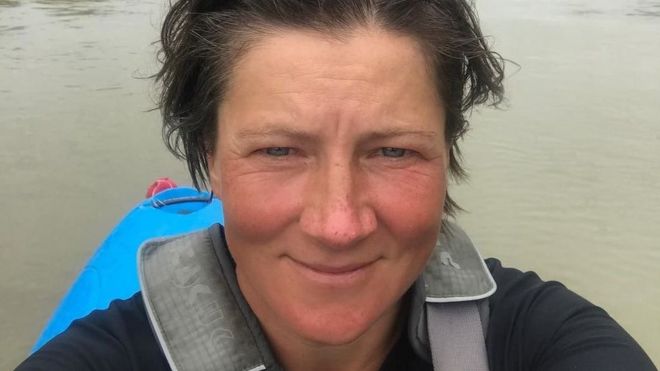
Kelty had been traveling alone, kayaking the Amazon River source to sea, when she was attacked and killed on September 13, 44 days into her journey. She was in northern Brazil at the time along a stretch of the river between Tabatinga and Manaus. This part of the Amazon is known to be particularly lawless, harboring drug runners and bandits. Emma had posted on her Facebook page that she had a run in with a group of thugs the day before she was murdered, but wrote that it was "all good."
The next day she was spotted by thugs again and they reportedly began shooting at her tent. The group of seven men then attacked her and stole some of her electronic gear. Local villagers say she was still alive when the men put her into their canoe, although she was badly injured.
Three of her assailants were later arrested when they were caught trying to sell some of her stolen equipment. Those men have told police that they were part of the gang that attacked Kelty, but that their leader was the one responsible. He is still at large somewhere in the jungle at this time. In their confession, they admitted to torturing and raping Kelty before dumping her body into the river.
Here at The Adventure Blog we followed Emma's expedition to the South Pole very closely last year, reporting on her progress regularly, and sending congratulations when she reached 90ºS. We even had a note from her at one point clarifying parts of the story on her journey. The news of her death has been a shock to say the least, and we send our condolences to her friends and family. Hopefully the men responsible for this brutal attack will be found and face justice.
This story is another harsh reminder of the challenges that we face on some of these adventures. The Amazon in particular has not been kind to explorers over the past few years, as attacks like this one have become all too common. Having been there myself, I can say that it is an amazing place, but it happens to be populated by not-so-nice people in certain areas.
In an ironic twist of fate, Evanilson Gomes da Costa – one of the bandits believed to have attacked Emma – has already met with an ignominious end. According to this story, he was shot dead by a rival gang who were looking to rob him as well. (Thanks again to Lou-Phi for the info)
Adventurers to Attempt Atlantic to the Pacific Crossing of Amazon

The duo, who are planning on starting the expedition today, hope to create a four-part documentary series about their journey, which will look at the way various changes to their environment is impacting the lives of the Amazon people. Severe deforestation, climate change, and other factors have become a severe threat to the lifestyle of these tribes, potentially ending a way of life that has existed relatively unchanged for centuries.
Reza and Pip will be traveling by bike and boat across the Amazon. They'll start at the mouth of the mighty Amazon River in Belem in Brazil and eventually ending in Lima, Peru. Most of the journey will be done on bike (both are accomplished adventure cyclists), but they will take a boat up the Purus River in order to cross one very remote section of the route.
Dubbed the Transamazonica expedition, the plan is to follow a road of the same name that was built in the 70's to help open travel and commercialization of the rainforest. That road covers some 4000 km (2485 miles), and has been a major boon for companies who have logged and developed the Amazon Rainforest. The hope is that this expedition will help raise awareness of the challenges that are currently faced by the people living in the rainforest basin, which is undergoing significant changes.
It should certainly be interesting to follow Reza and Pip's adventure, which you can do on both of their websites linked above.
Massive Reef Discovered at the Mouth of the Amazon River
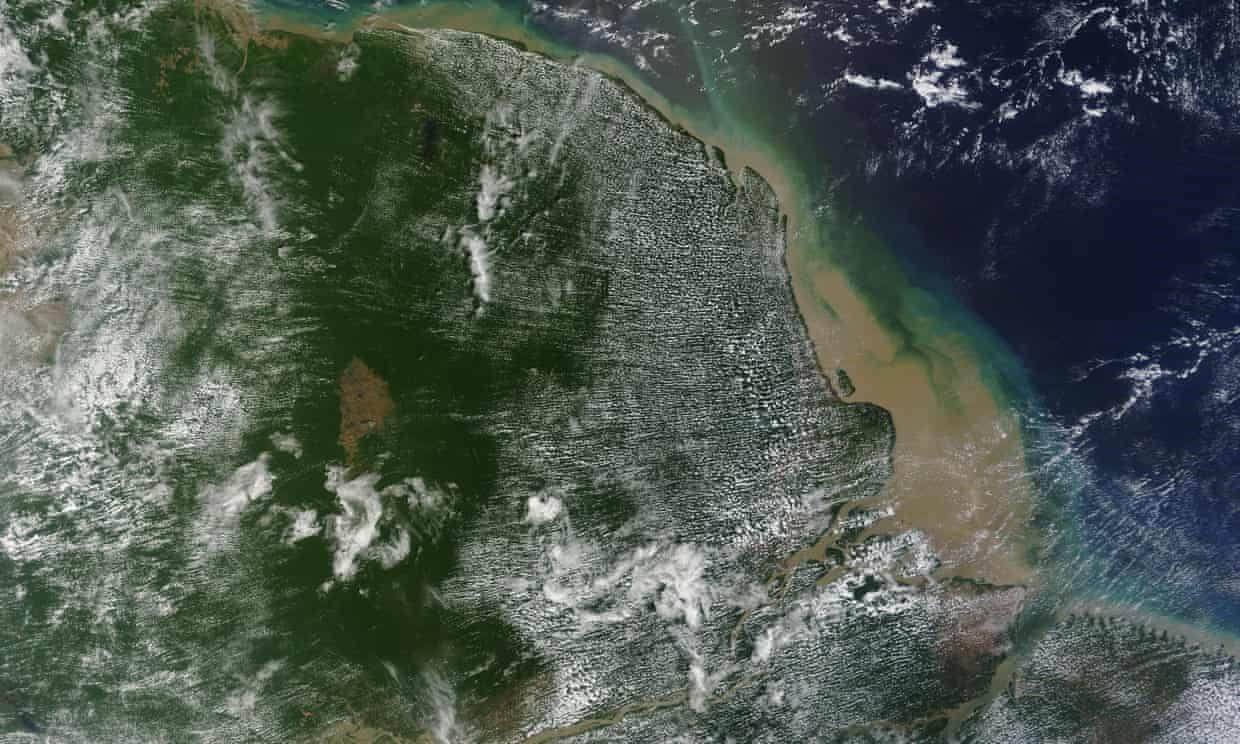
Indications that the reef might exist first appeared back in the 1970's when fishermen began catching fish that were more commonly found on and around reefs in other parts of the world. But confirmation of the existence of this particular reef didn't come until recently, when researchers were finally able to prove that against all our knowledge and understanding of the ocean that it was hidden away along the coast of Brazil.
The reef stretches for nearly 700 miles (1126 km), and is more than 3600 sq. miles (9300 sq. km) in size. It is also said to be home to at least 60 species of sponges and 73 species of fish. Even more surprising is the fact that unlike other reefs found around the world, this one appears to be very healthy, and even growing. Climate change has begun to warm the oceans, which is causing coral reefs to die at an alarming rate. But this one is not displaying those same symptoms.
What makes this new reef so amazing is that it exists in a place that it was previously believed one shouldn't be able to survive. While it is submerged in ocean waters, the surface of the Atlantic is covered in fresh water that is dumped in from the might Amazon River. The river also deposits plenty of mud and sentiment into the water, which is typically not conducive to the growth of coral either. On top of that, oceanographers typically find reefs in shallower waters that are warmer and clearer than where this one exists. This has left some scientists to wonder if other reefs are out there in our oceans, just waiting to be found.
But the good news over the discovery of this reef – and the fact that it is thriving – is tempered somewhat due to the fact that it is already being threatened by man. It seems that the Brazilian government has already sold 80 parcels of ocean to oil companies to start drilling at the mouth of the Amazon. 20 of those blocks are already in operation, some of which are believed to be right on top of the reef itself. How that will impact the life of the reef moving forward remains to be seen.
Coral reefs play an important role in the keeping the ocean healthy as they often form protective barriers for ecosystems both along the coast line and living within the waters themselves. As those reefs recede, ocean storms, hurricanes, and typhoons could have a larger impact on certain regions of the planet. The Earth's coral reefs are also seen as the canary in the coal mine in terms of indicating the impact of climate change on an area too.
Still, finding this particular reef is amazing, especially since it shouldn't exist at all. Hopefully it will be well protected moving forward.
Previously Uncontacted Tribe in Brazil Reveal Themselves for the First Time

These types of stories always fascinate me. It is amazing that in the 21st century there are still place on our planet that are so remote that there are people that live there that have still been untouched by the modern world. It has become increasingly difficult for such pockets of wilderness to continue to exist, even in the Amazon, but just knowing that these tribes are out there, isolated in the rainforest, is amazing to me.
The story is a bit disturbing however, because most of these tribes have occupied their little corner of the world for generations. Something dramatic and life altering must have happened to force them to abandon their territory and set out into the unknown. It is believed that loggers, harvesting trees from the Amazon illegally, may have infringed on the tribes lands, forcing them to flee the area.
Sadly, once they begin to have contact with the outside world, the tribe faces even more dangers. Their immune systems are not equipped to handle certain diseases and illnesses that they could encounter, and if they infringe on the territory of another tribe, violence could ensue. It is no doubt a frightening time for this tribe, which is said to be quite large.
Hopefully there will be some efforts made to isolate this tribe to a degree and assist them in resettling somewhere safe. It would be interesting to learn what caused their migration as well. Truly a fascinating piece of news.
Video: Update From The Brazil 9000 Expedition
It has been awhile since we had an update from Aaron Chervenak and Gareth Jones, the two adventurers who embarked on the Brazil 9000 Expedition back in 2012. Their plan has been to travel north to south, starting at the border with Guyana, and ending in the village of Chul, on the border with Uruguay. In the process, they'll cover some 9000 km (5592 miles), traveling through some of the most remote and challenging regions in the world.
In January, the boys achieved a major milestone by reaching the village of Belém, which sits at the delta of the Amazon, where that might river reaches the Atlantic Ocean at long last. At that pony they were about a third of the way done with the journey, which was originally expected to take roughly 15 months to complete, but it has now stretched on far longer due to logistical issues, funding and a host of other challenges to overcome.
The video below s there latest dispatch from Brazil, and like their previous videos, it is exceptionally well done. Not only does it give us a sense of what it like to travel through the dense Amazon Rainforest on foot and by canoe, but it also gives us a glimpse of what life is like in a place that few of us ever get the opportunity to ever see.
Black Gold: Brazil 9000 Update #4 from The Skeeto Lounge on Vimeo.
In January, the boys achieved a major milestone by reaching the village of Belém, which sits at the delta of the Amazon, where that might river reaches the Atlantic Ocean at long last. At that pony they were about a third of the way done with the journey, which was originally expected to take roughly 15 months to complete, but it has now stretched on far longer due to logistical issues, funding and a host of other challenges to overcome.
The video below s there latest dispatch from Brazil, and like their previous videos, it is exceptionally well done. Not only does it give us a sense of what it like to travel through the dense Amazon Rainforest on foot and by canoe, but it also gives us a glimpse of what life is like in a place that few of us ever get the opportunity to ever see.
New Farthest Source Of The Amazon Discovered

Since 1971, the Apurimac River has been considered the furthest source of the Amazon, and many explorers and adventurers have operated in the region under that assumption. According to this new report however, the Mantaro River, located in southwest Peru, now holds that distinction.
The researchers who have asserted that the Mantaro is the new source used satellite imagery and topographic maps to study the Amazon and it's numerous tributaries. With GPS tracking points, the team determined that the Mantaro is actually about 10% longer than the Apurimac, which would make the furthest source.
But as I mentioned, there is some controversy afoot. The Mantaro doesn't flow for parts of the year, thanks to a dam that was built in 1974. When defining a "source," most geographers feel that a river must flow uninterrupted. The researchers behind this new finding say that the Mantaro would flow all year if it wasn't for the dam.
Does it really matter where the true source is located? Most would probably say no. But if you're one of the many adventurers who has attempted to travel the length of the river, or explored the Amazon Basin, it means quite a lot. This revelation could invalidate certain past expeditions that paddled the entire river for instance.
Personally, I happen to enjoy that we're still discovering things about our own planet. It is stories like this one that remind us that exploration is important, even in the 21st century. Now, who wants to be the first to go upstream and actually visit the source? I'm in!
Amazon Express Team Looking To Kickstart Documentary
Last year a team of paddlers kayaked the length of the Amazon River, source to sea, covering 4200+ miles (6760 km ) in the process. The expedition was called The Amazon Express and we followed it very closely here on the Adventure Blog as the paddlers made their way through some incredibly difficult and challenging areas on their way to making history. It was the first time that anyone had managed to kayak the entire length of the river before.
Now, the team is hoping to produce a documentary about their adventure and they've launched a Kickstarter campaign to help raise funds to do so. Unfortunately, I only just learned about their efforts in the past few days and since I've still been digging out from my travels over the weekend, I hadn't had a chance to post about this sooner. As I write this, there are only a few hours left on the clock for this to get kickstarted and they are well below the funding they were seeking. Perhaps they'll give it another go, but at the moment it looks like that barring a miracle of some kind, this documentary won't getting made. Still, the video below gives you an idea of what they have in mind. Hopefully they'll find the funding they need. I'd definitely like to see this film at some point and I can't be the only one.
Now, the team is hoping to produce a documentary about their adventure and they've launched a Kickstarter campaign to help raise funds to do so. Unfortunately, I only just learned about their efforts in the past few days and since I've still been digging out from my travels over the weekend, I hadn't had a chance to post about this sooner. As I write this, there are only a few hours left on the clock for this to get kickstarted and they are well below the funding they were seeking. Perhaps they'll give it another go, but at the moment it looks like that barring a miracle of some kind, this documentary won't getting made. Still, the video below gives you an idea of what they have in mind. Hopefully they'll find the funding they need. I'd definitely like to see this film at some point and I can't be the only one.
Amazon Express Update: Mission Accomplished!
The past few days have not been easy ones for West Hansen and his companions. The closer they got to the finish line the more difficult the paddling became. At times they were averaging just 1.5 miles (2.4 km) per hour as the incoming tides from the Atlantic made it difficult for them to make any kind of headway. The team took breaks where they could and rested during high tide, but over the final two days they slept for just a couple of hours as they made a mad, desperate dash for the end of the river.
Reading the most recent post to the Amazon Express blog it is clear that the final leg of the trip has been an exhausting one. The three paddlers miss their families and homes dearly and are more than ready to wrap things up and head back to the U.S. They'll do that tomorrow, but for now they're enjoying some basic creature comforts they haven't had for some time and relishing in the feeling of having accomplished their quest to paddle the Amazon River from source to sea.
No word yet on whether or not this was a new speed record of any kind. Originally when the expedition was conceived it was meant to be an attempt to paddle the entire 4000+ mile length of the river at a record pace. There really hasn't been much mention of that goal since the early going, so we'll have to wait to see if that remained a driving factor in the end or if this simply evolved into an adventure along the world's largest and most powerful river.
Congratulations to West and his team for completing this epic journey. I can only imagine some of the things that they saw while out on the water.
Amazon Express Update: End In Sight

According to their latest dispatch, West and company are expected to reach Belem, the last major city before the end of the paddle, on Monday, December 3. Belem sits approximately 77 miles (123 km) up river from the point where the Amazon empties into the Atlantic. At this point, they don't expect to pull into the city at all, but instead paddle past it. Taking their current speed into account, it seems likely that they will then wrap up the expedition on Tuesday or Wednesday of next week at the very latest. By the time they are done, they'll have kayaked in excess of 4000 miles (6437 km) through some of the most remote and isolated regions on Earth.
These past few weeks have not been particularly easy ones for the team. As they've paddled further down the river, the current has gotten slower, making it more difficult to cover adequate mileage each day. On top of that, the conditions have gotten windier, which always makes paddling tougher, and they are now dealing with the effects of tides as well. As a result, they're only managing about 3-3.5 mph (4.8-5.6 km/h) in the mornings. In the afternoons the winds die down, allowing them to go faster, but that is also when the tides are at their highest, so that time of day presents its own set of challenges. Needless to say, it has been exhausting work and the crew is ready to finish up and head home.
It looks like next week they'll get to do exactly that.
Amazon Express Update: Into And Out Of Manaus

Their stay in Manaus was a short one, as the intend to be back on the water today. But it gave them an opportunity to take a brief rest and restock some of their supplies. West has been paddling pretty much non-stop since mid-August and after covering more than 2500 miles, 500 of which were rough whitewater, he's feeling the strains of the journey.
Reading the team's updates I'm reminded of just how large the Amazon River truly is. I've been there myself and was in awe, but sometimes you forget the scope of this waterway. The video below puts it somewhat into perspective, as the boat that is seen here is actually an ocean-going cargo ship that managed to sail 1400 miles (2250 km) up stream. For a vessel of that size to go up the river that far, you know that it must be not only plenty wide but more importantly plenty deep.
The team isn't quite in the homestretch just yet, but they are doing well. I think they'll be wrapping up their epic expedition by early to mid-December. Stay tuned for more updates.
Brazil 9000 Update: Lost And Found In The Rainforest

As promised, Aaron and Gareth have been documenting their adventure and have just released their first video update from the field. It will give you a great sense of what they've been dealing with thus far, including passing through rainforest so dense that their guide abandoned them after just 16 km (10 miles). Left to fend for themselves, they managed to find their way into what they describe as a "no man's land" along the Brazil-Guyana border. The region is uninhabited even by indigenous tribes, but from the video it looks absolutely beautiful. From there, they move on a river that local miners told them was impassable, but they managed to run it just 11 days.
The footage in this five minute video is simply spectacular and if they continue to release short films of their expedition of this quality, we are all in for a treat. We already knew this was going to be an amazing experience before they after started, but this first update is nothing short of stunning. I'm already looking forward to more videos in the weeks ahead.
Amazon Express Update: Into Brazil, Picking Up Speed!
Perhaps the biggest news to come from the AE squad this week is that they have left Peru behind at last and are now padding the waters of the Amazon in Brazil. Upon arriving at the first settlement in that country they had to share their paperwork, permits and passports but once the officials there saw that everything was in order, they were allowed to continue on their way. That means they've crossed the last diplomatic hurdles in their way, and should now have a free run to the finish, although they are likely to be stopped by local police or the Brazilian navy a few times along the way.
Shortly after enter Brazil, the team also moved into another timezone. While that may not really seem like much of an accomplishment, when you consider that they've now paddled far enough to completely traverse one timezone and enter another, it gives you an idea of the scope of their adventure. Add to it that they've now been on the water for 62 days and you being to get an idea of how challenging this journey must be for them, both physically and mentally. (Note: The 62 days represents the number of days they've been in their kayaks and paddling. The expedition has actually been longer.)
That daily grind isn't slowing them down much, as they have managed to really crank out the miles this week, even setting a new single-day distance record yesterday. Earlier in the week they came close to passing 80 miles (128 km) in one day, missing it by the narrowest of margins. Yesterday they blew past that mark however, covering an impressive 85.6 miles (137.7 km).
As they head further east, the team is finding fewer and fewer places to camp each night. The river is growing wider and larger as they go, and they are probably wandering further away from something that actually defines a shoreline. When camping last night they also reported that there were quite few caiman eyes watching them from the water. For those who don't know, a caiman resembles a small alligator, with most measuring no more than a couple of meters in length. They aren't particularly dangerous or aggressive, but I'm sure the boys are giving them plenty of respect none the less.
I'll post more updates as the team continues to make progress. They're doing quite well at the moment, but still have a number of weeks on the water before they're done.
Video: Kayaking Source to Sea on the Amazon River
This past December, kayakers Darcy Gaechter, Don Beveridge, and David Midgley completed a 4300-mile (6920 km) descent of the Amazon River, starting at its newly found furtherest source on the Rio Mantaro of Peru. Along the way, Darcy became the first woman to complete that journey, and they are the first team to do so without raft support. The video below gives us a glimpse of what that expedition was like, starting in the Peruvian mountains, then heading into wild whitewater, before giving way to the massive expanse of the Amazon proper. Keep your eyes peeled for the legendary pink dolphins of the Amazon as well. I saw them when I was there a few years back, and was amazed.
Update On Davey du Plessis

Over the past few few days, Davey has been in the ICU and under constant supervision by doctors. They have been monitoring his condition and waiting for him to regain his strength while they determined if they would need to do surgery to remove the bullets and shrapnel from his body. In many cases the body will adapt to the bullet fragments and no invasive surgery is required. As it stands right now, the doctors feel that they won't need to operate on Davey, despite the fact that he has shrapnel in his heart and lung. They may eventually remove the bullet from his neck, but they are still waiting to make that determination as he gets stronger.
Du Plessis will remain in the intensive care unit until Friday, which is when the doctors are planning on removing the drip drain from his lung. They are hoping by then that the lung will have started to heal, but as of now it continues to bleed.
Overall, Davey is in remarkably good shape all things considered. He is in a good deal of pain, which is not relieved by medications as they make the young man feel ill. He has passed through the critical period and it doesn't seem that his life is in jeopardy, although there is a long road ahead towards healing and rehabilitation. He has his father with him now and his mother will join him in Lima tomorrow, which will certainly help his efforts to get well too.
It will be interesting to hear his full story once he has recovered and has the strength to share it. I'm sure there are elements to it that we're not aware of yet. It'll be a harrowing tale for sure, but for now I think it's good to just know Davey is out of danger and starting the healing process. For more updates as they come, checkout Davey's Facebook page and website.
Amazon Source-To-Sea Update: Davey Shot In The Amazon, Evacuated To Lima
Upon hearing the news, I immediately thought about the Amazon Express team, which consists of West Hansen and his crew, who are attempting to make a speed run along the the length of the Amazon as well. They are still miles behind where Davey ran into trouble, but I thought it important that they were made aware of the situation. It seems like that turned out to be a good thing as they were able to get in touch with Davey's mom and speak directly to Davey himself, providing us with more information on the story.
It seems du Plessis was simply floating down the Amazon on his inner tube, as he had been for some time while navigating through the trickier sections of river. He then saw a young man, described to be in his early 20's, appear out of the jungle, then quickly disappear, only to return with a second man. They immediately opened fire on the South African without a verbal exchange of any kind and without provocation. Davey managed to reach the shore and fled into the jungle, but by that point he had already been hit by several bullets. He ran for approximately 5km (3.1 miles) before finding help and even then, according to his mom, the locals were reluctant to lend a hand without first asking for money. He was eventually taken to a local hospital where he was treated for his wounds before being sent on to Lima today.
According to reports on his Facebook page, Davey is in the ICU where he is being treated for bullet wounds to his neck, head and back. He has shrapnel in his lung and arm and is in rough shape as you can imagine. That said, he doesn't appear to be in immediate danger any longer, but doctors plan to wait for until he is stronger before going in to remove the bullets. Friends and family are en route to Peru to be with him today.
Keep Davey and his family in your thoughts today. The young man is lucky to be alive and his story is a grim reminder that the challenges of these adventures go well beyond the environment.
Amazon Source To Sea Update: Davey's Paddling At Last

For those who haven't been following Davey's adventure thus far, he set off in June on an epic journey that will eventually cover as much as 7200km (4474 miles). He began his journey high in the Peruvian Andes at the most distant source of the Amazon. After climbing and trekking through the mountains, du Plessis climbed aboard his bike and rode along the Apurimac River for about 1500km (932 miles) to where it meets the might Amazon itself. It was at that point that he entered the water to start the third and final leg of the journey – a 5700km (3541 mile) paddle to the sea.
The start of the river portion of the adventure ended up being more challenging than he expected. The water was faster and higher than anticipated and as a result Davey elected to use a tire to float past the more difficult secitions. Even that wasn't easy however as he nearly lost all of his gear, which he pulled behind him in a kayak, on more than one occasion.
Yesterday du Plessis posted a big update to his blog. In it he talks about how his foldable kayak finally cleared customs, allowing him to truly start paddling. On his way from Lima back to the river however, he met a German couple whose son drowned while kayaking the section that Davey is now passing through. That left him a bit unsettled to say the least.
An update on his Facebook page also says that he received a military escort yesterday to meet the local chief of the indigenous tribes. Once that introduction has been made and Davey's plans made clear, the tribes will grant him safe passage along the water. If this bit of diplomacy didn't take place, it is likely that he would be met with hostility and suspicion along the way.
The river seems to still be the main threat to his safety however as he is still encountering plenty of challenging whitewater and his little kayak was not designed for those kinds of conditions. He estimates that he'll need to get another 50km (31 miles) down stream before the river widens out and slows its descent. After that it'll be calm, flat paddling for thousands of kilometers.
I spent some time on the Amazon River in Peru a few years back and it was far from difficult to paddle. That said, I was way down stream on the river proper where it spreads out for kilometers in all direction . It is a massive waterway in scope and scale with hundreds of tributaries and backwater to be explored and while there are settlements along its banks, there are also plenty of incredibly remote areas with few people as well.
For Davey, this adventure is just getting started and he will have so much to experience as he makes his way to the Atlantic Ocean over the months ahead.
Amazon Express Update: On The Water And Underway

Hansen is calling his expedition the Amazon Express and the website is already being updated with news from the field. It seems these early days of the paddle have not been particularly easy, as Hansen and his team are starting in the headwaters o the Amazon where it is very rocky and water flow is on the low side right now. As a result, they've had to portage around certain sections and some of the kayaks have been too heavy for the shallow waters. These conditions won't last long however, as the river will begin to pick-up speed and intensity in the days ahead. The first 650km (403 miles) or so will feature some of the most dramatic whitewater on the planet, before eventually flowing into the Amazon proper.
The fact that updates from the river are currently being posted at least once a day is good sign for those who want to follow Hansen's progress. The reports have been brief, but detailed and share a lot of information about logistics and conditions. Currently, since they are still in the mountains, those conditions have been on the cold side. They've even had flash snow storms and very chilly over night temperatures. That will all change once Hansen and his squad get to lower altitudes however and the warmth of the rainforest will probably be welcome. At least for a little while.
One thing I should point out about this expedition is that in my earlier post I had noted that Hansen was attempting to make a solo speed record attempt. There doesn't appear to be anything that I would call "solo" in this, at least not so far. Not only does he have a support team, there are a few other paddlers with him at the moment. Perhaps once he's on the Amazon itself, and not the tributaries, he'll be alone, but for now West has plenty of company.
Follow the updates at AmazonExpress2012.com.
Amazon Source To Sea Update: The Challenges Of The Amazon

In his most recent update, which came last week, Davey indicated that the white water was faster and more difficult than he had expected and as as a result, he capsized his boat and nearly lost all of his gear. On his first day on the water he managed to cover an impressive 70km (43 miles), but spent some time running the more precarious rapids in an inner-tube while dragging his boat behind. At one point, the kayak struck a rock, which was the cause of it capsizing and that was an indication that perhaps it wasn't entirely well suited for running the early rapids of the Amazon. Fortunately the white water doesn't last for long and by now he should be on relatively flat water, with a good current, that spreads out for miles in all directions.
Since that update last Wednesday there has been no word out of Davey. Hopefully all is well and he's simply having some issues getting his communication systems to work. He obviously still has a long way to go before he reaches the ocean and it would be great to get regular updates on his progress.
Thanks to Lisa De Speville for keeping me in the loop on Davey's expedition progress.