Showing posts with label Antarctic. Show all posts

The New Yorker Publishes Riveting Story About Henry Worsley's Doomed Antarctic Expedition

In 2016, British polar explorer Henry Worsley lost his life while attempting a solo, unsupported crossing of the Antarctic continent. He was attempting to become the first to make such a journey, which remains one of the biggest challenges that remain for adventurers traveling in that part of the world. It is impossible to know exactly what that journey was like, but now – thanks to an unlikely source – we have a bit more of an idea. 

Recently The New Yorker published an amazing article about Worsley and his expedition to the Antarctic. Entitled "The White Darkness," the story is written by David Grann, who also wrote the excellent Lost City of Z. It takes us out onto the ice with the British explorer, providing us with some impressive insights into what that journey was like and what must have been going on in Worsley's mind as spent days on end skiing across the frozen continent. 

Many of us who follow these types of expeditions have some idea of at least the logistics behind such a venture. But unless you've done such a journey yourself, it is difficult to truly understand what it is like to grind out every mile, day-in and day-out, in such a cold, inhospitable place. This article will help you to understand what that is like just a bit more. 

The story is a long one, so prepare yourself and get comfortable. This is best read on a tablet in comfy chair with a drink or even a snack close at hand. You'll be going on a journey along with the Worsley, but it is definitely one that you'll want to take. And when you come out the other side, you'll have learned a lot more about this man and what drove him to push himself to his very limits, and beyond. It is sad, inspiring, joyous, and humbling all at once, and I highly recommend that anyone who enjoys reading my stories gives this a thorough read too.

Check it out here.

Video: Get a Whale's Eye View of the Antarctic

The Minke Whale is one of the least studied and understood species in the whale family and in an effort to get to know them better, researchers recently attached a camera to one of the creatures as it swam in the waters of the Southern Ocean. The video below gives us a whale's eye view of the Antarctic, providing a brief glimpse into the Minke's world.

Antarctica 2017: Ice Maidens Complete Antarctic Crossing

While we've been focused heavily on the winter climbing season over the past few weeks, the Antarctic expedition season is still underway as well. One of the teams that we've been following for over two months now has finally completed its journey across the frozen continent, bringing an end to a record setting adventure that has been a challenge from the start.

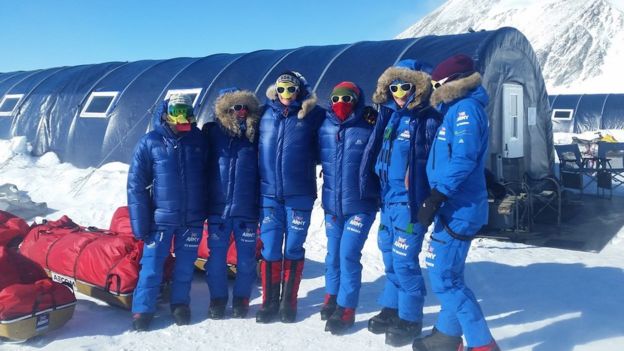
The all-female squad known as the Ice Maidens wrapped up their traverse of Antarctica this past weekend when they arrived at Hercules Inlet 62 days after they started the crossing. In doing so, they became the first all-women team to make such a journey, which began way back in November. That's when the team set out from the Ross Ice Shelf then proceeded onto the Leverett Glacier, before crossing the Transantarctic Mountains, before reaching the Polar Plateau. Their route also took them to the South Pole on the way back to Hercules Inlet.

The Ice Maidens consisted of Major Nice Wetherill, Major Nat Taylor, Lace Sergeant Sophie Montagne, Captain Zanna Baker, Major Sandy Tennis, and Lt. Jenni Stephenson. All of the members of the team are part of the active British military or reservists, and were selected from over 250 applicants who wished to be a part of the expedition.

The expedition didn't get off to a promising start when the ladies first had to spend two weeks stuck at the Union Glacier camp waiting for the weather to improve. At the time, it looked like things could be in jeopardy as it was expected to take upwards of 90 days for them to finish the crossing. But once they got out on the ice, things picked up quickly and they managed to cover longer distances as they went. In the end, they were able to wrap up the crossing in a fraction of the time, and will still get home on schedule.

The Antarctic season is nearly coming to an end. The last flight off the continent is scheduled for next week, although that plane is meant for ALE personnel and supplies. The final flight for clients should take place at the end of this week, weather permitting. That will close another chapter on a busy season at the bottom of the world.

Antarctica 2017: The End is in Sight for More Antarctic Teams

The Antarctic expedition season is nearing its end with just a few short weeks to go until the frozen continent is shut off to the outside world once again. But, there are still a number of teams that are working their way towards the finish line as the days slowly tick by.

We'll start with an update on Rob and Barney Swan, the father and son team that has been out on the ice for nearly two months now. The duo undertook this expedition as a way to raise awareness of clean energy with a focus on creating a 7-year goal to clean up 326 million tons of carbon dioxide in the atmosphere in accordance to the Paris Accords. They have even used nothing be clean energy sources to power their adventure, using solar energy to keep all of their devices going.

Yesterday, the two men – along with a group of skiers who joined them for the final degree – reached the South Pole. It took them 56 days to compete the journey, covering roughly 600 nautical miles (690 miles/1112 km) in the process. Rob has been here before and knew what to expect, but was still impressive in his efforts at the age of 61. For Barney, it was his first polar journey at the age of 23. Congratulations to both of them.

Meanwhile, Norwegian skiers Astrid Furholt and Jan Sverre Sivertsen are closing in on the Pole as well. The duo were amongst the first to hit the ice way back in November, and have been following the original Amundsen route to 90ºS. If all goes as planned, they should arrive their as early as tomorrow, but their updates indicate they are exhausted, pushing hard against headwinds, and struggling to cover the full distances they need. Still, they are currently within striking distance of the South Pole station and should get there soon.


Their original plan was to ski the return leg back to the coast to complete a round-trip journey, but with the season now running short, It seems unlikely that will happen. We should know more in a few days, but the last ALE flight off the continent for clients is scheduled for January 26, just 10 days from now.

The Ice Maidens are now racing against the clock to beat that deadline, but they too have the end in sight. The six women who make up the team reached the South Pole all the way back on December 17, but that was just a milestone on their continued traverse of the Antarctica. By the time they are done, they will have covered more than 1700 km (1056 miles), beginning and ending at the coast. They'll also be the first all-female team to accomplish that task.

Finally, the Spectre team has completed its expedition at long last. You may recall that this expedition was made of three climbers –  Leo Houlding, Jean Burgun, and Mark Sedon – who traveled to Antarctica to climb the Spectre rock spire in the Gothic Mountains. They used kite skis to reach that point back in December, and actually completed their climb on December 12, then started for home two days later. It took them until last Thursday – January 11 – to reach their exit point on the coast. It was a hard slog back, often with very little wind to help assist in the process. It ended up taking far longer than they expected, but they completed their journey at last and are now safely back home.

We'll continue to keep an eye on the Antarctic season as things unfold over the next couple of weeks. But, the curtain is definitely dropping on the expedition season, with very few teams still out on the ice. I'll post updates of any important news as it happens.

Two More Dire Warnings on Climate Change

It seems 2017 has been a year filled with dire warnings about the future of our planet and the impact climate change will have on our lives. This week, two different reports were released indicating that things are changing more rapidly than we imagined and we could be on the brink of catastrophe.

On Tuesday, the 2017 Arctic Report Card was released and amidst the various messages about the loss of pack ice in the Arctic was a clear warning. The 85 scientists from 12 different countries who compile the report on an annual basis say that the Arctic shows no signs of returning to the reliably frozen region of past decades. In other words, there is less and less ice in this part of the world, and that doesn't appear to be changing anytime soon.

The report goes on to say that that warming of ocean's surface and retreat of the sea ice extent is unprecedented in the past 1500 years. The researchers can determine this by examining such variables as tree rings, sediment cores, and air bubbles trapped in ice samples recovered from the arctic.

Data indicates that the Arctic had its second-warmest year on record in 2017 with an average air temperature that was nearly 3ºF above what it was on average between 1981 and 2010. The scientists are able to compare that data to temperatures recorded as far back as 1900 when measuring these trends.


As a result of this warm year, the sea ice extent didn't recover as it has in the past, leaving much of the Arctic free from ice altogether. Fortunately, a cooler than normal summer prevented more of it from melting off, or the situation might be drastically worse. Either way, things don't look great in the far north of our planet.

On Wednesday another report was released on the scholarly journal Earth's Future that calls into question our estimates of the increase in sea level across the planet as a result of melting ice sheets in the Antarctic. Data indicates that as those ice sheets continue to collapse – something we saw several times in 2017 – the rise in ocean levels will be faster and more severe than imagined. Just how fast and how severe? According to the report, we could see a major shift in water levels as soon as 2050, with oceans rising as much as 8 feet (2.4 meters). If that happens, it would have an impact on more than 236 million people across the globe.

But the same report says that it is not too late to avert this potential disaster. The researchers behind the paper say that we can still cut the emission of greenhouse gases like CO2 to try to turn things around. They do warn that time is running out however, with major changes needed in the next few years.

For me, climate change is the biggest challenge we currently face as a species. All of the indicators are there that things are happening around us, but whether or not we can still do anything about it remains to be seen. I remain optimistic, although I do think we need to get more serious about the situation. Hopefully this last report is right and that there is still time to change things for the better.

Antarctica 2017: Spectre Team Heading For Home, Ben Crosses 87ºS

It has been another busy couple of days in the Antarctic where the teams continue to hit milestones on their various expeditions. By now, most everyone has settled into a routine and have hit their stride, which makes it easier to cover the miles, even if they all still face major challenges ahead.

For the Spectre team of Leo Houlding, Jean Burgun, and Mark Sedon the next stage of their journey is clear. The boys have abandoned the Gothic Mountains after achieving their goal of summiting the Spectre rock spire this past weekend and are now turning for home. They left this morning while experiencing the best weather of the trip so far. Eventually they'll deploy their kites to help speed them along back to the coast, but for now they're man hauling it while they work through an area thick with crevasses and snow bridges.

Before leaving, the team spent the past few days continuing to climb in the area. They had knocked off the Spectre, completing the second ascent of that tower from the north, and yesterday they mad a trick ascent to the summit of another rock face called Organ Pipe A. The climb was tricky over mixed terrain that included rock, snow, and ice. There were few cracks to use as holds or to install climbing aids, but they still managed to make it to the top, and rappel back down. The weather was reportedly fantastic, and it was a good way to cap the climbing portion of the expedition. Now, they're simply focused on the return trip.

Ben Saunders is a long way away from starting the final stage of his journey across the Antarctic but he did hit another major milestone today. On his march to the South Pole, the British polar explorer has now crossed 87ºS as he closes in on the bottom of the world. He now has roughly 590 miles (949 km) to go before he is done, and he knows it won't be easy.


The day began with a large sastrugi field that made for tough going, zapping the legs and slowing progress. Later in the day, the surface flattened out however allowing Saunders to ski more naturally for one of the first times since he returned to the antarctic. It isn't likely to last, as the area after the 87th degree is known to be a sastrugi minefield, but he'll take what he can get while it lasts. At the moment, he's knocking off about 14 miles (22 km) per day, which means it'll likely take all of the 65 days he predicted – and perhaps then some – to complete the traverse.

Father and son team Rob and Barney Swan hit the halfway point of their expedition today, 23 days into their march. The duo are skiing to the South Pole via the standard route that begins at Hercules Inlet. They've now reached the Thiel Mountains and have experienced a couple of days of excellent weather with warmer temperatures, lighter winds, and blue skies overhead. In other words, perfect ski conditions that have allowed them to cover about 10 miles (16 km) per day.

Rob and Barney are making this journey to promote the use of alternate sources of fuel and clean energy products. Of course, like everyone else in the antarctic, they're using solar panels to charge their electronic gear, but they are also using a new biofuel from Shell in their stoves. So far, this is proving to be clean and efficient, not causing them any problems with blocked fuel lines or burning through too much gas.

They are also using solar powered snow melters to create fresh drinking water too, which is a serious innovation for polar travel. Normally, expeditions heading to the North or South Pole, or even up big mountains, have to spend an inordinate amount of time melting snow so they have water to drink or use in their food preparation. But The Swans have a new device that melts the snow while they ski, allowing them to save a lot of time and energy. I'll be curious to find out how this works, as will a number of others who follow polar expeditions closely.

Finally, the Ice Maidens continue to pick up steam on their way to towards the South Pole. Yesterday was their first 30 km (18 mile) day, which means they have certainly found their groove. They still have a long way to go to reach their goal of becoming the first all-women's team to traverse across the continent, but the ladies have more than demonstrated their strength, determination, and skill out on the ice.

More updates soon!

All-Star American Climbing Team Putting Up New Routes in the Antarctic

Yesterday I noted the success of an international team of climbers in the Antarctic who completed the second ascent of a rock spire called the Spectre. Not to be outdone by their European counterparts, a group of all-start climbers from the U.S. is also down south and has been putting up some impressive routes as well.

The very strong team of climbers includes the likes of Conrad Anker, Jimmy Chin, Alex Honnold, Cedar Wright, Savannah Cumins, and Anna Pfaff. The group is also joined by cameraman Pablo Durana, who is documenting the expedition to Queen Maud Land, where they are focused on opening new routes in an area rich with possibilities.

According to this story from Planet Mountain, Honnold and Wright have been exploring different routes near the famous Ulvetanna cathedral. The entire team arrived on the frozen continent on December 1, and immediately started scouting out six different peaks that surround their base camp, which includes Holtanna, Hollstind, Kinntanna, Stetind, Hel and, obviously, Ulvetanna itself.

Reportedly, Honnold and Wright first joined forces with Cumins and Pfaff to climb the 2650 meter (8694 ft) Holtanna, before they moved on to establish three new routes in the region, including a 400 meter (1312 ft) line up Mount Fenris. Meanwhile, Anker and Chin have been focused on a project of their own which involves a new route up Ulvetanna.

As you can imagine, we'll be keeping an eye on their progress for the rest of the season. It should be interesting to see what this incredibly talented group can do. Hopefully we'll get some awesome video footage out of it.

Want to Become a Polar Explorer? Apply for this Scholarship to Learn From Eric Larsen!

Over the past month or so, I've been writing extensively about the unfolding expedition season down in Antarctica. As I write this, adventurous men and women are making their way across the frozen continent on skis while pulling sleds filled with supplies and gear behind them as they go. Some are headed to the South Pole, other are traversing to different places, but they are all crossing one of the most dramatic, demanding, and spectacular wildernesses on the planet. If you've ever dreamed of doing that same thing, then I definitely have a tip for you.

In January of 2018, polar explorer Eric Larsen will be conducting a Level 1 Polar Training course to help others follow in his footsteps. The course will be held on Lake Winnipeg in Canada and will consist of a week of intense training that will help you to become more adept at winter travel or even prepare you for your own journey to the North or South Pole.

The course will consist of three days of indoor training, which in turn leads to four days of practical experience out in the field. Students will actually embark on a traverse around Lake Winnipeg in conditions that will replicate those found near the poles. They'll travel on skis, pull their sleds, sleep in tents, and learn every aspect of what it is like to survive in arctic conditions.

If this sounds like your kind of adventure, you can actually apply for a scholarship to attend the program. Allied Feather & Down and Helly Hansen have teamed up to give one lucky recipient the chance to travel to Lake Winnipeg to take part in the course, which is taught by Eric himself. The scholarship covers all the costs, including required gear, travel expenses, course fees, and more.

You can find out a lot more about the training program – including a full itinerary – by clicking here. And if this sounds like something you'd like to take part in, you can apply for the scholarship by clicking here.

If you've ever had dreams of skiing to the South Pole but weren't sure how to get your expedition off the ground, this course will certainly put you on track. You'll not only come away with some valuable skills for use in polar conditions, you'll also get the chance to learn from a guy who has spent a lot of time in very cold places. This will be the chance of a lifetime for some lucky adventurer and I'll definitely be jealous of whomever gets the opportunity.

Find out more here.

Video: To the South Pole with the Energy Challenge Team

I've written about Rob and Barney Swan a couple of times during the current Antarctic expedition season, but this video does a good jog of sharing their story. This father and son team are skiing to the South Pole to help raise awareness of renewable and clean energy sources. But in this clip, it's more about the relationship between the two men, who are spending weeks out on the ice together on their journey to 90ºS.

Antarctica 2017: Spectre Team Summits and Antarctica Without Sound

More news from the Antarctic today, where the expedition season continues to unfold at a fairly fast pace. The explorers who are making their way across the continent this year seem to continue to hit milestones on their way towards their own individual objectives. And while the season still has a very long way to go before it ends, it seems like it will be one of the more interesting years on the frozen continent in quite some time.

Will begin with an update on the Spectre team, which consists of Leo Houlding, Jean Burgun, and Mark Sedon. This trio of adventurers set off across the Antarctic via kite ski to reach the Gothic Mountains. Their plan was to climb a challenging rock spire called the Spectre by making the first ascent via the South Spur. Unfortunately, when they finally arrived there, they discovered that route that they had indeed to use for their descent was incredibly difficult, consisting more of blue ice and snow than rock and solid ground.

When we checked in with the team last week they were setting off on a traverse of the tower to look for alternate ways of getting back down. What they discovered that this rock face presented more challenges than they had first anticipated, so they had a quick change of plans and decided to change up their route and climb the North Side of the Spectre instead. That route was originally climbed by Mugs & Edmund Stump back in the 80's and remains the best approach to the top.

On Sunday, the trio of climbers set out to complete their objective and while it was hardly an easy ascent, they did manage to top out. Along the way they had to deal with cold temperatures, unexpected winds, and a complex rock face that was tougher than they thought it would be. You can read their account of the climb here.


With ascent of the Spectre over, the team now has a couple of days before they have to begin the return journey. Before heading for home, they're going to take on a traverse of a nearby ridge that will be a good challenge, but safer than attempting the South Spur, which is difficult enough that it now falls outside of their margin of safety. They hope to complete this new objective in a day or two, then begin packing for the journey back to the coast.

Meanwhile, Ben Saunders continues his tough slog up the Antarctic Plateu. He has reached an altitude of about 2000 meters (6561 ft), so the air is getting thinner and he still has a ways to climb before he is done. The weather has been fickle, at times sunny and warm and then quickly shifting to cold, windy, and with whiteout conditions. His daily distances are roughly 14 miles (22 km), which is enough to keep taking chunks out of his route. At the moment, he has about 620 miles (997 km) to go before he is done and about a month and a half before the season wraps up. Still very doable, particularly since he'll pick up speed as he approaches the South Pole and on the return trip to the coast.

Finally, Antarctic Ghurka Scott Sears has been dealing with other challenges, most notably a malfunctioning iPod. He's been using the device to help him get through the day by listening to music, podcasts, and audio books while he skis. But, the audio player has suddenly started running into issues which have provided him with complete silence instead. Scott says the silence was actually quite pleasant for awhile, but it makes his 12 hour days on the trail seem even longer than they actually are.

Scott's pace has been extremely quick in recent days, knocking off 30+ km (18+ miles) or more each day. This has allowed him to ski past the 86th parallel and he is now quickly approaching the 87ºS mark. From there he'll enter a zone that is well known for its sastrugi, which will likely slow him down and test the legs and stamina a bit. After that, it will be smooth sailing to the Pole however, which he may reach in time for Christmas.

That's all for today from Antarctica. We'll continue to keep an eye on things at the bottom of the world however, and bring updates where warranted.

Receding Antarctic Glaciers Bring Cause for Concern

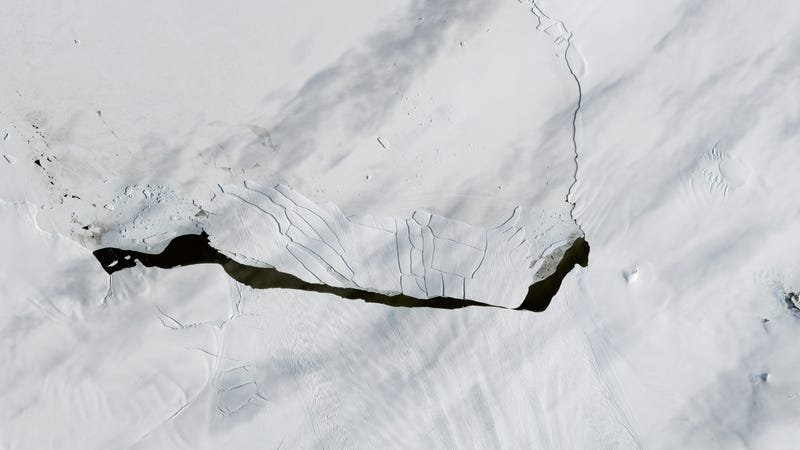
Throughout 2017 I've posted a number of stories about Antarctica's ice shelves are calving off massive chunks of ice sending icebergs adrift into the Southern Ocean. We first saw one of these events back in July, when a large section of the Larsen-C Ice Shelf broke away, creating a berg the size of Delaware. In September, a similar break-up occurred near the Pine Glacier as well. As you can imagine, these events have been watched closely by scientists, who view Antarctica as the canary in the coal mine when it comes to climate change. Now, there is even more cause for concern, as thing continue to confound and perplex researchers.

Typically when a large chunk of ice breaks away from the Antarctic, it tends to float north into the Southern Ocean, where the warming waters cause it to melt and break-up over a period of years. But, that isn't what happened with the piece from the Pine Glacier, which quickly broke up into 20 smaller pieces less than a month later. That means that the ice itself is already somewhat thin and fractured, and possibly that the water around it is starting to warm up as well.

Why is this such an issue? Because the Pine Glacier is already the fastest retreating glacier on the planet, and it contains about 10% of the water in the Western Antarctic Ice Sheet. When you combine that with the nearby Thwaites Glacier, which is also shrinking rapidly, you'll find that there is enough water to raise sea levels across the globe by 11 feet (3.3 meters). That would be disastrous to millions of people around the world.

The large sections of ice that broke off from Pine Glacier and the Larsen-C Ice Shelf actually serve as a buffer between the sea and the glacier itself. With those protective buffers gone, the melting of the glaciers is only expected to accelerate. While it will take decades for them to vanish altogether, resulting in that 11-foot rise in sea levels, it won't take long for them to begin brining those levels ups couple of feet. That alone would be devastating. Throw in the fact that there are plenty of other glaciers that are adding to the increase, and you start to understand why this is such a major concern.

Unfortunately, it may be too late to do anything about it. The Byrd Research Center in Antarctica reports that average temperatures near the Pine Glacier have already risen 2ºC or 3.6ºF. That may not seem like a lot, but in a fragile ecosystem like the Antarctic, it is enough to push things past the point of no return.

Antarctica 2017: Maidens Halfway to the Pole and the Challenges of Going Solo

The 2017 Antarctic expedition season continues to unfold at the bottom of the world. Unlike our last update, most of the skiers are now reporting good weather, although surface conditions remain challenging with sastrugi and soft snow making for slow going at times. Still, the teams that we've been following closely continue to forge ahead, making progress toward their individual goals.

Ben Saunders has been out on the ice longer than anyone and he's being reminded of the challenges of going solo. Back in 2014 he made a round trip expedition to the South Pole and back to the coast with Tarka L'Herpiniere and the duo split duties breaking trail. That helped to give each of them a break from being the lead man, but perhaps more importantly also provided some companionship on the hardest days. On his current traverse of the frozen continent, Saunders has neither someone to split those duties with nor anyone to keep him company either. That has worn on him some, causing him to grow tired more quickly. As a result, he's being more conservative with his efforts.

Still, the British polar explorer continues to make good strides forward. He's been knocking off 12-14 miles (19-22 km) per day and now has 688 miles to go before he's done. That is still a considerable distance, but he has now passed the 85ºS mark and has his sights set on reaching the Pole before he begins his return trip to the coast at the Ross Ice Shelf.

Speaking of making good time, Scott Sears – aka the Antarctic Ghurka – has found his rhythm and is covering solid distances most days now. Yesterday he managed to cover 40.1 km (25 miles) in a little more than 12 hours of skiing. In Antarctic terms, that is flying and he should be very pleased with the progress. He also passed the 84th degree, and is making his way towards Thiels Corner on the edge of the Thiel Mountains. That's a milestone for anyone skiing to the South Pole as most make a turn there and begin heading more directly towards 90ºS.


So far, Scott seams to be in excellent spirits and is enjoying his expedition. He hopes to become the youngest person to ski solo for the full distance to the South Pole, and right now that seems like an attainable goal. He is starting to get low on podcasts that he downloaded prior to setting out, which have kept him company on the journey however, but it seems unlikely that will hinder his progress too much.

Elsewhere, the Ice Maidens have reached a major milestone on their journey across Antarctica as well. The six ladies who make up the team have now reached the halfway point to the South Pole, which is remarkable considering their late start. Poor weather conditions kept them grounded at Union Glacier for far longer than they would have liked, but they've definitely been making up for it since. They are hoping to become the first all female team to traverse the continent under their own power however, so the Pole itself will just be their halfway point too. So far, everything is going well.

Finally, the Spectre team made it to the foot of the mountain this past weekend and have now established Base Camp there. They've already been scouting the rock towers they hope to climb there, but have discovered some unexpected challenges. For instance, a section of the mountain that they thought might be skiable, or at least make for an easier descent, is actually a 70º wall of blue ice. Obviously they'll have to look for a different route than they had planned, but such is life in the Antarctic.

The team planned on spending yesterday traversing the Spectre rock towers to look for alternative exits, but they have announced any plans yet. They've been enjoying a few days of staying in one place after battling their kites for a couple of weeks just to get to the mountain. Soon, they'll begin their ascent, weather permitting of course.

That's all for today. I'll continue to keep an eye on things down south in the days ahead and share updates when applicable.

Antarctica 2017: Spectre Team Finding Tough Going on the Frozen Continent

I wrote about the Spectre Expedition to Antarctica a few weeks back, just as the squad was preparing to get underway in the Antarctic. At the time, the team of Leo Houlding, Jean Burgun, and Mark Sedon were just finishing up their prep work in Punta Arenas and were getting set to fly out to Union Glacier. Since then, they have actually embarked on the journey and are now en route to their ultimate goal, the Gothic Mountains, where they hope to complete several climbs, including the second ascent of the Spectre, a 2020 meter (6630 ft) rock tower that presents a serious technical challenge.

The trio of climbers are actually using kites to ski across the Antarctic landscape, and so far they have met with moderate success. All told, they'll need to cover some 2000 km (1242 miles) to complete the expedition as planned, which includes nearly 70 days of travel, 20 of which will be spent in the mountains where they expect to climb without fixed ropes, bolts, or drilling of any kind.

As with most antarctic teams, the Spectre squad found it challenging to get started, but are starting to find a rhythm out on the ice. The winds haven't been all that cooperative thus far however, so they aren't skiing the larger distances that they would like. Currently, they are tent bound with poor conditions, but over the past few days they've covered as little as 10 km (6.2 miles) and as much as 42 km (26 miles), which doesn't sound all that bad by antarctic ski standards, but is't much at all when you're relying on kites to help you cover distances in excess of 100 km (62 miles) in a day.

The team had hoped to be at the Spectre by now, but they are still about 100 km shy of that goal, which means it could be a few more days before they set up Base Camp and begin surveying the rock spire. The original plan called for 10 days of travel to reach Gothic Mountains and begin the climb, but they actually thought they'd be there in 6 or 7 days total. Today is day 12, and they still haven't arrived at their destination.

The forecast does call for improved conditions starting today however, so they are hoping to make up some ground. Sitting in their tent the past few days hasn't helped their supply situation either, as they've begun eating into their food and fuel that was meant for use while on the wall. Hopefully they can overcome these early challenges and get to the Spectre within the next day or so. From there, they'll be able to start the challenging ascent of the South Spur of the mountain. A route that hasn't been taken before.

You can follow their progress on the team's official website, where they not only have live tracking but daily updates on their progress too.

Antarctica 2017: Father-Son Team Skiing to the South Pole for Clean Energy

We've been following some ambitious expeditions across the Antarctic already this season, but now we can add another one to the list. A father and son team have launched their own ski journey to the South Pole and they're doing it with an important environmental message too.

Rob and Barney Swan have embarked on what they call the South Pole Energy Challenge (SPEC) as part of their much larger 2041 Project. Over the course of the coming weeks, they'll travel on foot for more than 600 miles (965 km) in order to reach 90ºS. It appears they are following the usual route from Hercules Inlet to Pole, with an estimated time of about 8 weeks to finish the trip.

What makes this particular journey unique is that they plan to unveil some cutting edge technologies while en route and become the first team to ski to the South Pole using only clean energy sources. The duo are promoting the 2016 Paris Climate Accords and are hoping to use the expedition as a way to demonstrate clean energy technologies, while also acting to preserve the continent from the advances of global warming.

The father and son team have been skiing for about a week now, and are making solid progress for their first few days out on the ice. During the early part of the expedition it usually takes awhile for skiers to get their legs under them, and the sleds that they pull are at their heaviest. As time goes buy, they begin to find a rhythm and as they consume food and supplies, the sled gets a bit lighter, allowing them to travel further and faster. So far though, Rob and Barney have been chugging long at a nice pace, with mostly good weather and surface conditions.


This isn't Rob's first time skiing to the South Pole. In fact, he first followed in the footsteps of Robert Falcon Scott back in 1985-86. Then in 1989 he also marched to the North Pole, becoming one of just a handful of people to make both of those journeys by foot. Now, he's traveling across Antarctica once again, and finding it to be both a very different place than when he first visited, and yet often the same.

So why have they dubbed their expedition the 2041 Project? Because we have until the year 2041 to renew a treaty that bans mining and commercialization of Antarctica. In order to preserve this place, it is crucial that those agreements stand and are renewed. There are some indications that certain countries would like to mine or drill in Antarctica to claim precious resources, but those actions could be disastrous to the environment there. Rob and Barney are hoping to avert such a crisis.

Exactly how the SPEC squad distinguishes itself from other teams skiing to the South Pole remains a bit unclear. Most skiers use solar energy to power their gear while on the continent, although the fuel sources for their stoves vary a bit. On top of that, Rob and Barney flew to the Union Glacier camp from Punta Arenas, Chile, so I'm not certain how using a massive Ilyushin aircraft to get to Antarctica falls into their plan of using only clean energy. Still, I respect their message and mission and look forward to following them throughout the journey and learning more about the 2041 Project in general.

Antarctica 2017: The Ice Maidens Are Underway at Last

The Antarctic expedition season is continuing to unfold at a rapid pace. It seems like just yesterday we were reporting that the first teams skiing to the South Pole had arrived on the ice, and now we're nearly a month into the season already. For the first groups of explorers it has been a long couple of weeks already, but for very different reasons.

For the Ice Maidens, the start of the journey was slow in coming, even though they were on the first plane out to Union Glacier. The six ladies who make up the squad are eager to become the first all-female team to ski the full distance to the South Pole, and yet Antarctica wasn't being all that cooperative. As a result, the Maidens were forced to sit at the Union Glacier camp while they waited for the weather to improve at their starting point on the Leverett Glacier.

And so they waited, and waited, and waited. For nearly three weeks they stood at the ready to begin their journey, but continued to face delay after delay. Such is the life of an Antarctic skier, particularly at the start of the season. But fortunately the weather has improved at long last, and the women have finally begun their expedition in earnest. They were dropped off on the glacier a few days back and are now making their way south. They have given up the relatively warm and comfortable confines of camp for the wild, unpredictable weather and wide open spaces of the Antarctic, which is of course what they've been hoping for all along.

Ben Saunders has now been out on the ice for more than three weeks and he is continuing to make steady progress towards the South Pole. He's been knocking off solid distances on most days, skiing for 9 hours, while taking six 10 minute breaks along the way. The frozen continent hasn't been making it easy on him however, as high winds and whiteout conditions have made for tough going at times. On more than one occasion Ben has been forced to navigate using his compass and watch, because in a whiteout there aren't any landmarks that can help him find the way. This slows down the progress some, but is vitally important for staying on course.


As you'll probably recall, Saunders is attempting to become the first person to ski solo and unassisted to the South Pole and back again. That means he's going completely on his own and without any outside support, supply drops, or any assistance of any kind. That makes this expedition an extremely difficult and dangerous one, particularly when skiing alone in a whiteout without anyone else to help navigate or pick up the slack. And with more than 800 miles (1287 km) yet to go, there are times when I'm sure he wouldn't mind having someone else along to help break the trail.

Scott Sears – aka the Antarctic Ghurka – has been skiing for ten days now and seems to be finding his rhythm quite nicely. He's been knocking off around 25 km (15.5 miles) per day, and is picking up steam in his quest to become the youngest person to ski the full distance to the South Pole. The journey hasn't been without its challenges however, as he too has faced whiteout conditions multiple times already. When that happens, he can barely see past the end of his skis, again making navigation a challenging affair.

The whiteouts also keep Sears from being able to recharge the batteries he uses to keep his electronic gear operating. Like most Antarctic explorers, he places solar panels a top his sled, which collect power while he skis all day, But on days where the sun is elusive, that isn't possible, and as a result the batteries don't collect all the energy they need. Considering that it is daylight 24/7 in Antarctica right now, it won't take long for Scott to get his gear up and running again. For now though, he is without comms from time to time.

The next ALE flight is scheduled to take place on December 4, bringing more skiers to the Antarctic. We should also soon start seeing the arrival of teams of climbers heading to Mt. Vinson, the tallest peak on the continent as well. I've heard rumors of a few other mountaineering expeditions to Antarctica this season as well, but until they are confirmed, I'll keep them under my hat for now. Besides, we have plenty of news to keep us busy for now anyway.

More to come soon.

Antarctica 2017: Antarctic Ghurka Hits the Ice, Maidens Still Waiting

Last week while I was away another plane carried more Antarctic skiers to the Union Glacier camp to begin their expeditions on the frozen continent. Some didn't have to wait long before they were shuttled out to their starting points, while others continue to sit and wait for a weather window that will allow them to get underway at long last.

One of the new skiers who has just launched his expedition is Scott Sears, a former member of the British Royal Ghurka Soldiers, who is attempting to become the youngest person to ever ski the full distance to the South Pole solo and unassisted. Dubbed the Antarctic Ghurka, Scott flew to Union Glacier on November 15 and was able to be taken directly out to his starting point at Hercules Inlet the following day. He's now three days into his journey and so far has had mostly excellent weather, with blue skies and bright sunlight. There have been occasional high winds, but for the start of his 1100 km (683 mile) expedition to the South Pole, it has been mostly smooth sailing thus far.

The same can't be said for the Ice Maidens, a team of six women who are active and reservist in the British military. They've been sitting and waiting at Union Glacier for more than two weeks now simply because there hasn't been a weather window at their starting location on the Leverett Glacier. Hopefully that will change soon, but for now they continue to sit and wait.

Delays like this one aren't all that uncommon in the Antarctic, particularly early in the season. They can be extremely frustrating nonetheless, as teams are eager to get started. A two-week pause at Union Glacier is somewhat unusual however, although not unheard of it. The weather forecast is starting to improve however, so hopefully the Maidens will get underway soon.

British polar explorer Ben Saunders has faced none of these delays and has already been out on the ice for two weeks. He has started to find his his rhythm and is making decent time across the ice, although he has started to run into the regular challenges that are found in the Antarctic, most notably high winds, soft snow, and sastrugi, all of which can cause serious slow downs and zap the strength from your legs. Soft snow is hard to ski in and sastrugi are very hard ridges of packed snow on the ice that act as speed bumps. Neither are fun to deal with, but Saunders is making the best of his situation so far and is forging ahead with impressive resolve.

That's all for today. I'll continue to keep an eye on the things going on down on the frozen continent and post updates as warranted. The season is truly just getting underway, so there should be plenty of interesting updates to come.

Antarctica 2017: Delays, Starts, and Whiteouts on the Frozen Continent

The Antarctic expedition is in full swing now, and with another aircraft scheduled to arrive at the Union Glacier camp tomorrow, we could have even more teams embarking for the South Pole. To date, there has been only one flight out of Punta Arenas, Chile but soon others will follow and things will really start to get interesting.

For the teams who have already arrived in the Antarctic it has been a challenging week. The Ice Maidens, which is made up of six female British active military members or reservists, appear to still be waiting at Union Glacier, even though they've been there for more than a week. They will be attempting to ski from Hercules Inlet to the South Pole, then make a return trip via the Trans-Antarctic Mountains and over the Leverett Glacier and ending on the Ross Ice Shelf. In total, they'll cover about 1700 km (1056 miles) once they get underway, receiving two supply drops en route.

Norwegians Astrid Furholt and Jan Sverre Sivertsen have finally gotten underway on their attempt to follow Roald Amundsen's route to the South Pole and back again. They were dropped off at their starting point on Sunday, and have now started their trek to 90ºS. The duo are looking to cover more than 1900 km (1200 miles) and are using kite skis to help them complete the journey, which they expect to take roughly 80 days to complete.

Their route is a bit unusual in that they will first ski away from the Pole out to Amundsen's camp on the coast, then turn around and head to South Pole, crossing the Axel Heiberg Glacier, climbing up onto the Polar Plateau, through the infamous Devil ’s Dance-floor, and over the Titan Dome at 3200 meters (10,500 ft). So far, they haven't posted any updates from the ice, but I would expect a steady stream of news to start soon.


Finally, Ben Saunders continues to chug along on his solo, unsupported crossing of the Antarctic continent. He was dropped off at his starting point on November 8, and has been making steady progress despite challenging conditions. Whiteouts have been the norm so far, with small amounts of good weather mixed in here and there. Yesterday, Saunders reports that it was warmer than usual on the frozen continent and he was able to ski without his face covered for the first time. Prior to that, high winds, blowing snow, and cold temperatures made it impossible to enjoy exposing his skin to the elements.

So far, Ben is knocking off about roughly 17.5 km (11 miles) per day, which is a very good pace for the start of an Antarctic expedition. At the beginning, most of the skiers are still finding their legs and getting into a rhythm. On top of that, their sleds are extremely heavy too, slowing them down some. As they expedition unfolds, they usually consume food and fuel, which makes the sled lighter as they go along. Right now, Saunders is still in the process of finding that rhythm, but has been making good progress nonetheless.

That's all for today. We should have more expeditions to follow out on the ice soon.

Antarctica 2017: Weather Keeps Expeditions Grounded

Just a quick update from the Antarctic today, where weather is delaying the start of some of the expeditions. While both the Ice Maidens and Norwegians Astrid Furholt and Jan Sverre Sivertsen are eager to get started with their expeditions, poor weather has kept them stranded at the Union Glacier camp. But, there is hope that they will fly to their respective starting points soon, allowing them to truly get underway at long last.

The Ice Maidens are made up of a group of six British women who are hoping to become the first all-female squad to ski to the South Pole. They'll start at Hercules Inlet and ski the "normal" route to 90ºS, covering some 1700 km (1056 miles) in the process. Each of the ladies on the team are all serving in the British Military or the Reserves as well, and will receive two supply drops while en route, but will otherwise be self-sufficient out on the ice.

Meanwhile, the Norwegians are taking on a daunting task of their own as they follow the historic route of national hero Roald Amundsen to the South Pole and back. Their route will cross 2050 km (1273 miles), starting and ending on the Ross Ice Shelf, which they hope to complete in 70 days. If successful, Astrid will also become the first female explorer to complete this route.

British polar explorer Ben Saunders has been out on the ice for a few days now and is already making steady progress. It hasn't been an easy start to the expedition however, without whiteout conditions, crevasses, and other challenges welcoming him back to the Antarctic. You can read about his expedition thus far by clicking here.

The next flight to Union Glacier is set to take place next week, with even more teams arriving on the ice. Hopefully by then, those waiting at the camp will have been dropped off and will be well on their way. Things are definitely starting to get interesting on the frozen continent.

Antarctica 2017: The Spectre Expedition is a Different Kind of Polar Journey

With the Antarctic expedition season now ramping up, we'll no doubt see a number of interesting projects unfold over the next few months. One of those will be the Spectre Expedition, which is eschews the normal plan of skiing to the South Pole in favor of other, more unique challenges.

The Spectre team consists of Brit Leo Houlding, Frenchman Jean Burgun, and New Zealander Mark Sedon. These men have set an ambitious goal for themselves of traveling more than 2000 km (1242 miles) and climbing a 750 meter (2560 ft) big wall, all within the difficult and demanding conditions that are the norm in the Antarctic, even during the austral summer.

The trio of adventurers are set to fly to Antarctica on an ALE flight to Union Glacier on November 15. From there, they'll then catch another flight out to a remote point located at 88˚S, 110˚W where they'll actually begin the expedition, which will start with a 300 km (186 mile) journey to the Gothic Mountains.

Over the next 69 days they will be completed unsupported and self-sufficient out on the ice, while they spend 20 of those days exploring and climbing in the Gothic Range. The plan is to make a few first ascents, without using any fixed ropes, no drilling and no bolts. They will be using kite skis to help them traverse the landscape however, allowing them to cover more ground at a rapid pace. They'll also have a 20-day fuel and supply cache at the drop off point for the return trip.

The team derives its name from the main objective of their expedition – a mountain called Spectre that is located in the Gothics. Their goal is to ski to that mountain, climb its 750 meter face, and then ski home. It is an ambitious and difficult endeavor for sure, and I appreciate that they are attempting to do something different in the Antarctic, rather than just ski to the South Pole. A visit to 90ºS is still an amazing feat for sure, but it is accomplished every year by an increasing number of skiers.

Houlding, Burgun, and Sedon should now be en route to Punta Arenas to begin their journey next week. I'll be following along with them throughout the entire season. Look for more updates soon.

Antarctica 2017: Ben Saunders Officially Begins Solo Trek Across Antarctica

British polar explorer Ben Saunders is off! The man attempting to become the first person to ski solo, unassisted, and unsupported across Antarctica has begun his journey after getting a drop off on Berkner Island earlier today. Now, he faces more than a thousand miles of icy landscapes and challenging weather as he traverses the continent via the South Pole. 

Saunders was expected to be dropped off at his starting point yesterday, but poor weather grounded the Twin Otters aircraft that would have flown him to Berkner. That isn't uncommon this time of year, as the austral summer hasn't quite settled in yet and conditions remain wildly unpredictable. He didn't have to wait long for the next opportunity to fly however, as he was on another flight early this morning that took him to the drop-off point. 

Upon arrival, Ben gathered his equipment, hooked up his sled, and soon began skiing across the ice. High winds made things a bit challenging for the start, and blowing snow dropped visibility. Still, he reports that things are going well and he was happy to be moving at last. He skied for about 45 minutes before establishing camp for the night, all part of his plan to stay on UTC time, rather than switch to the Chilean time zone. 

Ben reports that Antarctic explorer Hannah McKeand was also on his flight this morning. Back in 2006 she skied solo to the South Pole and has been guiding on the frozen continent for years. She is reportedly setting up a camp near a penguin colony near Gould Bay, and is likely guiding clients once again this year. Hannah was the record holder for the fastest time to the Pole for quite a number of years, and is obviously still very comfortable in Antarctic. 

No word yet on whether or not the Ice Maidens or the Norwegian team have been flown to their starting point just yet. Both squad have yet to update their schedules. But, if the weather has improved, they should both be getting underway soon as well. 

The next ALE flight to the Union Glacier camp isn't scheduled to take place until November 15, and it is listed as "Full" on the company's website. That is when we'll likely see the next wave of Antarctic skiers be delivered to the ice, although the flight schedule could be shifted around depending on the weather conditions. 

Things should start to ramp up quickly now and we can expect a steady stream of updates moving forward. It promises to be another interesting expedition season down at the bottom of the world. Stay tuned for more.