Showing posts with label History. Show all posts

Who Were the Most Powerful Women in History?

National Geographic has posted an interesting story that takes a look at some of the most powerful women in history, while also examining how those women wielded power. The story serves as a reminder that while many ladies are in positions of power around the world today, we still have a long way to go before we have achieved any sort of parity in that department. Still, the historical figures mentioned in the story were trail blazers in many ways, influencing the world around them in a time when most women didn't even have a voice.

The story says that many female leaders from the past were able to wield power in different ways. For instance, it points to Cleopatra as an example of a woman who wielded "soft power," using her influence, intelligence, and guile to shape the direction of events in her lifetime. Others were more direct in their influence, such as Artemisia of Halicarnassus, who ruled in the 480's BC and played a pivotal role in the war between the Greeks and Persians. Some of the most influential women had both soft and direct power however, such as Enheduanna, who was an important figure in early Mesopotamia.

The story is an interesting one that highlights a few of the more well known female historical figures who have left a lasting mark on history within their own lifetimes. Still, it leaves a lot of important women off the list, including the likes of Catherine the Great, Elizabeth 1 of England, Egyptian Queen Hatshepsut, and many others.

Still, in an era of the #MeToo movement and a time when women are claiming their rightful place in roles that they should have had for very long time, it is nice to see that there are some examples from the past that show influence and power.

Check out the full story here.

Men's Journal Names the 25 Most Adventurous Women of the Past 25 Years

A couple of weeks back I shared a link from Men's Journal that listed the 25 most adventurous men of the past 25 years, turning the spotlight on some impressive figures that we've followed closely here at The Adventure Blog. That group of impressive guys wasn't without controversy, as I felt there were a few deserving men who were left off the list. Now, MJ is back at it again, this time introducing its picks for the 25 most adventurous women as well.

As with its first list, each of the entires includes a photo of the adventurer in action and a few paragraphs explaining why she has earned a spot in this group. For instance, Sarah McNair-Landry starts things off thanks to her long and impressive resume of polar travel. She's joined by the likes of Kristine McDivitt Tompkins, who has been at the forefront of the conservation movement for decades, and thru-hiker Jennifer Pharr Davis, who once held the speed record for hiking the Appalachian Trail.

Other ladies who make the cut include ocean explorer Céline Cousteau, filmmaker Kathryn Bigelow, and climber Steph Davis. The rest of the list you'll have to discover for yourself, as it is once again filled with some impressive explorers, thought-leaders, and all-around badass women.

Just like with the men's list, there are a few ladies that I think are missing, but with a limit of 25 people, it is impossible to fit them all in. But this is definitely a great group of ladies who deserve the honor, with all of them having no problem standing alongside the men in their field. In this day and age when there simply can't be enough role models for both young girls and boys, these individuals are certainly worth celebrating.

Check out the entire list here.

Men's Journal Presents the 25 Most Adventurous Men of the Past 25 Years

Men's Journal has released another interesting article that is sure to spur some heated conversation. This time out, the magazine has posted its selection for the 25 most adventurous men of the past 25 years, making their picks based not only on the amazing feats that these men managed to pull off, but also their "consistency and commitment" for taking on big adventures. Also, as the name of the article implies, these gentleman have been mostly active over the past two-and-a-half decades, which has led to some big names potentially being left of the list. Even still, while those that made the cut are obviously deserving of some serious recognition, I can think of at least one or two names that didn't make the cut that would certainly have been on my own personal list.

As usual, I'll leave the bulk of the list for you to discover on your own, but will mention a few of the more familiar names that you'll find there. Not only did Conrad Anker earn a place amongst the top 25, his buddy Jimmy Chin is on the list too. Their joined by the likes of Alex Honnold, Eric Larsen, and Erik Weihenmayer as well. 

All of the entries on the list include a profile of the individual with a few paragraphs explaining why they deserved a mention. In some cases there is a break down of their defining expeditions and moments, while for others it is an overview of their entire career. All told, the article serves as a good introduction for these men, most of whom are still very active today. 

It is obviously very difficult to break down a list such as this one and select just 25 people to put on it. I'm sure there was a group of explorers and adventurers who didn't make the cut that are impressive in their own right. But, I was surprised to not find Ueli Steck on the list, as he redefined what was possible in the mountains over the length of his career. Kilian Jornet didn't make the cut either, nor did Simone Moro, who has four first winter ascents of 8000-meter peaks on his resume. Of course there isn't room for everyone in the top 25, but Ueli's omission is puzzling in particular. 

Still, it is hard to argue with the guys who are on MJ's list. They are all inspirational men who have pushed boundaries in their respective areas. To find out who did earn a spot in the rundown, click here

Video: 130 Years of National Geographic Covers in Under 2 Minutes

Many of us who have a thirst for outdoor adventure and exploration can trace the origins of that curiosity back to National Geographic magazine, which has been an iconic part of our lives for more than a century. The monthly periodical with is broad yellow border and astounding photographs has stirred the imagination of generations of readers. In this video, we take a 130-year tour of magazine, watching its covers evolve and change over time. For many years, the cover didn't vary much from month to month, but later its now-famous imagery came onto the scene. As you watch this two-minute clip, you're almost certainly going to see a few that your recognize along the way. Take a walk down memory lane and enjoy this fantastic video.

Crunching the Numbers on Everest Expeditions Over the Years

Last week I posted a story about Alan Arnette's recent look at the cost of climbing Everest in 2018. This week, he's back to delve deeper into the numbers behind all of the expeditions that visit the world's highest peak, and take a peek ahead at what we can expect in the spring of 2018, when more people than ever will be heading to the Himalaya.

As you probably recall, the Himalayan Database is the main authority on who has and hasn't climbed Everest and the other big mountains in Nepal and Tibet. Recently, the database was updated to include all the summits from 2017 and was released online for free. Over the past couple of weeks, Alan has been pouring over the numbers to search for any interesting tidbits of information, with some fascinating things being revealed.

According to the database, 4833 people have summited Everest a grand total of 8306 times to date. Most of those (5280) came from the Nepali side, with an additionally 3026 reaching the summit on the North Side in Tibet. 2017 was a highly successful year on the Big Hill, with 648 total summits. Thats the second most in a season ever, behind only 2013 which saw 658 summits. The success rate this year was 61%, meaning that 6 out of 10 people who made it to Base Camp actually reached the top. The break down was 446 from the south and 202 from the north, with 11 people summiting without the use of supplemental oxygen.

Sadly, six people are confirmed to have died, five on the Nepali side and one in Tibet. That brings the total number of deaths on Everest to 288 total. Of those, 181 occurred on the South Side, with 107 coming from the North. But the news is encouraging as the death rate for both sides of Everest is declining. It also stands at 1.27% from the South Side and 1.15% from the North, which are actually incredibly small numbers compared to other big peaks like Kangchenjunga, Annapurna, and K2.


There is lots of other interesting trends and statistics to look at as well, and Alan does a good job of coming through them. For instance, he's found that the number of climbers heading to Tibet to take on Everest is on the upswing, while in Nepal it has actually declined slightly. The number of climbers attempting the mountain without bottled oxygen is also on the upswing, and they are also more successful in those pursuits. There has also been a dramatic uptick in the number of Sherpa summits over the past 15 years as well, with more local Nepali guides climbing the mountain.

Other interesting facts gleaned from the article is that the Himalayan Database recognized just 1 true solo ascent (presumably by Reinhold Messner), 34 traverses of the mountain, 22 descents by ski or snowboard, and another 13 by paraglider. There are also 20 20 disputed ascents (the database says they didn't make it, the climbers say they did!) and 14 "unrecognized ascents," although I'm not sure exactly what falls into that category.

To read Alan's full analysis of these numbers and get further insights, click here.

Introducing the Deux Pas Vers l'Autre Expedition - Two Steps Towards Others

In January of 2018 a pair of adventurers – Marie Couderc and Nil Hoppenot – will set out on what they call the Deux Pas Vers l'Autre expedition. This journey on foot will take them 10,000 km (6213 miles) across Southern Europe completely on foot in an effort to get to know more about their own neighboring countries.
Both Marie and Nil are experienced travelers who have been all over the world. But, like many of us, they often overlook the opportunities for adventure that can come in our own backyard. To that end, they will begin their trek in Portugal and march all the way to Istanbul, Turkey, spring their experiences along the way.

All told, the journey is expected to take roughly 500 days to complete, crossing through 17 different countries while en route. They'l spend four full season on the road and visit 120 national parks, and hike some of Europe's most iconic trails along the way.

The video below is a teaser for what they expect to find on this excursion, and you can read an interview with Marie and Nil here. In that profile they discuss what they hope to accomplish during their trek, as well as their workflow for sharing their adventures while on the road. They hope to immerse themselves in local cultures, explore the history of the places they visit, and soak up the incredibly landscapes they find along the way.

Marie and Nil's adventure sounds like a grand one, but I especially appreciate the idea of exploring places closer to home. They are both European, but haven't taken the time to visit some of the places that are close by, choosing instead to jet off to destinations like Thailand and Mexico. Sometimes we're so caught up in seeing the distant places that we forget about the ones right under our nose.

Find out more and follow along on the couple's Facebook page and YouTube channel.


Legendary Climber Fred Beckey Passes Away at the Age of 94

Sad news for the climbing world today as it has been revealed that legendary climber Fred Beckey passed away yesterday at the age of 94.

A giant in the climbing and mountaineering world, Beckey spent the better part of the past 70 years on some of the most difficult and beautiful mountains across North America, and other parts of the world, putting up first ascents on peaks like Mt. Despair and Forbidden Peak, while also pioneering new methods of climbing. He was a leader and trailblazer in the climbing community, exploring places that would become popular decades after he first visited them.

Beckey also pioneered the dirtbag life, living out of his car and traveling from one climbing spot to the next in search of new challenges. Today, that is a common approach that many top climbers take, but Beckey was one of the guys who actually set down the template for that lifestyle.

The iconic climbers was born in Dusseldorf, Germany back in 1923, and his family emigrated to the U.S. two years later. They settled in Seattle, which became the perfect setting for young Fred to explore the natural world and work on his climbing skills. By his late teens he had become quite a force in that world, already putting up first ascents and pushing the boundaries of the sport.

Beckey would also write and contribute to some of the best and most well known climbing guide books of all times. His vast knowledge of the various mountain ranges across North America made him an excellent resource for climbing beta, and his love of the outdoors brought an enthusiasm that was contagious to all that knew him. It was difficult not to want to go on an adventure after hearing him speak.

94 is a ripe old age, and few lived a fuller life than Fred Beckey. Still, this is a man who left an indelible mark on the climbing and mountaineering world. He will be missed.

2000 year old Thracian chariot and horse skeleton found in Bulgaria


Norwegian Explorer Fridtjof Nansen Honored with a Google Doogle

If you've got Google set as your browser's homepage as I do, you may have been surprised to find a new Doodle in place today when you opened the page. The Internet search giant posts these little works of art with increasing frequency these days, but they are often used to turn the spotlight on lesser known historical figures and events. That just happens to be the case today, as the subject of the Doodle is none other than Fridtof Nansen, a Norwegian explorer who became an activist for refugees later in life.

Amongst Nansen's long list of accomplishments is the first ski expedition across Greenland's remote interior in 1888. He also famously led an expedition to reach the North Pole aboard his ship the Fram, from 1893-1896, and although that journey ultimately wasn't successful the team set a record for the furthest anyone had traveled north by reaching a latitude of 86°14′.

Following that epic adventure, Nansen retired from exploration, but was a major influence on all who followed in his footsteps. He had set the logistical path for exploration in the Arctic, and his methods of transportation, use of gear and supplies, and techniques became the blueprint for others to follow, not only in the Arctic but the Antarctic as well.

Later, Nansen would go on to study zoology and earn himself a doctorate as he studied the nervous system of sea creatures. But, perhaps his biggest accomplishment came in the wake of WWI, when he became the Commissioner of Refugees for the League of Nations. While manning that post, he helped thousands of people who had been displaced by the war find new homes, earning the Noble Peace Prize for his efforts in 1922. To help with those efforts he created what became known as the "Nansen Passport," which was recognized by more than 50 countries, allowing refugees to move about more easily in their effort to find a place to settle.

Today is the 156 anniversary of Nansen's birthday, hence the reason Google is honoring him with a Doodle. Considering everything he accomplished in his lifetime, it is great to see him receive this honor. In some ways, he is a forgotten explorer with men like Amundsen, Shackleton, and Scott earning more notoriety. But without Nansen, those men may not have gotten very far at all.

Hungarian Revolution, 1956


1993 New York City in HD

Apparently, it was shot with Digital-VHS. Was this technology available to the average consumer?

Walt Disney-designed children's gas mask, WWII


Open Access Journal: Neronia Electronica

[First posted in AWOL 28 February 2012. Updated 16 November 2014]

Neronia Electronica
ISSN: 2272-6985
http://www.sien-neron.fr/wp-content/uploads/2012/10/revue-FR1.png
La Revue NERONIA ELECTRONICA, à comité de lecture international, a pour objectif de nourrir la recherche et le débat scientifique sur l’époque néronienne (de Claude à Titus), ses racines hellènes, hellénistiques et romaines, son legs historique et son image jusqu’à aujourd’hui. Conformément à la vocation de la société, elle accueille des travaux des différents champs disciplinaires (histoire, littérature, philosophie, histoire de l’art, droit, archéologie, épigraphie, numismatique) en étant ouverte aux problématiques transversales et aux débats scientifiques.
La revue publie :
Sont acceptées des contributions dans les langues suivantes : français, anglais, allemand, espagnol, italien.

    Neronia Electronica – Fascicule 4 (2016)

    Sommaire L’image de Claude dans l’Antiquité.  Du maître de la mer au jouet de la cour (Anne-Claire Michel) The Rhetorical Construction of Female Characters and the Imperial Image of Nero in Tacitus’ Annals  (Sarah F. L. Azevedo) Afranius Burrus dans … Continuer la lecture
    Publié dans Précédents fascicules de Neronia Electronica | Laisser un commentaire

    Neronia Electronica – Fascicule 3 (2014)

    Sommaire • Les cités thessaliennes et Néron : à propos d’une inscription inédite de Larissa. (Athanasios Tziafalias, Ancien Ephore des Antiquités de Larisa (Thessalie) et Richard Bouchon, Maître de Conférences en histoire grecque – Université Lumière Lyon 2 – HiSoMA UMR5189) … Continuer la lecture
    Publié dans Précédents fascicules de Neronia Electronica | Laisser un commentaire

    Neronia Electronica – Fascicule 2 (2012)

    Sommaire • Dionysiaca aurea: The development of Dionysian images from Augustus to Nero. (Stéphanie Wyler – Université Paris 7 – Anhima, UMR 8210) • Les passages relatifs à Ofonius Tigellinus dans les Annales de Tacite. (Sandra Delage – Université Bordeaux … Continuer la lecture
    Publié dans Précédents fascicules de Neronia Electronica | Laisser un commentaire

    Neronia Electronica – Fascicule 1 (2011)

    Sommaire • Les réformes électorales de Caligula et de Néron. Quelques réflexions. (Virginie Hollard – Lyon) • Le récit de l’année 53 dans les Annales de Tacite (12.58-63). (Olivier Devillers – Bordeaux) • La ex Vigna Barberini e le costruzioni … Continuer la lecture
    Publié dans Précédents fascicules de Neronia Electronica | 2 commentaires

      Rise and Fall of Civilisations: Ibn Khaldun’s Historiography

      Ibn Khaldun is one of the most well-known historians of Muslim heritage who propounded a new historiographical method whereby he analysed the factors contributing to the rise and fall of civilisations: the immutable cycle which governs the lifespan and nature of an empire or polity. This article is a brief but interesting introduction into his work.

      Ibn Khaldun is best known for his formulation of the notion of ‘Asabiyyah, broadly translated as “group-feeling/solidarity” which is the fundamental building block which provides strength to the successful origins and development of a fledgling empire or polity. His broad interactions with a range of peoples from multiple continents contributed to his theory and model of human social organisation. His Islamic learning and scholarship also contributed to his view of history’s divine coordination by Allah.
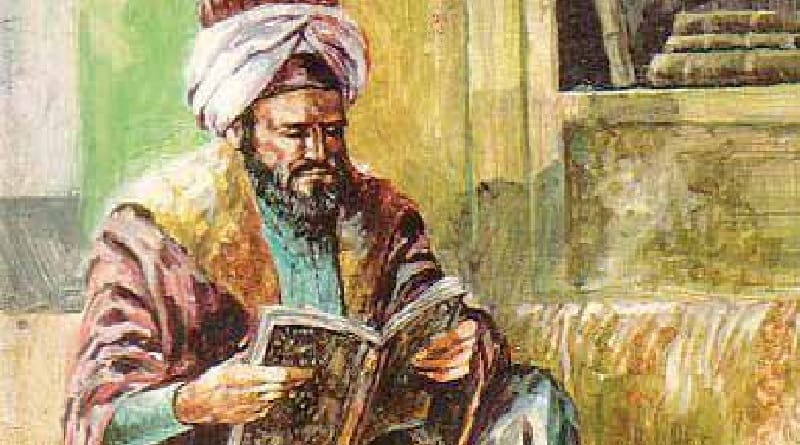
      2‘Abdur-Rahman Ibn Khaldun is considered as one of the greatest thinkers in the annals of human history. He lived in the middle-late fourteenth century and is known as the father of the disciplines of history and sociology, also making an indelible imprint in the fields of philosophy and economy.[1] He crafted an independent theory of history – an amalgam of history proper and culture, whereby he probed the “origins, rise, decline and fall of civilisations”[2] and took into consideration the complex intersection of social, economic, environmental political and moral factors in the development of civilisations.[3][4] His ideas were a product of his extensive experience in observing matters of statecraft, the scholarly Islamic education he received and various peoples he encountered across the expanse of the existing Islamic dynasties. He has influenced a broad spectrum of historians and intellectuals, from the historians of the Ottoman Empire to the Orientalists of the nineteenth century who brought his works to prominence in Europe and the West. His ideas continue to hold prominence today, having an impact on a number of modern theories and intellectual currents.

      The Social & Cultural Background of Ibn Khaldun
      Ibn Khaldun was born of an Arab Hadrami family and his intellect found the environment to flourish through constant interaction and exposure to elite scholarly circles. His ancestors migrated to Iberia with the Ummayads and then moved to North Africa in the twelfth century. He was educated in the traditional Islamic sciences including the Qur’an, the Hadith, jurisprudence, Arabic poetry and grammar. Through his learning he was qualified for judgeship, counsellorships and received the patronage of rulers wherever he travelled.[5] He was often in the midst of political turmoil and controversy and the warring dynastic struggles of the North African states. He was put in prison at one point for alleged subversive activities, then freed and raised desert armies in support of another ruler.[6] This extensive practical experience in partaking in and observing the affairs of statecraft and engaging with people of a variety of backgrounds, both sedentary, elite and nomadic, no doubt helped shape Ibn Khaldun’s philosophy of dynasty and civilisation.
      4
      Map of the Muslim World around 1400, a few years before Ibn Khaldun’s death.
      His epistemology was shaped distinctly by Islam, evidenced throughout his works. He combines both what in Muslim terminology is the ‘Aql-Naql mind’ – revealed knowledge with human reasoning to explain the phenomenon of human social organisation.[7] This is discerned through his frequent mention of Allah being the ultimate source and cause of all events and cyclical behaviour of civilisations he describes:
      “This is how God formerly proceeded with His servants. And verily you will not be able to change God’s way”[8], “God inherits the earth and whoever is upon it”[9].    
      Islam, to him, was the historical articulation of a divine plan that was rational. The shortcomings and disintegration of Muslim dynasts, such as the late Umayyads and Abbasids, was not due to the deficiencies of Islam,[10] but rather the proponents and rulers of the dynasties who fell into the cycle of luxury and complacency, failing to live by proper Islamic principles. The Islamic Weltanschauung of Ibn Khaldun is thus evident through his explanation of the fall of civilisations. He makes the point repeatedly that it is due to mankind’s infractions towards the Shar’iah – through the sins of pride, luxury, ostentation and oppression – that he is led to downfall in the earthly kingdom.[11]

      Methodological Approaches, Subject Matter and the Purposes and Objectives of Ibn Khaldun’s Works
      Ibn Khaldun completely reconceptualised the art of presenting history by introducing a new historiographical method. He crafted an independent theory of history, where he reviewed historical experience on a universal scale and presented a general set of laws governing the evolution of civilisations.[12] He was critical of previous and contemporary Muslim historians and their method of presenting history and therefore established his new “science of civilisation” – ‘Ilm al-‘Umran.[13] His magnus opus the “Muqaddimah” translated as the “Prolegomena to History” in English is the introduction to his “Kitab al-Ibar”, his history of the world which was a history of the Berbers and a general covering of human history including the Arabs, Nabataeans, Syrians, Persians, Israelites, Copts, Greeks, Romans, Turks and Franks.[14]
      It took him four years to write it and he related after its completion that “words and ideas (were) pouring into my head like cream into a churn”.[15]  Arnold Toynbee, a prolific British historian and philosopher of history of the first half of the twentieth century, described it as,
      undoubtedly the greatest work of its kind that has ever yet been created by any mind in any time or place.[16]
      3
      The Muqaddimah: His magnum opus
      The Muqaddimah is regarded as the first time a historian has attempted to uncover the structure in the changes and developments affecting human societies. It offers a rational and analytical method, encyclopaedic in detail,[17] differing from the vast majority of both medieval and modern historical works of a simple presentation of a chronology of factual events,[18] being rather an investigation as Ibn Khaldun himself articulates, of “the subtle explanation of the causes and origins of existing things, and deep knowledge of the how and why of events”.[19]
      Ibn Khaldun begins the book by critiquing common historiographical errors which he had seen Muslim authors committing. This includes “accepting reports in their plain transmitted form, without checking the principles underlying such historical situations”[20] and narrating implausible events and passing them off as ‘history’. He provides the template the historian must follow in conveying deep and meaningful history:
      the scholar in this field needs to know the principles of politics, the (true) nature of existent things, and the differences among nations, places, and periods with regard to ways of life, character qualities, customs, sects, schools, and everything else.[21]
      Ibn Khaldun begins with a discussion of human civilisation in general, proving through deductive reasoning why human co-operation and social organisation is an inescapable necessity for survival, followed by why authority is an essential element to provide a “restraining influence”[22] to prevent injustice.
      This is followed by information about the geography of the earth, the oceans, rivers, zones and where different civilisations are found. Following this, he discusses the temperate zones of the earth, the various climates and environmental conditions and their influence in the physical characteristics and behaviours of humans.
      This leads to his main thesis which he is most renowned for: he posits that the environmental conditions the Bedouins in the desert are exposed to foster the values of fortitude, independence, self-reliance, courage, and above all “‘Asabiyyah”.
      The harsh conditions of desert life, with the limited access to material goods, luxuries and amenities combined with strong leadership are the root basis and origins of most civilisations and empires – and especially the Islamic polities.[23]
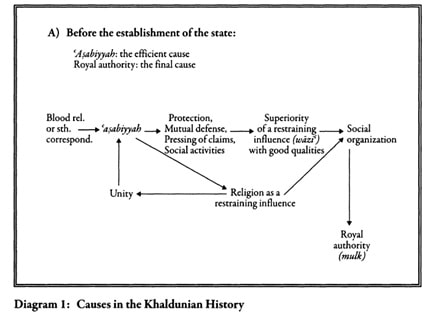
      This is when ‘Asabiyyah is at its strongest, which he claims is the fundamental block which keeps a civilisation running. The weaker the ‘Asabiyyah, the closer an empire is to collapse. “‘Asabiyyah” is a rich term which encompasses a range of meanings – authors have generally translated it through particular expressions of universal sociological notions such as “public spirit”, “social solidarity”, “group cohesion”, “espirit de corps’”.[24]
      Erwin Rosenthal describes it as “the motor development of the state”[25], whilst Toynbee posits ‘Asabiyyah as the “basic protoplasm all bodies politic and bodies social are built up”.[26] ‘Asabiyyah was often based upon blood-ties or a tribal basis, and later on based on religious unity with the advent of Islam. The core of the idea is loyalty to a common leader, united under the same ideological idea and defence against external attack.[27]
      A summary of the interdependent variables involved in the development of ‘Asabiyyah
      A summary of the interdependent variables involved in the development of ‘Asabiyyah [28]
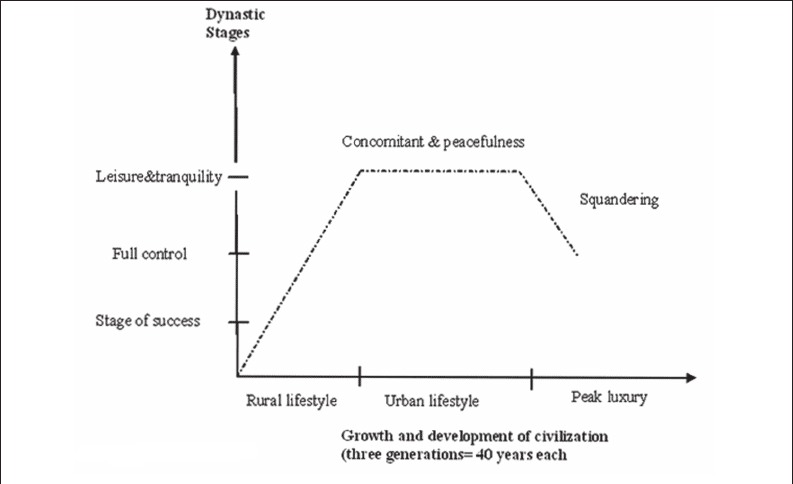
      The central thesis of Ibn Khaldun then is that a ruler unites his virile Bedouin people with a common feeling of ‘Asabiyyah and often comes to power by overturning an existing established civilisation which has reached the end of its life-cycle, revelling in decadence and luxury. The whole conception of historical development is based upon these two dichotomous groups: the nomadic and sedentary.[29] This was witnessed with the rise of the first Islamic Caliphate, from its humble desert origins, defeating the Roman and Persian Empires.
      In this first stage the leader rules over his people equitably and shares power with them[30]. This is then followed by a period of conquest and consolidation of territory, where the first stages of despotism appear. The leader picks a few of his favourite men and checks the authority of his original followers, hence establishing his dynasty.[31]
      The third stage is the epoch of civilisation and decay, where an impressive civilisation is established, where the ruler and populace fall prey to the refined elements of life and luxury and focus on the acquisition of wealth in their sedentary mentality, becoming weak and cowardly, losing their former military prowess[32][33]. These factors lead to a weakening of ‘Asabiyah and the original qualities which helped establish their initial power, hence making them vulnerable to outside attacks from a fresh nomadic race who are at stage one of the cycle.
      Maladministration and the abuse of power is widespread, the expenses of the ruler and state build-up leading to increased taxation. These are the symptoms of the disintegration of the empire and are an inevitability which cannot be circumvented in the Khaldunian thesis. The victors then undergo this same process, and thus this cycle keeps on repeating itself.
      This, then, is the story of human history Ibn Khaldun asserts.[34] This entire cycle of the rise and fall of civilisations is calculated to last for three generations, which is about 120 years according to Ibn Khaldun.[35]
      A "graph"ical summary of Ibn Khaldun's cycle of civilisations
      A “graph”ical summary of Ibn Khaldun’s cycle of civilisations


      The Impact of Ibn Khaldun on Ottoman Historians
      It has been claimed by Orientalist scholars that Ibn Khaldun was not overly prominent prior to being discovered by them in the nineteenth century and that he “was not a famous Muslim scholar before he achieved fame among non-Muslims of expansionist Europe”[36].
      Recent research, however, has proven this not to be the case: many manuscripts, and later published copies of the Muqaddimah, existed in the libraries of Istanbul and other Ottoman cities, with many commentaries written on the illustrious work by Ottoman scholars[37].
      The first confirmed date of Ottoman adoption of Ibn Khaldun can be traced to 1598 when the scholar and poet Veysi acquired a manuscript of the Muqaddimah in Cairo. However, Ottoman scholars did not till the mid-seventeenth century make explicit references to Ibn Khaldun. The polymath Kâtip Çelebi appropriated Ibn Khaldun’s stages of civilisation analogous to the human body, of growth, maturity and decline[38].
      7
      The polymath Kâtip Çelebi
      Muṣtafa Na’īmā had an immense enthusiasm for Ibn Khaldun. He explored the decline of the Ottoman Caliphate in describing that it was entering into its “penultimate phase”[39] and made recourse to Ibn Khaldun’s formulations on the cyclical pattern of societies and the tension between nomadic and sedentary polities[40]. It was in the early eighteenth century that Ibn Khaldun’s popularity was firmly established amongst Ottoman historians. Müneccimbaşi, the author of a universal history in Arabic, adopted Ibn Khaldun’s methods of historical inquiry and in 1725, chief Islamic scholar Pîrîzâde Mehmed Sâhib Efendi produced the first ever translation of the Muqadimmah to Turkish. Henceforth Ibn Khaldun became a celebrated intellectual in the pantheon of Ottoman intellectuals and statesmen.[41][42]
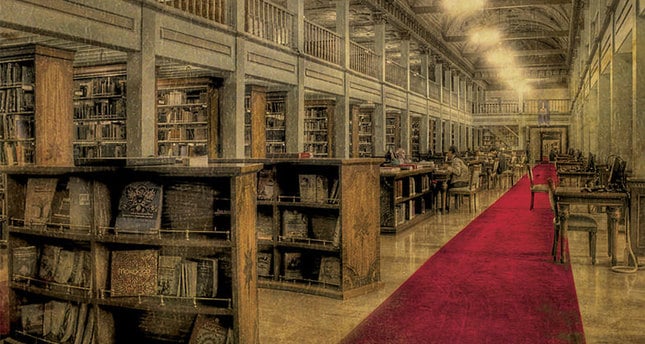
      The Muqaddimah existed in the libraries of Istanbul and other Ottoman cities
      The Muqaddimah existed in the libraries of Istanbul and other Ottoman cities

      Concluding Observation and Thoughts
      Ibn Khaldun has carved out an immutable arena for himself in the historical and sociological spheres in both the Orient and Occident. He has conveyed a unique formulation of the cyclical nature of history with regards to the rise and fall of civilisations. However, some of his ideas seem relevant only to the medieval period of history, beginning to lose relevance with the phenomenon of modernity.
      With the rapid urbanisation and modernisation of society and the virtual non-existence of nomadic societies with military clout, his established theory of the virile nomadic peoples overturning the decadent sedentary population is no longer witnessed in modern history. Rather the power and economic structures and variables of military warfare are now vastly different with shifts in state power occurring in varied ways.
      Some of his other theories however, have universal appeal, such as his assertion of ‘Asabiyyah being the building block of cohesion for a state to function efficiently. The modern global landscape and its arrangement is incredibly intertwined on the notion of ‘Asabiyyah. The Westphalian separation of nations in the form of the nation-state is based upon the cultural homogeneity of each specific nation, who build a sense of ‘solidary’, ‘group-feeling and cohesion’; in other words ‘Asabiyyah, to function more productively. Governments strive to ensure that the ‘Asabiyyah of the population do not wane, with various measures in place to ensure loyalty to the home nation’s values and ideals.  It may thus be said that Ibn Khaldun’s notion of ‘Asabiyyah has only increased in its relevance and actuality in the social organisation of human societies than the time he proposed his ideas.
      The reason why Ibn Khaldun is held in high regard is due to his efforts in seeking to answer the fundamental ontological operations of the earth, its relationship with human beings, and the laws which govern the panorama of human history. He was a thinker who has relevance in all ages and a universal appeal which resonates with the curious and intelligent mind irrespective of his or her era.

      Author: Tarek ‘Abdur Rahman who is in his 4th year at the University of New South Wales in Sydney, Australia, studying Arts/Education, majoring in History & minoring in English.

      References
      [1] Ronald A. Messier, “The Worlds of Ibn Khaldun: Introduction.” The Journal of North African Studies 13, no. 3 (2008): 275, accessed October 1, 2015, 10.1080/13629380701844482.
      [2] Yolanda Gamarra, “Ibn Khaldun (1332–1406): A Precursor of Intercivilizational Discourse.” 28, no. 3 (2015): 455, accessed October 1, 2015, doi: 10.1017/S0922156515000217.
      [3] Gamarra, “Precursor of Intercivilizational Discourse,” 455.
      [4] Qadir, “Social and Political Ideas,” 118.
      [5] McCorriston, “Pastoralism and Pilgrimage,” 615.
      [6] McCorriston, “Pastoralism and Pilgrimage,” 615.
      [7] Mahmoud Dhaouadi, “The Ibar: Lessons of Ibn Khaldun’s Umran Mind.” Contemporary Sociology 34, no. 6 (2005): 586.
      [8] Ibn Khaldun, The Muqaddimah (Unabridged), 77.
      [9] Ibn Khaldun, The Muqaddimah (Unabridged), 80.
      [10] Bruce B. Lawrence, “Introduction: Ibn Khaldun and Islamic Ideology,” in Ibn Khaldun and Islamic Ideology, ed. Bruce B. Lawrence (Leiden: E.J. Brill, 1984), 8.
      [11] H. A. R. Gibb, “The Islamic Background of Ibn Khaldūn’s Political Theory.” Bulletin of the School of Oriental and African Studies 7, no. 1 (1933):  31, accessed October 1, 2015, doi: 10.1017/S0041977X00105361.
      [12] M. Abdul Qadir, “The Social and Political Ideas of Ibn Khaldun.” The Indian Journal of Political Science 3, no. 2 (1941): 118.
      [13] Ali Çaksu, “Ibn Khaldun and Hegel on Causality in History: Aristotelian Legacy Reconsidered.” Asian Journal of Social Science 35, no. 1 (2007): 79.
      [14] Qadir, “Social and Political Ideas,” 118.
      [15] Dawood, “Introduction,” in The Muqaddimah, viii-ix.
      [16] Hayden V. White, “Ibn Khaldûn in World Philosophy of History.” Comparative Studies in Society and History 2, no. 1 (1959): 112.
      [17] Dawood, “Introduction,” in The Muqaddimah, ix.
      [18] Yusuf M. Sidani. “Ibn Khaldun of North Africa: An AD 1377 Theory of Leadership.” Journal of Management History 14, no. 1 (2008): 76.
      [19] Ibn Khaldun, The Muqaddimah (Unabridged), trans. Franz Rosenthal, 55, accessed October 1, 2015,  https://asadullahali.files.wordpress.com/2012/10/ibn_khaldun-al_muqaddimah.pdf.
      [20] Ibn Khaldun, An Introduction to History The Muqaddimah, trans. Franz Rosenthal (London: Routledge and Kegan Paul, 1967), 11.
      [21] Ibn Khaldun, The Muqaddimah, 24.
      [22] Ibn Khaldun, The Muqaddimah, 47.
      [23] McCorriston, “Pastoralism and Pilgrimage,” 616.
      [24] Yves Lacoste, Ibn KhaldunThe Birth of History and The Past of the Third World (London: Verso, 1984), 101.
      [25] Lacoste, Ibn Khaldun, 100.
      [26] Lacoste, Ibn Khaldun, 101.
      [27] Qadir, “Social and Political Ideas,” 121.
      [28] Çaksu, “Ibn Khaldun and Hegel,” 75.
      [29] Lacoste, Ibn Khaldun, 92.
      [30] Qadir, “Social and Political Ideas,” 125.
      [31] Qadir, “Social and Political Ideas,” 125.
      [32] Lacoste, Ibn Khaldun, 92.
      [33] Qadir, “Social and Political Ideas,” 121.
      [34] Qadir, “Social and Political Ideas,” 121.
      [35] Qadir, “Social and Political Ideas,” 125.
      [36] Nurullah Ardiç, “Genealogy or Asabiyya? Ibn Khaldun between Arab Nationalism and the Ottoman Caliphate,” Journal of Near Eastern Studies 71, no. 2 (2012): 317.
      [37] Ardiç, “Genealogy or Asabiyya?,” 317.
      [38] Cornell Fleischer, “Royal Authority, Dynastic Cyclism, and ‘‘Ibn Khaldunism’’ in Sixteenth-Century Ottoman Letters,” in Ibn Khaldun and Islamic Ideology, ed. Bruce B. Lawrence (Leiden: E.J. Brill, 1984), 47.
      [39] Fleischer, “Royal Authority,” 47.
      [40] Fleischer, “Royal Authority,” 47.
      [41] Ardiç, “Genealogy or Asabiyya?,” 318.
      [42] Fleischer, “Royal Authority,” 48.