


This past spring, mountain runners Kilian Jornet and Emelie Forsberg set out to climb an 8000-meter peak as quickly as possible. With their busy schedules, neither of them had the time to spend two months climbing in the Himalaya, so they elected to try a radical new method of acclimatization and preparation that would ultimately cut down the time needed to summit Cho Oyu to less than two weeks. In this video, we find out how they did it and see these two top athletes in their element in the mountains.
Showing posts with label Cho Oyu. Show all posts
Showing posts with label Cho Oyu. Show all posts
China Closes Tibet to All Climbers for Fall 2017
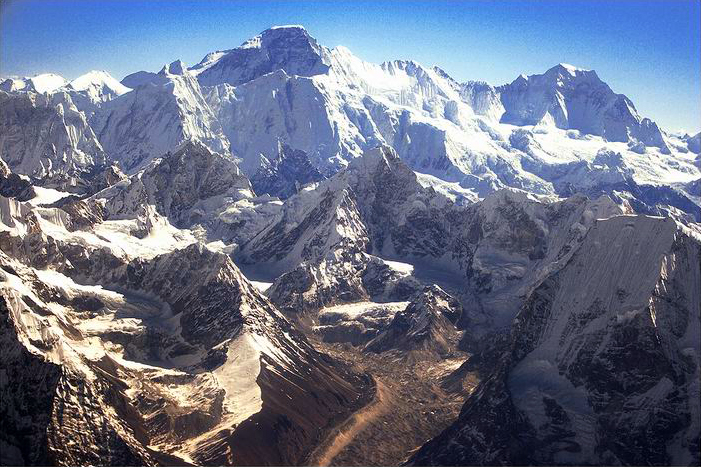
Alan Arnette is reporting that China has completely closed Tibet for the fall climbing in 2017 due to Adamski's flagrant violation of the rules. Yesterday, the China-Tibet Mountaineering Association issued a memo stating that it would no longer issue any permits for climbing during the post-monsoon season and even goes so far as to name Adamski specifically in the note. Officials in China have yet to announce any legal actions against the Polish mountaineer, but it is likely he'll face a ban from climbing in that country as well.
It had been previously known that no permits would be issued for the North Side of Everest this fall, but it was expected that as many as 50 permits would be offered for Cho Oyu. That will no longer be the case and any permits already issues will be revoked. As Alan points out, that due to the actions of one selfish climber, now many others must pay the price.
He also notes that Adamski's actions may simply be the excuse that Chinese officials needed to close down Tibet to foreigners this fall. If they suspect that there will be political unrest in the area, or an incident that might draw attention to the plight of the Tibetan people, the government there won't hesitate to close its borders. It has happened several times in the past and will likely happen again too.
Either way, it looks like climbing in Tibet is completely closed until next spring, which is sure to come as a disappointment to any teams that were planning to go there later this year.
Himalaya Spring 2017: Rope Fixing Team Retreats on Everest, Kilian Speed Climbs Cho You

This delay in getting the ropes into place will likely cause the teams that are currently at or above C2 to retreat to Base Camp as well and wait for the work to be completed. Most of the climbers are now fully acclimatized and are simply waiting for the lines to be installed and a proper weather window. Once access to the summit is granted, there is likely to be a mad dash for the summit, provided the weather allows.
Reports indicate that there is plenty of snow on the upper flanks of Everest this year, which is welcome news for the climbers. Most would rather climb on snow and ice rather than bare rock, and it seems that will be the case this season. Not only is it easier to make the ascent over the more technical sections of the climb, it is also safer too. Often the wind clears the snow from the upper sections of the mountain, but this year it looks like it will remain.
So what does this mean for the climbing schedule? It now looks like the ropes won't be fixed until late this week, which means summits attempts will be pushed into next week. The forecast continues to look good, although winds do pick up some over the next couple of days. If everything holds however, we can now expect possible summits by next week this time, although even that could fluctuate some. So far, everything is still going as schedule, and nothing is really out of the ordinary, but until the rope fixing is completed, the teams remain in a holding pattern.
Elsewhere, Kilian Jornet has posted an update on his efforts on Cho Oyu, and as you would expect they are impressive. He and Emelie Forsberg set out to make a speed climb on the mountain in much the same way as Adrian Ballinger and Emily Harrington did last year by using oxygen tents to pre-acclimatize before ever arriving in the Himalaya. As a result, Jornet and Forsberg were ready for a summit push in just nine days.
A few days back they launched their attempt and were reportedly climbing very fast in good conditions. At the Yellow Band – located at 7700 meters (25,262 ft) – Emelie turned back as it looked like the weather was starting to take a turn for the worse. For her, this was her first climb above 6000 meters (19,685 ft), so it sounds like she made an impressive effort all around. Kilian pressed on, and as he neared the top it began to snow heavily, making it difficult to see. He reached what he believed was the summit, but because there are few features on Cho Oyu, and the snow was coming down hard, he isn't sure if he did indeed top out. He says that he didn't see a way to climbing any higher, but that he still isn't positive he reached the summit.
From there, both he and Emelie descend back to BC and left camp. She is going home to train for the running season ahead, while Kilian will now head to the North Side of Everest in Tibet to prepare for his speed attempt on Everest.
So how fast was the Cho Oyu climb? Reportedly it took Kilian just 14 hours to go from Camp 1 to the summit. Not bad at all, and a good indication that he is now ready to take on the Big Hill soon too.
That's it for now. More to come soon I'm sure.
Himalaya Spring 2017: Kilian Jornet Reveals Plans, Sherpa Injured on the Everest

I know a lot of people have been waiting to hear what Kilian Jornet is up to this spring. We know that he intends to go for a speed record on Everest, and that due to permit issues on the North Side he was forced to move his expedition up from late summer as he had originally planned. But other than that, we haven't heard a lot of details. Over the weekend, that changed some.
In an email sent out to members of the media yesterday, the Spanish mountain runner indicated that he would first travel to Cho Oyu with partner Emelie Forsberg where the pair will attempt a summit on that 8201 meter (26,906 ft) mountain. This will serve as acclimatization and training for Kilian, who now intends to head to the North Side of Everest in mid-May to attempt his speed record. The benefits of doing it from that side of the mountain being smaller crowds and a more direct route that doesn't include the Khumbu Icefall.
Jornet just left for Kathmandu yesterday after competing in one last race before setting out to the Himalaya. He and Forsberg will likely spend a few days in the Nepali capital before heading out to the mountains.
Meanwhile, The Himalayan Times is reporting that Sherpas working on the South Side of Everest have now fixed the ropes all the way up to the South Col. That means teams are now free to goal high as Camp 4 once their bodies are prepared to handle the altitude. It also means that everything is on schedule to complete rope fixing up to the summit ahead of the final push that will begin in a few weeks time.
The Times is also indicating the a Sherpa was injured in an avalanche on the South Side as well. Climbing guide Furba Rita Sherpa was struck by ice when a serac collapsed near Camp 1 as he and several other porters were making their way up to C2 to drop gear and supplies. He reportedly suffered a broken hand and multiple injuries to his head and wrists as well. Fortunately, others were there to immediately lend a hand and Furba was quickly evacuated back to Kathmandu for treatment. He is reportedly doing well and already recovering nicely.
That's it for today. More detailed info to come once I've caught my breath from returning from Oregon.
Himalaya Fall 2016: Climbers Make Controversial Speed Ascent of Cho Oyu
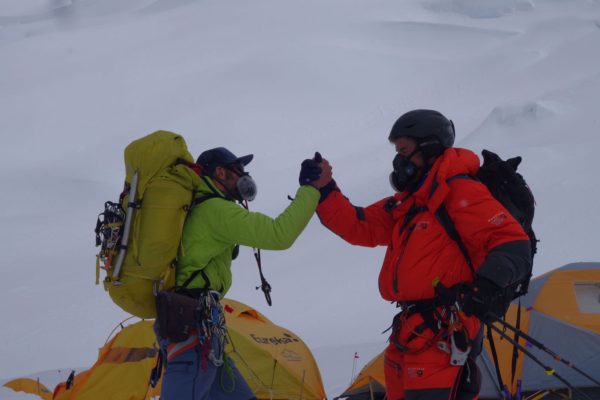
Last Sunday, Adrian Ballinger – of Alpenglow Expeditions – and his partner Emily Harrington completed a successful summit of Cho Oyu, the sixth highest mountain on the planet at 8188 meters (26,884 ft). That in and of itself wasn't too unusual, as a number of teams topped out during a great summit window last weekend. But, Adrian and Emily did it just ten days after leaving their home in California, something that has been unheard of until now.
Typically on a big Himalayan peak it takes weeks to acclimatize to the altitude. Most climbers arrive in Kathmandu two months prior to their projected summit date. They then travel to their respective base camps, follow a set process for acclimatization by going up and down the mountain several times, and wait for good weather to make a summit bid after their bodies have acclimated to the thin air. That can sometimes take 4-6 weeks, depending on conditions and the climbing schedule.
But Adrian and Emily trained back home using altitude tents to simulate the conditions they would find on the mountain. These tents were able to create an environment that closely approximates the thin air of a big Himalayan peak, but it allows them to stay home, sleep in their own beds, and have the comforts that they are typically accustomed too. Meanwhile, a support team established a Base Camp for them on Cho Oyu, making it ready for their arrival.
Two weeks ago, Ballinger and Harrington left the U.S. to fly to Nepal and then traveled to Tibet to reach the mountain. By the time they reached BC, they were fit, acclimated, and pretty much ready to go. Once the weather window opened last week, they were able to safely climb to the top, taking two clients who had prepared in a similar fashion along with them.
This approach to acclimatizing at home and shortening the length of an expedition isn't new. In fact, it is something that Ballinger and Alpenglow have been working on for some time. The company's Everest expeditions are just a month in length thanks to this novel program, and now he has proven that he can shorten the time considerably on shorter peaks too. This allows clients to spend less time on a potentially dangerous mountain, while having to be away from home for fewer days too. That makes it vacation friendly as well. The downside? An Alpenglow expedition is considerably more expensive than the competition.
This new approach has rankled some in the mountaineering community in the past, but this new Cho Oyu speed ascent has many talking once again. For some, it is an innovative new way to climb in the Himalaya, while others feel like it is still a bit unproven and could be potentially risky. There are those who see it as a bit of "cheating" – for lack of a better word – as well. Those detractors tend to be old school climbers who often consider the use of bottled oxygen as a performance enhancing drug too.
Either way, this could be the future of mountaineering. Alpenglow will of course continue to pursue this novel training technique with the idea of attracting more clients who want to climb on the big peaks, but don't necessarily have two months to dedicate to that proposition. As Ballinger and his team continue to refine their methods, I'm sure more than a few other climbers and guides will be looking to employ similar techniques to aid their expeditions as well.
Himalaya Fall 2010: Avalanche May End Season On Cho Oyu

According to this story, a team of Sherpas was working the route on Cho Oyu earlier today, hoping to finish fixing the lines to the summit so that the climbers could complete their attempt on the mountain in a few days time. That work was interrupted however when they men were struck by an avalanche while installing ropes above the second rock band. While no one was hurt in that avalanche, one of the Sherpas was reportedly very shaken up, and the entire team has elected to come down the mountain due to the unsafe conditions at altitude.
Apparently those conditions don't look to improve any time soon, and the reports are that there is still way too much snow high on the mountain for it to be safe to go up. As a result, the IMG team has pulled the plug on their Cho Oyu expedition for the fall, and it seems like the other big teams will likely now follow suit. According to ExWeb, the Adventure Consultants have recalled their team from C2 to ABC, and are currently weighing their options, while the Field Touring Alpine squad is hoping to gain more information on the stability of the snow near the summit before they make their decision.
The poor conditions are a bit of a bitter pill to swallow for the climbers hoping to summit Cho Oyu this fall. They waited for weather conditions to improve, and it seems that it finally has, only to present another difficult challenge. It seems that things are likely over on the mountain for the fall, lets hope that climbers on other mountains in the region have a bit more luck.
Himalaya Fall 2010: Climbers Injured In Avalanche On Cho Oyu
According to ExWeb, six members of the Chinese-Tibetan Mountaineering Association were caught in an avalanche while fixing lines just below 8000 meters on Cho Oyu, and were buried beneath the snow. Rescuers were dispatched quickly, and helped to dig the men out, and later assisted them down the mountain to ABC in bad weather. On Saturday, the avalanche victims were taken the rest of the way back down the mountain to Base Camp, where they were loaded up in vehicles and driven away for medical attention.
The ExWeb story quotes Jagged Globe team member Robert Anderson, who reports that the injuries for the CTMA climbers ranged from a few bumps and bruises to mild concussions and snow blindness. He also said that they were assisted down in blizzard conditions, with several hours between the first and last men arriving in ABC. He says that they now hope to get some more CTMA climbers on the mountain to help finish the fixing of lines above C3 once the recently deposited snow settles some. If all goes according to plan, they hope to make a summit bid sometime this week.
There is no update on the condition of the climbers caught in the avalanche, but from the sounds of things they should all be in good condition, although a bit battered. Apparently the avalanche was big enough that it knocked the men from the mountain and drove them down for some distance, and while they all suffered injuries of varying degrees, they are also fortunate to be alive.
Father, Son Team Go For Cho Oyu!

The Orange County Register has a series of really great articles about John and Ryan Dahlem, a father and son climbing duo who recently traveled to Tibet to climb Cho Oyu together. John is 65, and Ryan is 38, and the pair have a great deal of experience on some big mountains, including Denali and Vinson, but this was their first trip to the Himalaya together.
For a mainstream article, it does an excellent job of laying out the dangers of climbing one of the 8000 meter peaks, and doesn't go overboard with the hyperbole on how dangerous it is. The stories are actually broken down into three parts, with Part 1 serving as an introduction tot he climb and the climbers. The author is a climber himself, with a great deal of experience as well, and I think that really helps to tell the story.
Part 2 gets more into the meat of the climb itself, discussing the logistics of the climb, including a bit on the trek to the mountain itself, and what it's like on the upper portions of the mountain. We're also treated to detailed accounts of what the storms that rocked Cho Oyu this fall were like.
Finally, the Part 3 is a tale of sadness and success. Sadness, because it notes that two climbers died on the mountain (Guy Leveille and Miha Valic), even as the father and son reached the summit. This article talks about them standing on the summit together, and then making the grueling descent together.
All in all, an excellent set of stories that give a nice, personal look at climbing the sixth tallest mountain on Earth. The fact that it was a father and son team, climbing with Summit Climb, makes it an even better story. Good stuff!
British Commando Team Save Climber On Cho Oyu
Members of the elite British commando squads the SAS (Special Air Service) and SBS (Special Boat Service) conducted a high level rescuse operation at 24,000 feet on Cho Oyu, saving the life of an Italian climber. According to the Times Online article the soliders were preparing for a crack at Everest in the Spring when they came across Roberto Marabotto, who was suffering from AMS, and hadn't eaten in several days. They then proceeded to take the Italian down to Camp 2 where they fed him and kept him over night before proceeding to Camp 1 the next day.
The SAS/SBS soldiers are making a run at the Seven Summits and this outing was meant to be high altitude training, but turned into high altitude rescue instead. Wish an effort like this one though, are they ever going to fit on Everest? Ok, I'm kidding about that last part. ;)
Thanks GoBlog!
The SAS/SBS soldiers are making a run at the Seven Summits and this outing was meant to be high altitude training, but turned into high altitude rescue instead. Wish an effort like this one though, are they ever going to fit on Everest? Ok, I'm kidding about that last part. ;)
Thanks GoBlog!