


This beautiful short film takes us on a quest with skier Drew Petersen, who set out to ski the highest peaks in all 11 of the states that make up the Western U.S. They include Nevada, California, Arizona, New Mexico, Colorado, Idaho, Utah, Washington, Oregon, Wyoming, and Montana. In order to achieve his goal, Drew had to go to some great lengths, but as you'll see, those efforts were incredibly rewarding in so many ways.
Showing posts with label California. Show all posts
Showing posts with label California. Show all posts
California's Wine Country Is On Fire
SFGate: 10 dead as Wine Country fires burn at least 1,500 structures, force evacuations
A swarm of fires supercharged by powerful winds ripped through Napa, Sonoma and Mendocino counties Monday, killing at least 10 people, injuring dozens of others, destroying more than 1,500 homes and businesses, and turning prominent wineries to ash.
Starting in the middle of the night, the fires hopscotched across neighborhoods, raced across fields and jumped freeways. Wind gusts up to 70 mph pushed walls of flames nearly 100 feet high, throwing embers ahead like hot fingers into strip malls and subdivisions. Many people who fled the surge had enough time to grab car keys, perhaps a pet, but not much more.
Read more ....
WNU Editor: A few weeks after 9/11 I went to visit my brother in California (he lives in San Mateo). He took me on a tour of wine country in Napa and Sonoma, and I fell in love with the region right away. When I came back home to Montreal I could not get Napa out of mind .... so 3 months later I was back in California and I started to look for homes in Napa. A place to call home during winter. Found an incredible property off Silverado Trail that also had a few acres of grapes. I liked the price and terms .... went back to Montreal to arrange the money but on my way back I learned my father had a stroke. It changed everything .... and I stayed in Montreal. But Napa and Sonoma have always been on my mind, traveling there many times over the years, even convincing the GF a few weeks ago that our next trip will be to NAPA. Tonight .... everything that I love about Napa and Sonoma is on fire. Sighhhh. My prayers are for those who are suffering tonight.
More News On The State Of Emergency For Northern California
At least 10 dead, 1,500 structures lost in Northern California firestorm, among worst in state's history -- L.A. Times
At least 10 dead as fires rage in California wine country -- AP
Napa fire evacuees tell of fleeing for their lives in the middle of the night -- Napa Valley Register
Fast-moving wildfires kill 10, spur evacuations in Northern California -- CNN
Photos show how wildfires are ravaging parts of California's wine country -- Business Insider
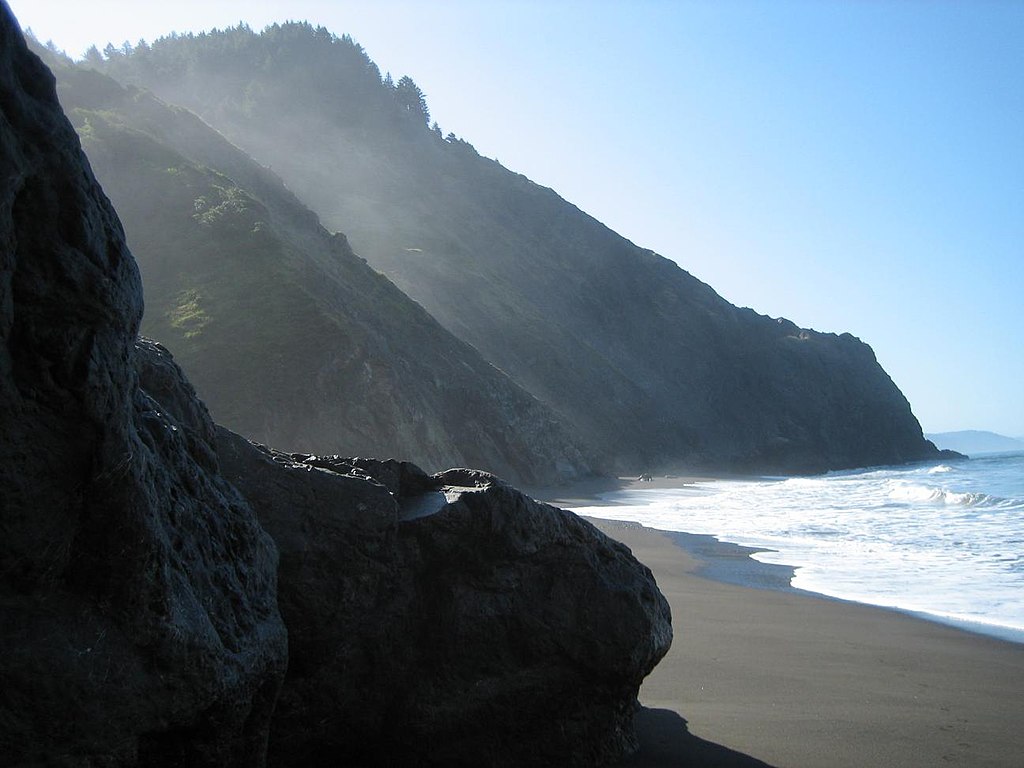
Traveling to California - The Lost Coast Trail with Tepui Tents
I depart early on Monday and will be back early on Thursday, so there is a good chance there won't be any updates until next Friday. But should a big story break, there is a chance I'll be able to post something to the blog before then. In the meantime, have a great weekend, enjoy the spring weather, and I'll be back before you know it.
After this trip, I don't have anything planned for a few weeks, which means I should be around for summit season in the Himalaya. Always an exciting time of year for sure.
Video: A Flood in Yosemite National Park
January has been a rough month for much of the American West. It has dumped untold inches of snow across many parts of the region, while areas of California have seen an incredible amount of rain. That includes Yosemite National Park, which as you'll see in this clip, has seen its streams and rivers swell, waterfalls overflow, and parts of the valley flood. California has been in a drought for sometime now, but this isn't necessarily the way you would want to see it come to and end. Still, the water as a whole is welcome sight to much of the state.
Video: Where Have All the Stars Gone? - How Light Pollution Affects the Night Sky
One of the great joys of travel for me is visiting places where it is so dark that you can see the night's sky completely unobstructed. Watching the billions of stars overhead is an incredibly humbling experience. But, not everyone gets to feel that thanks to light pollution, which can block the heavens, even on the darkest of nights. In this video, we see just how much of an impact the urban lights can have as we walk through the various levels of light pollution and how they affect our enjoyment of the stars overhead. These timelapse images will put everything into perspective and help you appreciate our dark zones even more.
Video: Tempus Fugit - Time Flies in this Timelapse Video
Shot in Austria, Italy, Switzerland, Norway, Iceland and California, Utah, Washington and Oregon in the U.S., this video takes us on a whirlwind tour of some of the most beautiful and iconic landscapes at those destinations to show us how they look in an amazing timelapse fashion. This is four minutes of incredible beauty that shouldn't be missed. A perfect way to wrap up the week.
TEMPUS FUGIT 2 from Dr. Nicholas Roemmelt on Vimeo.
Old friend introduces bill to bar State of California from doing business with companies that boycott Israel
How many of you remember Travis Allen? Travis won that election in District 72 in California, and has now used his position to strike a blow at the boycott, divest, sanction (BDS) movement, which is strong on many California college campuses.
Travis Allen, of Huntington Beach in southern California’s Orange
County, introduced the bill – called the California- Israel Protection
Act – to “
Old friend introduces bill to bar State of California from doing business with companies that boycott Israel
How many of you remember Travis Allen? Travis won that election in District 72 in California, and has now used his position to strike a blow at the boycott, divest, sanction (BDS) movement, which is strong on many California college campuses.
Travis Allen, of Huntington Beach in southern California’s Orange
County, introduced the bill – called the California- Israel Protection
Act – to “
Mountain Hardwear Is Giving Away Free Campsites This Summer

The three campsites include Clear Creek Ranch in Northern California, Grand Tetons Climber's Ranch in Wyoming, and The Gunks in New York. Each is of these private campsites offer beautiful outdoor settings that are perfect for a short escape to the backcountry, particularly during the warm summer months.
Reserving the sites is incredibly easy. Simply go to this website and look for the location that you are interested in visiting. Then, select the dates that you would like to stay at that location, and check to see if they are open. From there, you can book the site absolutely free.
If the dates you are looking for aren't available, don't fret. Mountain Hardwear plans to open more dates throughout the summer, and will send emails to campers to alert them that they are available. Announcements of new open dates will also be made on MHW social media, including Twitter and Facebook.
You can find out more at the Mountain Hardwear Blog here.
Close But Not Quite
This cartoon by Brian McFadden is mostly on target:

But the problem with agriculture is not so much the demands of the east to eat but of the power of the ag industry in California. California politicians are not going to be shy about annoying the rest of the country (might get them more votes), but they are shy about confronting big Ag in the state. Otherwise, the reaction to the water problem would definitely involve restrictions on the farmers.
Anyhow, fun cartoon that is 95% of the way there instead of the usual 110%.

But the problem with agriculture is not so much the demands of the east to eat but of the power of the ag industry in California. California politicians are not going to be shy about annoying the rest of the country (might get them more votes), but they are shy about confronting big Ag in the state. Otherwise, the reaction to the water problem would definitely involve restrictions on the farmers.
Anyhow, fun cartoon that is 95% of the way there instead of the usual 110%.
Video: The Golden State in Timelapse
California isn't just sprawling metropolises. It also features some incredibly beautiful scenery as well. This 4-minute video takes us on a visually stunning tour of the state, giving us shots of some of its most spectacular landscapes. It is a wonderful clip that will make you even more jealous of those who live in Cali.
California from Hal Bergman on Vimeo.
Cinco de Mayo
 Oh good Lord! I'm a bad Mexican-American. I've been in Euroland so long that I forgot today was Cinco de Mayo.
 I knew that today was May 5th because my calendar was full of meetings but I lost the connection to Cinco de Mayo until one of my Spanish-speaking colleagues reminded me.
Cinco de Mayo commemorates the Mexican army's unlikely victory of the French in 1862 at the Battle of Puebla. It is not Mexican Independence Day (that's on September 16th).
It's a big deal in Puebla; less so in other parts of Mexico. It's a very big deal in the USA, especially in states with large Mexican populations like California and Texas. North of the border it's more about celebrating Mexican heritage (and drinking) than remembering a +150 year old battle. I've done a decent job of celebrating Thanksgiving over here, perhaps next year I should look at doing something for Cinco de Mayo.
Video: The Fate Of The Bristlecones
This video is not only beautifully shot, but also very interesting too. It tells the story of the bristlecones, the oldest trees on the planet, which are found on California's White Mountains. The oldest of those trees is said to be over 4800 years old, and has survived any number of challenges. But now, those trees have a new threat, and it is unlike any they've faced in their history.
The Bristlecone's Fate - AudioVision Ep. 3 from KPCC on Vimeo.
Video: Charlie Don't Surf, But Bigfoot Does!
It seems Bigfoot sightings are at an all time high. Not only was he recently spotted taking a nap in the woods but he was also surfing at Pismo Beach in California. What's a thrill seeking Sasquatch to do when he finds himself wanting to ride some waves? Why grab a board (and apparently a GoPro camera!) and hit the water!
Video: Borrego Stardance - A Mind-Bending Short Timelapse Film
Borrego Springs, California is home to a 600,000 acre state park that preserves a large chunk of the desert there. Inside that park you'll find some amazing statues that were created by a man named Dennis Avery. Those statues are of such creatures as dragons, dinosaurs, horses, wooly mammoths and more. In the video below, those mythical beasts making a dramatic appearance with an incredible timelapse skyline moving behind them. The result is a bit mind-bending but also quite beautiful.
BORREGO STARDANCE from Sunchaser Pictures on Vimeo.
Video: Drone Captures Awesome Surf Footage
It wasn't all that long ago that drones seemed like something out of a science fiction movie. Now they're common place and even average people can own one for personal use. We've seen them becoming increasingly popular with adventure filmmakers, who can now attach a lightweight GoPro camera and capture ariel footage of just about anything. Case in point, check out the beautiful and mesmerizing footage that was shot from a small drone at Steamer Lane in Santa Cruz. The video simply looks amazing and I'm happy that photographers now have these tools at their disposal. Great stuff!
Aerial footage of surfers at Steamer Lane, Santa Cruz (DJI Phantom) from Eric Cheng on Vimeo.
Irvine, California
 Irvine is a suburb in Orange County. It's about 46 miles (74 km) from Los Angeles. The city was incorporated on December 28, 1971.
 Irvine is 66 miles² (170 km²) and has a population over 220,000. It is the 3rd largest city in Orange County, as well as, the 16th largest in California and the 96th in the USA.
It's a great place to live and to raise a family. Which is why my sister and her family live here.
My sister wanted to know what I wanted to do while I was here. Aside from some shopping, grabbing some In-N-Out and perhaps going to the beach and Disneyland - not much. I don't need to do any real touristy things. I've had a great time so far just hanging out with my family.
.jpg) |
| Helping Emme with her car wash business |
.jpg) |
| Watching Krtek on YouTube |
.jpg) |
| After school skateboarding |
.jpg) |
| Kai & Dad making a spice cake |
Video: Singletrack High Trailer
A company called Pedal Born Pictures is working on a new documentary about the NorCal High School Cycling League which consists of a group of young riders who compete with one another in a series of races each spring while wearing their school colors. It looks like the film, which is set to come out in early 2013, has a lot of promise and it is great to see young people embracing an outdoor activity.
Thanks to the Nat Geo Adventure Blog for the tip! This looks great!
Singletrack High Teaser from Pedal Born Pictures on Vimeo.
Thanks to the Nat Geo Adventure Blog for the tip! This looks great!
Video: Mountain Biking The Lost Coast Trail With Sacred Rides
The Lost Coast Trail in California is a remote and beautiful trail along the Pacific Ocean. It is a popular one for backpackers who enjoy the quiet solitude of the place. Turns out you can also mountain bike the trail and Sacred Rides, an adventure travel company that specializes in cycling excursions to some of the best places on the planet, offers a seven day Lost Coast Adventure. If you can't join them to do the ride yourself, you can at least enjoy the three minute video they've produced which will certainly get you into the spirit. Looks like some great singletrack.
The Great Lost Coast Adventure from Mark Baeder on Vimeo.
Early California Was A Killing Field: Research Shatters Utopian Myth, Finds Indians Decimated Birds
AUTHOR: Lee Siegel
SOURCE: University of Utah
COMMENTARY: Allen MacNeill (following article)
"The wild geese and every species of water fowl darkened the surface of every bay ... in flocks of millions.... When disturbed, they arose to fly. The sound of their wings was like that of distant thunder."
--George Yount, California pioneer, at San Francisco Bay in 1833
When explorers and pioneers visited California in the 1700s and early 1800s, they were astonished by the abundance of birds, elk, deer, marine mammals, and other wildlife they encountered. Since then, people assumed such faunal wealth represented California's natural condition -- a product of Native Americans' living in harmony with the wildlife and the land and used it as the baseline for measuring modern environmental damage.
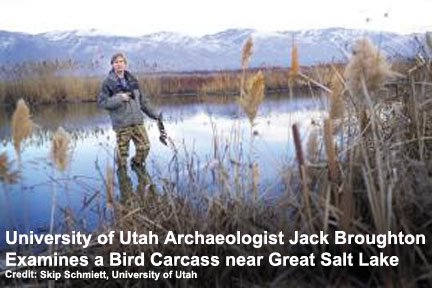
That assumption now is collapsing because University of Utah archaeologist Jack M. Broughton spent seven years -- from 1997 to 2004 -- painstakingly picking through 5,736 bird bones found in an ancient Native American garbage dump on the shores of San Francisco Bay. He determined the species of every bone, or, when that wasn't possible, at least the family, and used the bones to reconstruct a portrait of human bird-hunting behavior spanning 1,900 years.
Broughton concluded that California wasn't always a lush Eden before settlers arrived. Instead, from 2,600 to at least 700 years ago, native people hunted some species to local extinction, and wildlife returned to "fabulous abundances" only after European diseases decimated Indian populations starting in the 1500s.
Broughton's study of bird bones, published in Ornithological Monographs, mirrors earlier research in which he found that fish such as sturgeon, mammals such as elk, and other wildlife also sustained significant population declines at the hands of ancient Indian hunters.
Biologists long assumed that the abundant wildlife in California some 200 years ago had existed for thousands of years -- an assumption "that is ultimately used to make decisions about how to manage and conserve threatened or endangered species," says Broughton, an associate professor of anthropology.
"Since European discovery, California has been viewed by scholars and scientists, as well as the general public -- as a kind of utopia or a land of milk and honey, a super-rich natural environment," he says. "This perception has long colored anthropological research on the state's native peoples. The harvesting methods and strategies of native peoples have been suggested to have promoted the apparent superabundance of wildlife, and have been proposed as models for the management of wilderness areas and national parks today."
Broughton says his study challenges "a common perception about ancient Native Americans as healthy, happy people living in harmony with the environment. That clearly was not always the case. Depending on when and where you look back in time, native peoples were either living in harmony with nature or eating their way through a vast array of large-sized, attractive prey species."
The study may have broader implications. Broughton speculates that "utopian perceptions" of a pristine California teeming with wildlife "probably even influence how Californians view themselves, and how the world views the Golden State. The dream world of Disneyland, the glamor and glimmer of Hollywood, the Baywatch fun-in-the-sun culture -- all of this may trace a link to early historic descriptions of the land that now appear to be worlds apart from pre-European conditions."
Himself a product of sunny California, Broughton grew up in rural Camarillo in the southern part of the state, "collecting butterflies, watching birds, and skinning skunks." While earning bachelor's and master's degrees at California State University, Chico, he studied bones from archaeological sites in California's Sacramento Valley and began to recognize that early natives had a strong impact on elk, deer, and sturgeon -- "anything big and juicy," he says.
For his doctoral dissertation at the University of Washington, Broughton analyzed fish and mammal bones taken from the Emeryville shellmound, an ancient Indian site on the east shore of San Francisco Bay between Oakland and Berkeley.
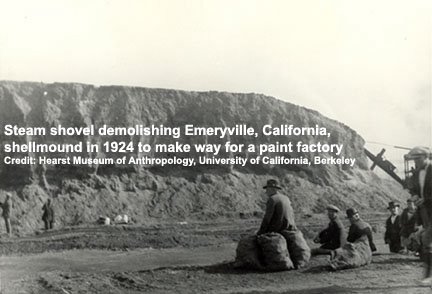
About 2,600 years ago, California's native people started living on the site and using it to dump residential waste such as shellfish remnants, bones, soil, rocks, ash and charcoal, and artifacts such as stone tools. The mound slowly grew until it was more than 30 feet tall, as long as three football fields, and as wide as the length of one football field. Then, in the 1800s, the top layers were flattened to make way for a dance pavilion, eliminating debris from recent centuries. What was left was a record of refuse containing the kinds of things native Californians hunted and ate from 2,600 to 700 years ago.
Emeryville was the largest of some 425 shellmounds identified along San Francisco Bay by 1900. It was made up of distinct layers, which allowed dating of its bones. In 1902, 1906, and 1924, scientists excavated thousands from the shellmound, recording the layer in which each bone was found. The shellmound then was destroyed by a steam shovel to make way for a paint factory, which was razed in the 1990s and replaced by retail stores. The shellmound bones were stored for decades at the Phoebe Apperson Hearst Museum of Anthropology at the University of California, Berkeley.
After finishing his dissertation on Emeryville mammal and fish bones, Broughton joined the University of Utah faculty in 1995. Two years later, he started examining the Hearst Museum's bird bones from the shellmound, alternating between that project and other research during the next seven years.
Analyzing 5,736 bones was a labor of love for him. "It's fun and relaxing," Broughton says. "It's a real challenge when you've got a broken bird bone and it could be any of 100 species. It may take hours or a day to identify a single bone. So you can imagine the excitement when you finally nail it."
To identify the shellmound bones, Broughton painstakingly compared them with bird bones kept in the University of Utah's Zooarchaeology Laboratory, which includes specimens from numerous sources, ranging from road kill to victims of Alaska's Exxon Valdez oil tanker spill.
Broughton found that the Hearst Museum's bones represented 64 species: 45 species of waterbirds, including ducks, geese, cormorants, and shorebirds; 15 species of raptors such as red-tailed hawks and bald eagles; and two species each from the groups that include grouse and quail, and crows and ravens. In terms of the number of specimens, waterbirds were most abundant, particularly ducks, geese, and cormorants.
By analyzing the relative abundances of the birds, Broughton showed that the bird population diminished throughout the entire 1,900-year period represented by the shellmound. Species with the most significant population reductions were those most attractive to hunters: large birds and birds that lived closer to humans. Among waterfowl, large geese on land and in marshes declined sooner than smaller geese and ducks, but as the supply of large geese waned, an increasing number of small geese and ducks from estuaries were hunted and their bones dumped in the shellmound.
As nearby food sources diminished, native peoples increasingly hunted birds at greater distances--particularly cormorant chicks on island breeding colonies--and depleted their populations. The bones also show increased hunting over time of sea ducks, found only in open water and on the outer coast, as duck populations lessened on land and in marshes. After depleting larger shorebirds -- marbled godwits, long-billed curlews, and whimbrels -- natives then hunted smaller shorebirds such as sandpipers.
Broughton's conclusion that hunting by native peoples depressed bird populations came only after he rejected possible alternative causes, such as changes in prehistoric climate and reductions in bird habitat. For example, the decline in cormorants might have been caused by the climate disruption known as ElNiño . If true, the species most affected should be Brandt's and pelagic cormorants, which depend on food in ocean currents altered by ElNiño. Instead, the population decline was most pronounced in double-crested cormorants, which lived closer to Indian hunters.
Broughton believes the Bay Area harbored a prehistoric native population of 50,000 to 150,000 before Europeans arrived in the 1500s. He believes that birds and other wildlife rebounded only after early European explorers came into contact with natives, infecting them with fatal diseases such as smallpox, malaria, and influenza and killing off as much as 90 percent of the Indian population. As a result, hunting pressure diminished, and by the mid-1800s, geese and ducks "were so abundant you could kill them with a club or stick," he says.
Until Broughton's study, "the general consensus was that pre-European humans living in North America had little or no effect on continental wildlife populations," says a commentary by John Faaborg, editor of Ornithological Monographs and a wildlife biology professor at the University of Missouri-Columbia. Except for "special cases" of ancient natives decimating bird populations on islands -- such as Hawaii 1,000 years ago -- many scientists view "negative effects on bird populations as a modern phenomenon, one that came along with burgeoning populations virtually throughout the globe," he adds.
But now, Faaborg writes, "We need to reconsider our impressions about human impacts on bird populations in the distant past. Jack Broughton makes an excellent case that native peoples living in the San Francisco Bay area harvested enough birds to deplete populations and even cause some local extinction, perhaps as long as 2,000 years ago."
While bird researchers emphasize human-caused environmental damage when discussing modern loss of birds, they often "do not consider that similar processes may have been occurring for thousands of years," Broughton concludes. Although visitors in the 1700s and early 1800s "witnessed an astonishing abundance of wildlife, the region had been characterized by human-induced faunal poverty only decades before and would nearly return to that condition with the wave of human consumers that came with the Gold Rush.
**********************************************************************************
COMMENTARY:
I was once one of those who believed in the myth of the "noble savages," who had an innate sense of ecological balance and would never act in a way that damaged their environment. As the reference to Rousseau implies, this was indeed a myth, based not on observation nor reality but on philosophical speculation. As recent archaeological and ecological studies have pointed out, the pre-European human populations of North and South America sometimes had severe ecological impacts on their environment. Perhaps the most significant of these was the decimation of the Pleistocene megafauna by the original human migrants from east Asia. As the animations at this website illustrate, there is a direct correlation between the ages of the remains of now-extinct Pleistocene megafauna (horses, camels, ground sloths, and mammoths, among others) and the spread of migrating humans into North America following the opening of the Bering land bridge.
Paul Martin, a professor at the University of Arizona has studied these extinctions for over forth years, and has concluded that humans were largely responsible for the extinctions of many of the species of large mammals and birds noted as having disappeared from the archaeological and paleontological record following the arrival of humans in North America.
More recent studies, such as the one reported in this article, have shown that these extinctions and near-extinctions did not end with the elimination of the North American megafauna. Local and regional extinctions, linked in many cases to human activity, have continued up to the present day throughout the old and new worlds, and especially in the Pacific Islands.
Should we really be surprised at this? I don't think so. Humans are smart, adaptable animals, but in general we have very little foresight. When there were few of us and lots of other animals (and there were many places where few if any people lived), it was quite easy to "live high" for a while on the surplus of the land. When the local animals began to get scarce, our ancestors simply moved on. This pattern of "live it up and leave" existence has been the general rule for most gatherer/hunter societies throughout most of our evolutionary history.
Only recently have we become aware of the downside of this subsistence pattern. This awareness has come, not through philosophical speculation or attention to comforting myths, but rather from the empirical sciences, especially archaeology, paleontology, and ecology (especially paleoecology). It has also come from the simple fact that there is no longer any place to go after we "live it up." When the human population of all of North America was less than the population of North Dakota it was possible to make a good living without making a big killing. We no longer have that option.
--Allen
**********************************************************************************
ORIGINAL PUBLICATION REFERENCE:
Location Online: University of Utah
URL: http://www.utah.edu/unews/releases/06/feb/birdbones.html
Original posting/publication date timestamp:
Posted: February 13, 2006
**********************************************************************************