Showing posts with label Kitzmiller v Dover. Show all posts

Fox News Polling Data Shows Support for Evolution Increasing Exponentially


There's a new poll out on the percentage of Americans who agree with the scientific evidence in favor of the theory of evolution. The new poll was conducted by Anderson Robbins Research and Shaw & Company Research for Fox News (polling data are here). The questions asked in the poll are very similar to those in the periodic polls on this question conducted by the Gallup organization (their polling data are here).

As a professional evolutionary biologist and someone who has followed this debate for decades, I find the Fox News poll results surprisingly encouraging. Although the fraction of the American public that agrees with the Young Earth Creationist position hasn't changed significantly for almost half a century, the fraction that agrees with the position taken by evolutionary biologists has increased very significantly since the Gallup organization first polled Americans on this question in 1982.

Here are the data, in chronological order:

Percent of Americans agreeing with evolutionary theory:

GALLUP:
1982 9%
1994 11%
2002 12%
2006 14%

FOX NEWS:
2011 21%

From 9% to 21% in only twenty-nine years (i.e. less than two generations)! If you plot the data, the increase is clearly exponential, with the inflection point at around 2006 (i.e. following the Kitzmiller-Dover decision). At the current exponential rate of increase, the "evolutionary biology" position should be the majority position within another generation. This is why we need to keep presenting the science, and why creationists (including the "intelligent design" variety) are their own worst enemies.

************************************************

As always, comments, criticisms, and suggestions are warmly welcomed!

--Allen

The ID Cookie Crumbles...


During this year of celebration of Darwin and evolutionary biology, Intelligent Design (ID) supporters are fond of asserting that a branch of the biological sciences that currently accounts for over 100 regularly published journals (containing over 1000 peer-reviewed scientific reports) per year, over 1000 books published by reputable scientific publishers per year, and involving grant and foundation support amounting to several billion dollars per year is "crumbling", while ID, which accounts for not one peer-reviewed scientific journal and one peer-reviewed book (published over a decade ago) is replacing it.

I can go to Mann Library here at Cornell (the second largest library of biology in the world, comprising over a million books and bound periodicals) and find the equivalent of an entire floor devoted to evolutionary biology. I couldn't carry this month's issues of the various journals devoted to evolutionary biology to the loan desk, even if I used a large laundry basket and made several trips. I have a paltry selection of the most current books on the subject of evolution in my personal library: only 1000+ volumes published in the past ten years or so. If I had unlimited funds, I could buy ten times as many, and still could not keep up with the field.

Virtually every large university in the world has a department of ecology and evolutionary biology. Here at Cornell we have such a department, with almost two dozen professors and dozens of graduate students, and there are at least five other departments at Cornell who number evolutionary biologists among their members. There are almost half a dozen undergraduate and graduate organizations devoted to the scientific aspects of evolutionary biology at Cornell; branches of such societies are found worldwide.

By contrast, there are two tenured professors in the entire world who explicitly support ID, only one of whom is in a department devoted to an empirical science (the other teaches at a theological seminary). Neither of them is currently engaged in empirical research intended to validate ID.

Of the 35+ undergraduate IDEA clubs (a very liberal estimate) that were founded during the heyday of ID (the late 1990s and early 2000s), not one is currently maintaining a website or apparently meeting regularly. And according to Google Trends, interest by the news media in ID has fallen almost to zero since the Kitzmiller v. Dover trial in late 2005, while interest in evolutionary biology is at an all-time high and still increasing with no end in sight.

So, based on the empirical evidence, which is "crumbling", evolutionary biology or ID?

************************************************

As always, comments, criticisms, and suggestions are warmly welcomed!

--Allen

The "Intelligent Design" Movement on College and University Campuses is Dead


AUTHOR: Allen MacNeill

SOURCE: Original essay

COMMENTARY: That's up to you...

On 22 December 2005, I posted a critical analysis of a press release on the Kitzmiller v. Dover decision, written by Dr. William Dembski, one of the founders of the "intelligent design" movement (Dr. Dembski's press release is apparently no longer available online). My analysis of Dembski's press release was hosted by Ed Brayton at his blog, Dispatches from the Culture Wars (you can find it here). In my analysis, I noted that Dr. Dembski had made a series of statements that were so divergent from the actual facts that they could be interpreted as symptoms of delusional thinking on the part of Dr. Dembski, if not deliberate falsehoods.

Here's the claim by Dr. Dembski that I would like to re-examine in this post:
Three years ago, there was one Intelligent Design and Evolution Awareness (IDEA) Center at the University of California-San Diego. Now there are thirty such centers at American colleges and universities, including UC Berkeley and Cornell. These centers are fiercely pro-ID. [emphasis added]

Dr. Dembski strongly implied in his press release that these IDEA Centers were essentially research centers, such as those commonly found at college and university campuses.

Well, they aren't...or, rather, weren't. They weren't "research centers" or anything like it. They were clubs, similar to the kinds of student-centered special interest clubs that abound on most college and university campuses. Such clubs have several characteristics in common:
1) they are founded, supported, and run by students (sometimes with support from affiliated national organizations),

2) they often have to have permission from the administration to use classrooms or other facilities for meetings, and

3) they sometimes receive funding from students, derived from student activities fees.

To do these things, campus organizations typically have to show that they have no political or religious requirements or ties, as this could jeopardize the academic institution's not-for-profit educational status. This was a problem for IDEA Clubs, for several reasons:
1) they were usually founded, supported, and run by students who received encouragement and training to do so from the national IDEA Center, a spinoff of the Discovery Institute in Seattle, Washington, the political "nerve center" of the "intelligent design movement";

2) the IDEA Clubs often met in campus classrooms or other facilities; and

3) some IDEA clubs did in fact receive funding derived from student activities fees.

This was problematic for two simple reasons:

1) the Discovery Institute receives much of its funding from religious organizations, especially those supported by Christian "reconstructionist" Howard Ahmanson (that this is the case can be easily verified by reading the so-called "wedge document", formulated by the Discovery Institute as a fund-raising tool);

2) the IDEA Center required that the founders and officers of the IDEA Clubs they helped organize and support be Christians.

This was the case for the IDEA Club chapter founded at Cornell University, with whom I had several debates and public meetings. The requirement that the Cornell IDEA Club's officers be Christians was withheld from its membership by its founders until it was made public by their opponents. This caused dissension within the club and eventually led to the modification of this policy by the national IDEA Center administration.

And so, to the purpose for this post: it appears from all indications that the IDEA Club "movement" (and, by extension, the "intelligent design movement" as a whole) is dead. You can verify this by going to the website of the national IDEA Center and clicking through the various links located there. I did that this morning, and found it very enlightening. To save you time, here is what I found (the links are listed first, followed by what they lead to):

Upcoming Events
: empty (no events listed)

Press Releases:
: except for a press release on "Expelled: No Intelligence Allowed" (the movie) and the online publication of the Spring, 2008 Light Bulb Newsletter (see below), the most recent press release is dated 11/11/06

Classes & Seminars: last updated spring 2004

IDEA Conferences: none

ORIGINS News Updates: last updated 2005

The Light Bulb Newsletter: started publication online (.pdf format) in 2002; listed as quarterly, but only eight out of twenty-six issues have been posted; most recent issue (Summer 2008) consisted almost entirely of a review of the movie "Expelled" (see link, above)

Listserves & Discussion Boards: none

Events Archive: last updated 05/24/07, previously updated on 07/26/03

Student Training Conferences: (for students interested in forming an IDEA Club) last conference held on 09/27-28/02

Ah, but this only indicates that the national IDEA Center is now moribund. Surely something is happening in the 35 international chapters, located at high schools, community colleges, colleges, and universities around the world? Well, here's the list, followed by what you find when you click on the link:
Armstrong Atlantic State University (GA): last updated 01/09/06; virtually no content

Baraboo IDEA Club (academic affiliation not listed) (WI): 404:File Not Found

Braeside High School, Nairobi, Kenya: IDEA Center press release, dated 09/15/03; when link to actual site clicked, received 404:File Not Found

California State University, Sacramento (CA): no events, no content, last updated 11/14/02

Cornell University (NY): when link to actual site clicked, received 404:File Not Found; blog last updated on 03/11/07

Fork Union Military Academy (VA): IDEA Center press release, dated 08/14/04; no actual website or content linked or listed at associated institution

Franciscan University of Steubenville (OH): IDEA Center press release, dated 03/12/04; no actual website or content linked or listed at associated institution

George Mason University (VA): IDEA Center press release, dated 04/06/05; no actual website or content linked or listed at associated institution

Hillsdale College (MI): IDEA Center press release, dated 09/20/03; no actual website or content linked or listed at associated institution

James Madison University (VA): IDEA Center press release, dated 04/06/05; no actual website or content linked or listed at associated institution

Midwestern State University (TX): IDEA Center press release, dated 04/13/04; no actual website or content linked or listed at associated institution

Myers Park High School (NC): when link to actual site clicked, received 404:File Not Found

Poway High School (CA): no content or events listed (no date listed for last update)

Pulaski Academy (AR): IDEA Center press release, dated 09/15/03; no actual website or content linked or listed at associated institution

Scripps Ranch High School (CA): IDEA Center main website homepage; no actual website or content linked or listed at associated institution

Seattle Central Community College (WA): when link to actual site clicked, received 404:File Not Found

South Mecklenburg High School (NC): IDEA Center press release, dated 08/14/04; no actual website or content linked or listed at associated institution

Stanford University (CA): IDEA Center main website homepage; no actual website or content linked or listed at associated institution

Tri-Cities IDEA Club (WA): no events listed; last updated on 05/08/08

University of California, Berkeley (CA): 403:Access Forbidden

University of California, San Diego (CA): when link to actual site clicked, received 404:File Not Found

University of Illinois, Urbana-Champaign (IL): IDEA Center press release, dated 04/06/05; no actual website or content linked or listed at associated institution

University of Mississippi ("Ole' Miss") (MS): IDEA Center main website homepage; no actual website or content linked or listed at associated institution

University of Missouri (MO): IDEA Center main website homepage; no actual website or content linked or listed at associated institution

University of Nebraska, Lincoln (NE): when link to actual site clicked, received 404:File Not Found

University of Oklahoma (OK): when link to actual site clicked, received 404:File Not Found

University of the Phillipines: IDEA Center press release, dated 07/11/04; no actual website or content linked or listed at associated institution

University of Texas, Dallas (TX): no events listed; last updated on 06/14/05

University of Victoria (BC): no events listed; last updated May, 1999

University of Virginia (VA): IDEA Center press release, dated 08/14/04; no actual website or content linked or listed at associated institution

Vanderbilt University (TN): IDEA Center main website homepage; no actual website or content linked or listed at associated institution

Wake Forest University (NC): IDEA Center press release, dated 04/06/05; no actual website or content linked or listed at associated institution

Western Baptist College (OR): IDEA Center press release, dated 04/06/05; no actual website or content linked or listed at associated institution

Westminster College (MO): IDEA Center press release, dated 04/06/05; no actual website or content linked or listed at associated institution


And there you have it: not one of the IDEA Clubs affiliated with an academic institution is still functioning. Indeed, only one of the clubs listed has even updated its website during the past year (the Tri-Cities IDEA Club).

UPDATE (01/04/09): The Tri-Cities IDEA Club website has now descended into "Under Construction/Placeholder" Hell, and so all of the current links to IDEA Clubs at the national IDEA Club website are currently non-functional.

Furthermore, a quick statistical analysis is also illuminating:
1) there are 39 IDEA Clubs listed, not 35 (as stated at the IDEA Club main website);

2) of the 39 listed IDEA Clubs, eight (21%) are located at high schools or community colleges;

3) four (17%) are located at religious institutions;

4) nine (23%) simply do not exist (i.e. have 404: File Not Found at their link); and

5) 18 (46%) have links that simply redirect to either a national IDEA Center press release or main website homepage.

These are the "intelligent design research centers" about which Dr. Dembski spoke so glowingly in his analysis of the effects of the Kitzmiller v. Dover Area School Board decision.

What can one conclude from this analysis? I conclude five things:
1) that the national IDEA Club website is essentially what is known online as a "shell site" (that is, a place-holder with no real content);

2) that the "movement" represented by the IDEA Club organization peaked in late 2005 or early 2006 (around the time of the Kitzmiller v. Dover trial);

3) since then (i.e. since Judge Jones issued his now-famous decision) it has died almost everywhere;

4) the majority of the output of the "intelligent design movement" consisted of press releases (and produced no empirical science of any kind); and

5) my conclusion in my critical review of Dr. Dembski's analysis of the Kitzmiller v. Dover Area School Board decision was essentially correct: he was (and probably still is) either delusional or a bald-faced liar.

So, why did I illustrate this post with a picture of a dodo? Because, like the "intelligent design" movement, the dodo was notorious for its stupidity and that fact that it is extinct.

UPDATE (09/01/09): All of the current links to IDEA Clubs at the national IDEA Club website are currently non-functional; if this keeps up, they may fossilize.

As always, comments, criticisms, and suggestions are warmly welcomed!

--Allen

The Dover “Monkey Trial”


AUTHOR: Allen MacNeill

CONTENT: Original Reviews

COMMENTARY: That's up to you...

Reviews of:

Humes, Edward (2008) Monkey Girl: Evolution, Education, Religion, and the Battle for America's Soul. Harper Perennial, New York, NY, ISBN #0060885491 ($15.95, paperback), 400 pages. Available for $10.85 from Amazon.com.

Judge John E. Jones, III, presiding judge for the Federal District Court for the Middle District of Pennsylvania, in the case of Kitzmiller, et al. v. Dover School District, et al. (2005) Memorandum and Order, 138 pages. Available online.

Lebo, Lauri (2008) The Devil in Dover: An Insider's Story of Dogma v. Darwin in Small-town America. The New Press, New York, NY, ISBN #1595582088 ($24.95, hardcover), 256 pages. Available for $16.47 from Amazon.com.

NOVA (2007) Judgment Day: Intelligent Design on Trial. WGBH, Boston, MA, ISBN #9781593757199 ($19.95, DVD). Available from WGBH.

In 2004 the school board in Dover, Pennsylvania voted to require that the following statement be read to students taking biology in the Dover Area School District:

The Pennsylvania Academic Standards require students to learn about Darwin’s Theory of Evolution and eventually to take a standardized test of which evolution is a part.

Because Darwin’s Theory is a theory, it continues to be tested as new evidence is discovered. The theory is not a fact. Gaps in the theory exist for which there is no evidence. A theory is defined as a well-tested explanation that unifies a broad range of observations.

Intelligent Design is an explanation of the origin of life that differs from Darwin’s view. The reference book Of Pandas and People is available in the library along with other resources for students who might be interested in gaining an understanding of what Intelligent Design actually involves.

With respect to any theory, students are encouraged to keep an open mind. The school leaves the discussion of the Origins of Life to individual students and their families. As a Standards-driven district, class instruction focuses upon preparing students to achieve proficiency on Standards-based assessments.


Thus began the most recent battle in what historian and philosopher Michael Ruse has called “the evolution wars”. This particular battle climaxed in a civil case brought in the United States District Court for the Middle District of Pennsylvania, Judge John E. Jones, III, presiding, begun in September of 2005 and ending with Judge Jones’ decision in the case, issued on December 20, 2005. Entitled “Kitzmiller, et al. v. Dover School District, et al.”, the trial is often referred to as the “Dover Monkey Trial”, in reference to the 1925 trial of John T. Scopes in Dayton, Tennesee, as chronicled by H. L. Mencken in the Baltimore Sun and dramatized in the award-winning play, movie, and television drama, Inherit the Wind.

The title of Jerome Lawrence and Robert Lee’s play about the Scopes “monkey trial” comes from the King James version of the Bible:

He that troubleth his own house shall inherit the wind
and the fool shall be servant to the wise of heart.
- Proverbs 11:29


In many ways, that quotation would be even more fitting to the outcome of the Kitzmiller v. Dover trail. As chronicled in two new books and a new NOVA video, the Dover trial not only set a new standard for the teaching of evolution and intelligent design in the public schools, it also set neighbor against neighbor in a little town in Pennsylvania where the most common source of conflict was local sports rivalries. As one of the participants in the trial, Casey Brown (a witness for the plaintiffs) commented,
“I was afraid Dover would never be the same [after the trial], and I was right”.


The title of Edward Humes’ book about the Dover trial, Monkey Girl, comes from a taunt that was hurled at the daughter of the chief plaintiff in the trial, Tammy Kitzmiller. Humes analyzes the Dover trail from both an historical and legal perspective, and provides many vignettes that illustrate the truth of Casey Brown’s concern. The Dover trial divided the citizens of Dover along political and religious lines in much the same way that the Scopes “monkey trial” divided the nation in 1925.

Humes’ book not only follows the legal arguments in the case, it also chronicles the personal and social costs of the trial, to members of both sides of the dispute. In particular, he analyzes the political and religious views of the members of the school board who voted for the reading of the statement recounted above, and the reactions by the science faculty at the Dover schools to the requirement that it be read to their classes.

It becomes clear on reading Humes’ account that there was much more at stake in this dispute than the wording of what appears to be a fairly harmless statement to be read to biology students. Underlying this action was (and is) an ongoing dispute about the moral effects of science education in general, and the teaching of evolutionary theory in particular. One side – represented in the Dover case by the members of the school board who voted for the reading of the statement – believed that the teaching of evolution is causally linked to what they perceive as the “rising tide of atheism and social disintegration in America”.

The other side – represented by the plaintiffs and their supporters among the Dover science faculty – believed that the intrusion of “intelligent design” into the public school curriculum was not only detrimental to the understanding of science, it was also part of a covert program of religious indoctrination and intolerance. It was these views, and not the simple wording of the statement to be read to students, that generated the heat in the courtroom, and the bitter controversy that divided the Dover community during and after the trial.

Lauri Lebo was a newspaper reporter covering the Dover trial, and also a long-time resident of the Dover area. She knew most of the participants on both sides of the dispute in the trial personally, and experienced first hand what some of the people on both sides of the issue suffered as a result of the political process that led up to the vote approving the reading of the statement, and the subsequent trial. Her account in The Devil in Dover is less focused on the legal issues, and more concerned with the effects of the trial on the personal lives of the people involved. It becomes clear from her account that there were no “winners” in this dispute, at least not insofar as individuals on one side or the other emerged from the trial unscathed. In her opinion (and in Humes’), science was the winner in the Dover trial, but at a significant cost to the participants on both sides of the dispute.

The NOVA video, Judgement Day: Intelligent Design on Trial, focuses primarily on the political and scientific issues in play in the Dover trial. As is the case in most Federal courts, photography and video recording of the trial were not allowed. Therefore, the producers of Judgement Day used dramatizations of key testimony in the trial to illustrate not only the content of the testimony, but to also give a flavor of how the testimony was presented and received.

Of these dramatizations, perhaps the most effective is that of intelligent design theorist Michael Behe, a professor of biochemistry at Lehigh University. Behe’s own evaluation of his testimony immediately after he presented it was that it would decisively carry the day for intelligent design, not only in the Dover case, but in American society in general. However, it is clear while watching the dramatization that exactly the opposite was the case: Behe’s testimony was devastating, not only to his own credibility as an expert witness, but also to the reputation of intelligent design as a science.

Taken together, these two books and video present both the essential facts and the personal and social impact of the Dover “monkey trial”. In my opinion, they are probably as close to an unbiased account as has appeared in the popular press since Judge Jones issued his historic decision in December, 2005. Readers who are interested in the legal details can read Judge Jones’ 138 page decision online here and consult the transcripts of the trial, available online here. Readers who are interested in how such a trial affects the participants would do well to read Humes’ and Lebo’s accounts, both of which are sympathetic to participants on both sides of the controversy.

There is one very important difference between the outcome of the 1925 Scopes “monkey trial” and the 2005 Kitzmiller v. Dover “intelligent design” trial: in 1925, John T. Scopes was convicted of having violated the Butler Act, which made the teaching of evolution in the public schools of Tennessee illegal. In 2005, the Dover Area School Board’s requirement that the statement at the beginning of this review be read was ruled unconstitutional, along with any inclusion of “intelligent design theory” in biology classes in the public schools of the Middle District of the Federal Circuit Court of Pennsylvania.

This difference marks a tectonic shift in the legal status of evolutionary theory versus creationism in the United States. What the two books and the video reviewed here also illustrate is how such shifts also involve personal and social costs (not to mention the huge monetary cost of pursing such complex legal cases) in the communities in which such court cases are tried. If history is any guide, the Dover trial will not be the last battle in the “evolution wars”. However, it does mark the “high tide” to date of science versus religion in American public education.

Judge Jones’ decision should be required reading for anyone concerned about science education in America. The NOVA video, Judgement Day, provides an excellent dramatization of the core of the legal dispute in the Dover case. Humes’ and Lebo’s books should be read by anyone concerned about the effects of injecting religion into science classes, both on the students, the teachers, and the communities in which all of them live. I recommend them all with the highest possible praise.

As always, comments, criticisms, and suggestions are warmly welcomed!

--Allen

Deborah Owens Fink Defeated in Ohio School Board Race


SOURCE: Evolution in Ohio Board of Education Races

COMMENTARY: Allen MacNeill

First, the news story, compliments of the National Center for Science Education (commentary follows):

In a closely watched race, Tom Sawyer handily defeated incumbent Deborah Owens-Fink for the District 7 seat on the Ohio state board of education. Evolution education was a key issue in the race; on the board, Owens-Fink consistently supported antievolution measures, including the "Critical Analysis of Evolution" model lesson plan, which was rescinded by the board in February 2006, and dismissed the National Academy of Sciences as "a group of so-called scientists." Defending her stance to The New York Times (October 26, 2006), she described the idea that there is a scientific consensus on evolution as "laughable."

Sawyer, in contrast, told the Akron Beacon-Journal (October 23, 2006) that evolution is "grounded in numerous basic sciences and is itself a foundational life science. By contrast, creationism in its many forms is not science but theology." But the campaign was not solely about evolution, he subsequently explained to the Beacon-Journal (November 8, 2006): the evolution debate "was a metaphor for the failure of some members of the state board of education to understand the larger issues facing education in Ohio. I mean funding, quality and governance."

Owens-Fink and Sawyer aired their views during a radio discussion entitled "Evolution's Effect on Voters," broadcast on October 26, 2006, by WCPN, and available on-line in MP3 format; also on the show were "intelligent design" sympathizer Chris Williams and Brown University cell biologist Kenneth Miller, then stumping for Sawyer and other pro-evolution-education state board of education candidates in Ohio. (A high point occurred when Williams claimed that evolution delayed the discovery of small interfering RNA, and Miller replied by remarking that Craig Mello, who won a Nobel Prize in 2006 for his work on RNA interference, was a student in the first biology class he taught.)

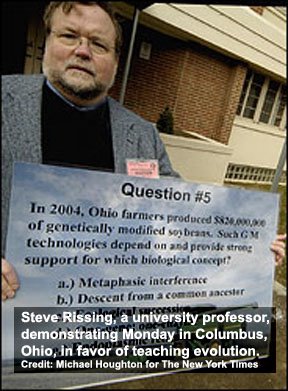
In the four-way race, Sawyer received 54% of the vote to Owens-Fink's 29%, David Kovacs's 12%, and John Jones's 9%, according to the Associated Press. The Beacon-Journal reports that Owens-Fink's campaign spent over $100,000, while Sawyer's spent about $50,000 -- both "unusually large sums for a state school board race." Sawyer also enjoyed the support of the pro-science-education coalition Help Ohio Public Education, organized by Lawrence M. Krauss and Patricia Princehouse at Case Western Reserve University and Steve Rissing at the Ohio State University.

Pro-science candidates prevailed elsewhere in Ohio. In District 4, incumbent G. R. "Sam" Schloemer handily defeated challenger John Hritz, described by the Cleveland Plain Dealer (October 22, 2006) as "a conservative millionaire who wants to include alternatives to Darwinism in science class." In District 2, John Bender narrowly triumphed in a four-way race with 37% of the vote; his closest rival, Kathleen McGarvey, who won 35% of the vote, was described by the Plain Dealer as "sympathetic to teaching alternatives to evolution." And in District 8, Deborah L. Cain defeated incumbent Jim Craig, who was criticized for ambivalence about the "critical analysis" effort.

The result of Ohio's gubernatorial election is also relevant, since eight seats on the state board of education are filled by gubernatorial appointment. Responding to a question from the Columbus Dispatch (July 23, 2006), Democrat Ted Strickland said, "Science ought to be taught in our classrooms. Intelligent design should not be taught as science," while Republican Ken Blackwell said, "I believe in intelligent design, and I believe that it should be taught in schools as an elective," adding, "And I don't see it as having met the generally accepted criteria as a science." Strickland won in the November 7, 2006, election, with 60% of the vote.

COMMENTARY:

About a week ago, I posted a commentary on the election race for the Ohio state board of education, highlighting the opinions and positions of ID supporter and anti-evolutionist, Deborah Owens Fink (see Scientists Endorse Candidate Over Teaching of Evolution. As the foregoing news story indicates, Owens Fink was overwhelmingly defeated yesterday by her pro-science rival, Tom Sawyer, in a closely watched election in a state that has repeatedly been a battleground over the teaching of evolution in the public schools.

In addition to Owens Fink, three other anti-evolution candidates for the Ohio school board were also defeated, in what appears to be a landslide in favor of the teaching of the science of evolution in the public schools (see "Honest Science Wins in Ohio" for the details). Following on the heels of the Kitzmiller v. Dover decision last December and similar court cases nationwide, it looks like ID is in full retreat in states that were once touted by the Discovery Institute as key to the success of ID in the public schools.

Even more interesting in the context of yesterday's elections is the fact that public support for the teaching of evolution (and against ID) cut across party lines in Ohio. The pro-evolution winners in the Ohio school board elections included both Democrats and Republicans, indicating decisively that support for good science (and opposition to pseudoscience) is a non-partisan issue. Even in states in which the voting public is generally conservative, such as Ohio, there is a landslide going on, a landslide in favor of science as it is practiced and taught by working scientists.

The "politics and public relations" tactics of the Discovery Institute have been consistently losing nationwide for almost a year, and public opposition to their deliberate distortions of science and scientific research has been growing exponentially. Even more encouraging to scientists and their supporters is the fact, demonstrated most clearly in Ohio yesterday, that even with massive amounts of money for political advertisements and public relations, the Discovery Institute is losing, and losing overwhelmingly in states once considered their best and brightest hope for ID in the public schools.

So, the future looks bright for real science – as I have said before, it's a wonderful time to be an evolutionary biologist, and an even more wonderful time to teach evolutionary biology!

--Allen

Scientists Endorse Candidate Over Teaching of Evolution


AUTHOR: Cornelia Dean

SOURCE: New York Times

COMMENTARY: Allen MacNeill

In an unusual foray into electoral politics, 75 science professors at Case Western Reserve University in Cleveland have signed a letter endorsing a candidate for the Ohio Board of Education.

The professors’ favored candidate is Tom Sawyer, a former congressman and onetime mayor of Akron. They hope Mr. Sawyer, a Democrat, will oust Deborah Owens Fink, a leading advocate of curriculum standards that encourage students to challenge the theory of evolution.

Elsewhere in Ohio, scientists have also been campaigning for candidates who support the teaching of evolution and have recruited at least one biologist from out of state to help.

Lawrence M. Krauss, a physicist at Case Western Reserve who organized the circulation of the letter, said almost 90 percent of the science faculty on campus this semester had signed it. The signers are anthropologists, biologists, chemists, geologists, physicists and psychologists.

The letter says Dr. Owens Fink has “attempted to cast controversy on biological evolution in favor of an ill-defined notion called Intelligent Design that courts have ruled is religion, not science.”

In an interview, Dr. Krauss said, “This is not some group of fringe scientists or however they are being portrayed by the creationist community,” adding, “This is the entire scientific community, and I don’t know of any other precedent for almost the entire faculty at an institution” making such a statement.

But Dr. Owens Fink, a professor of marketing at the University of Akron, said the curriculum standards she supported did not advocate teaching intelligent design, an ideological cousin of creationism. Rather, she said, they urge students to subject evolution to critical analysis, something she said scientists should endorse. She said the idea that there was a scientific consensus on evolution was “laughable.”

Although researchers may argue about its details, the theory of evolution is the foundation for modern biology, and there is no credible scientific challenge to it as an explanation for the diversity and complexity of life on earth. In recent years, with creationist challenges to the teaching of evolution erupting in school districts around the country, groups like the National Academy of Sciences, perhaps the nation’s pre-eminent scientific organization, have repeatedly made this point.

But the academy’s opinion does not matter to Dr. Owens Fink, who said the letter was probably right to say she had dismissed it as “a group of so-called scientists.”

“I may have said that, yeah,” she said.

She would not describe her views of Darwin and his theory, saying, “This isn’t about my beliefs.”

School board elections in Ohio are nonpartisan, but Dr. Owens Fink said she was a registered Republican. Her opponent, Mr. Sawyer, was urged to run for the Seventh District Board of Education seat by a new organization, Help Ohio Public Education, founded by Dr. Krauss and his colleague Patricia Princehouse, a biologist and historian of science, and Steve Rissing, a biologist at Ohio State University.

At the group’s invitation, Kenneth R. Miller, a biologist at Brown University, will be in Ohio today through the weekend campaigning for other school board candidates who support the teaching of evolution. Dr. Miller, an author of a widely used biology textbook, was a crucial witness in the recent lawsuit in Dover, Pa., over intelligent design. The judge in that case ruled that it was a religious doctrine that had no place in a public school curriculum.

After that decision, Dr. Owens Fink said, the Ohio board abandoned curriculum standards that mandated a critical look at evolution, a decision she said she regretted. “Some people would rather just fold,” she said.

But Dr. Miller said it was a good call, adding, “We have to make sure these good choices get ratified at the ballot box.”

COMMENTARY:

Once again Ohio is the battleground in the ongoing culture wars. A similar change in the composition of a state board of education happened in Kansas earlier this year. It will be interesting to see what happens in Ohio, especially in the context of what many are beginning to perceive as a "glacial shift" in Ohio politics, away from religious conservatism and the Republican party and toward a more tolerant and pluralistic libertarianism, as exemplified by Tom Sawyer (even his name resonates in American cultural history). Whether the Democrats can finally become vertebrates and take a principled position on this and related issues remains to be seen...

--Allen

Ohio School Board Votes Down Lesson Plan Criticizing Evolution


AUTHOR: Allen MacNeill

SOURCE: Associated Press

COMMENTARY: Allen MacNeill...and you!

It's been a tough couple of months for the promoters and supporters of "intelligent design (ID)." Last December, ID supporters in Dover, Pennsylvania were handed a resounding defeat when Judge John E. Jones ( a conservative Republican Bush appointee) handed down a legal decision blocking the reading of statements supporting ID in Dover high school biology classes.

Next, a school in El Tejon, California that had allowed a course in "creation science" to be taught in a philosophy class decided to end the course prematurely and to agree not to offer it again, as part of an out-of-court settlement to a lawsuit brought by Americans United for Separation of Church and State.

Now late this afternoon, the Ohio state school board voted 11 to 4 to eliminate eliminate a lesson plan and science standards that supporters of evolutionary theory said opened the door to teaching intelligent design. Specifically, the board voted to delete material in the lesson plan that encouraged students to seek evidence for and against certain aspects of evolutionary biology.

This vote reversed a close 9-8 decision in January to keep the lesson plan. Three of the board members who voted to keep the lesson plan in January were absent from today's deliberations, and have vowed to reinstate the material critical of evolution at an upcoming meeting. However, given the margin of victory today, it is unlikely that they will succeed. The Panda's Thumb has a compendium of information and links spanning this entire controversy.

As I mentioned in an earlier post, the governor of Ohio has recently criticized the lesson plan, saying that he should have exercised more control over the appointment of ID supporters to the state school board, with the clear implication that in the future he would do what he could to prevent ID supporters from influencing state educational policy.

Ohio Citizens for Science has issued a press release applauding the decision, while at the same time calling on supporters of evolution to continue to oppose efforts to insert ID theory into state lesson plans.

You might think that with all of these defeats, the ID movement would re-think its strategy. However, this seems unlikely as all of the recent legal maneuvering has come as the result of the ID movement having already changed their strategy. In 1998, the Discovery Institute, home and principle sponsor of the ID movement, promulgated what has now become known as the "wedge document," in which they laid out a five-year strategy to "defeat scientific materialism" and "replace materialistic explanations with the theistic understanding that nature and human beings are created by God." In it, they stated clearly that their first priority was research, writing and publication: that is, to develop a program of basic science in which ID theory would be tested and presented to the scientific community in such a way as to convince a critical mass of scientists that the theory had merit. As the author(s) of the wedge document stated, "Without solid scholarship, research and argument, the project would be just another attempt to indoctrinate instead of persuade."

Only once ID theory had been established in the scientific community would its supporters attempt to influence educational and public policy:


"Once our research and writing have had time to mature, and the public prepared for the reception of design theory, we will move toward direct confrontation with the advocates of materialist science through challenge conferences in significant academic settings. We will also pursue possible legal assistance in response to resistance to the integration of design theory into public school science curricula. The attention, publicity, and influence of design theory should draw scientific materialists into open debate with design theorists, and we will be ready. With an added emphasis to the social sciences and humanities, we will begin to address the specific social consequences of materialism and the Darwinist theory that supports it in the sciences."


The history of the intervening eight years shows just the opposite: only four articles relating to ID theory have been published in peer-reviewed scientific journals. None of these four articles contains the results of actual empirical (i.e. field or laboratory) tests of predictions formulated using ID theory. A grand total of only 34 articles and books (i.e. approximately four per year) have been produced during that entire time, as compared with thousands of articles and books in the mainstream scientific community on the various aspects of evolutionary theory.

Instead, the ID movement, and especially the Discovery Institute, has moved directly into the public arena, spending nearly all of their energy and financial resources on interventions in school board decisions, political elections, and press releases. Clearly, having lost the battle in the scientific community, they are attempting to appeal directly to the general public, hoping that slick publicity will succeed where scientific research (or rather, the lack thereof) has failed.

If I were a scientist who supported ID theory, or even a scientist who supported the idea of free and unfettered research, I would view the people at the Discovery Institute and their supporters in the various governments and school boards as traitors. The fact that Michael Behe and William Dembski don't see them that way says a lot about their confusion about the difference between science and politics.

--Allen

Ohio Expected To Rein In Class Linked To Intelligent Design


AUTHOR: Jodi Rudoren

SOURCE: New York Times

COMMENTARY: Allen MacNeill

The legal precedent set by Judge John E. Jones' decision in the Dover case, in which "intelligent design theory" was found to be a religious theory masquerading as science, has now reached to the state of Ohio. Here's today's story in the New York Times (commentary follows):

COLUMBUS, Ohio, Feb. 13 — A majority of members on the Board of Education of Ohio, the first state to single out evolution for "critical analysis" in science classes more than three years ago, are expected on Tuesday to challenge a model biology lesson plan they consider an excuse to teach the tenets of the disputed theory of intelligent design.

A reversal in Ohio would be the most significant in a series of developments signaling a sea change across the country against intelligent design — which posits that life is too complex to be explained by evolution alone — since a federal judge's ruling in December that teaching the theory in the public schools of Dover, Pa., was unconstitutional.

A small rural school district in California last month quickly scuttled plans for a philosophy elective on intelligent design after being challenged by lawyers involved in the Pennsylvania case. Also last month, an Indiana lawmaker who said in November that he would introduce legislation to mandate teaching of intelligent design instead offered a watered-down bill requiring only "accuracy in textbooks." And just last week, two Democrats in Wisconsin proposed a ban on schools' teaching intelligent design as science, the first such proposal in the country.

Here in Ohio, pressure has been mounting on board members in recent weeks to toss out the lesson plan and the standards underpinning it. Gov. Bob Taft, a Republican, called this month for a legal review of the plan, while newly revealed documents of Ohio's Department of Education linking it to treatises of the intelligent design movement have renewed threats of a lawsuit by opponents of the movement.

At the same time, a national group of evolution defenders has bombarded 5 of the 19 board members considered crucial to a vote against the lesson plan with 30,000 e-mail messages over the past week, and just Monday, the president of the National Academy of Sciences urged the board to change the lesson and the underlying curriculum guidelines to "conform to established scientific standards."

"All of that adds up to a sense of urgency and a sense of now is the time to clean up our act," said Robin C. Hovis, a stockbroker from Millersburg who is one of two board members pushing an emergency motion on Tuesday to delete the "critical analysis" language and the lesson plan. "There is an atmosphere among the board, at least a growing atmosphere, that this is a misguided policy and we better get rid of it."

Though the lesson plan is optional and never uses the words "intelligent design," its explanation of concepts like homology, the fossil record and endosymbiosis parallel those in the texts "Icons of Evolution" and "Of Pandas and People," written by proponents of intelligent design.

The Discovery Institute, in Seattle, the intellectual home of the design movement, had distanced itself from the Dover case but has long heralded Ohio's "critical analysis" approach as a model for the nation, and is ardently defending the lesson plan.

On Monday, the institute released a Zogby International poll it had commissioned showing that 69 percent of Ohio voters believed that scientific evidence against evolution should be included in curriculums, and 76 percent agreed that "students should also be able to learn about scientific evidence that points to an intelligent design of life." The institute has also proffered letters from two science professors supporting Ohio's standards and model lesson plan.

John G. West, associate director of the Center for Science and Culture at the institute, said: "This just shows the extremism of the other side. They think Dover is their wedge to try to stop any even voluntary critical analysis of Darwin's theory in the classroom. They obviously don't think they can win in the court of public opinion on the issue, and that's why they're using scare tactics."

Local supporters of the standards echoed Mr. West's confidence that, unlike the Dover curriculum, the one in Ohio could pass constitutional muster. The Pennsylvania ruling is not binding elsewhere.

"If I had the money, I'd pay for the lawsuit," said David Zanotti, president of the conservative American Policy Roundtable in Strongsville, Ohio. "They should sue or shut up."

Debate over evolution here dates to 2000, when the board began developing statewide academic standards, which do not dictate curriculum to the 613 local districts but provide a blueprint for standardized tests.

A proposal to teach intelligent design alongside evolution was rejected. Instead, the board in December 2002 unanimously adopted standards requiring that 10th graders be able to "describe how scientists continue to investigate and critically analyze aspects of evolutionary theory," with a parenthetical note that "this benchmark does not mandate the teaching or testing of intelligent design."

Since then, New Mexico, Minnesota and Kansas have adopted similar standards, and Pennsylvania lists evolution among half a dozen theories to be critically analyzed. But only Ohio has a model lesson plan, adopted by a divided board in 2004, that provides teachers a practical how-to guide. It is unclear how frequently it is used.

Besides the Dover decision, the disclosure in December of documents detailing internal discussions of the lesson plan helped revive debate here. Obtained by Americans United for the Separation of Church and State, a group considering a suit on the plan, the documents show that department scientists and outside experts condemned the lesson as "a lie," "crackpot," "religious," "creationism" and "an insult to science."

Asked whether the lesson connects skills to the real world, an external reviewer wrote: "Not the real scientific world. The real religious world, yes, the real world based on faith, yes, the real world of fringe thinking, yes!"

Patricia Princehouse, an evolutionary biologist and historian of science who has led the charge against the lesson plan, said, "Basically critical analysis is intelligent design relabeled, just as intelligent design was creationism relabeled."

Governor Taft entered the fray in early February, telling newspaper reporters and editors that the board should ask the attorney general to review the lesson; that intelligent design should not be taught or tested; and that he should have questioned candidates more vigorously on the issue before filling the eight board seats he controls.

Tuesday's expected showdown comes a month after the board voted 9 to 8 against an emergency motion to delete the lesson plan. Martha W. Wise, a board member who sponsored that motion, said that this time she would propose removing both the lesson plan and the critical analysis benchmark, while also restoring a fuller definition of science to note that its theories "while not 'believed in' through faith may be accepted or rejected on the basis of evidence."

Ms. Wise said she was unsure whether she had secured 10 votes for the emergency motion, but expressed confidence that a majority would at least call for a reconsideration of the lesson plan by the board's lawyers and a committee.

But Deborah Owens Fink, the board member who originally supported the dual study of evolution and design and has been the leading defender of the standards, said, "The lesson has been in use for two years, and certainly a hole hasn't been cut in the ozone or anything."

**********************************************************************************
COMMENTARY:

It's clear to me that the governor of Ohio is concerned that his state is going to gain a reputation as "anti-science" unless their "teach the controversy" policy is rescinded. With the National Academy of Sciences weighing in on the issue, any politician not already deeply committed to the Discovery Institute's position will be scrambling to rescind it as well...unless they're up for election, in which case they will probably be paying more attention to the Zogby poll results. Which means, of course, that the outcome will be almost purely political (i.e. it will have little or nothing to do with science).

The irony of all of this is that evolutionary biologists are having to make statements about how solid their own science is, when anybody in the field (indeed, anybody in any scientific field) knows that controversy is the name of the game. To me, that's the real danger in all of this. Not that scientists will be hoodwinked in any way by the IDers, nor that there will be any lasting harm done to public school students – after all, when I went to elementary school, we were all forced to recite a daily prayer first thing in the morning. No, the real danger is that, in attempting to show a "unified front," scientists will be tempted to suppress their own disagreements with current orthodoxy. Any inhibition on the free expression of doubts and disagreements in the scientific community would be harmful to science, in a way that "intelligent design theory" generally is not.

--Allen

**********************************************************************************
ORIGINAL PUBLICATION REFERENCE:

Location Online:
New York Times
URL: http://www.nytimes.com/2006/02/14/education/14evolution.html?adxnnl=1&adxnnlx=1139924263-e0hsLirTBn8dUuKRAs3wPw

Original posting/publication date timestamp:
Published: February 14, 2006

**********************************************************************************