


"The skills prehistoric peoples depended on seem exotic to today’s college students, who Schindler says arrive on campus each year with less and less of the sort of practical experience that he emphasizes in his class. He tells of the time he asked some students to crack eggs and separate the yolks from the whites. He returned to the kitchen 10 minutes later to find that not a single egg had been cracked. “I asked them if the problem was that nobody had ever told them how to separate the yolk from the whites, and received blank stares in return,” he recalled. “After a minute of silence, one of them said, ‘ I’ve never cracked an egg.’ I was floored—how do you even make it to 19 without cracking an egg?”
Showing posts with label education. Show all posts
Showing posts with label education. Show all posts
How is this possible?

"Includes hot lunch"
From the "Tuition and Financial Aid" page for Sidwell Friends school in Washington, D.C.:
Per year...
Addendum: After I originally posted this (brief) item, several readers have commented with queries about why this matter caught my eye, so I thought I'd elaborate a little more with an addendum. The topic came up because of a news story about the young Trump's school tuition (the data I pulled for the above was for the school that Obama's children attended). And the "includes hot lunch" clarification struck me as a curious item to specify - sort of like "buy this Maserati and get a free tank of gas."
But the general topic of the enormous cost of private education has been on my mind intermittently for quite a while. Several years ago I helped several classmates as we planned our 50th high school reunion (yes, I'm that old...). Fiftieth reunions are memoryfests for returning students, but for the schools they are major foci for fundraising. As we prepared our reunion program, I was gobsmacked to see the current tuition, and I took the opportunity to pull some historic data from the school, then graphed it against the Consumer Price Index. The results were startling:

I attended this school in the suburbs of Minneapolis in the 1960s, when the tuition was a bit under $1,000 per year, which was a stress for my parents, but one they considered appropriate and necessary. When I prepared the graph, the most recent data were from 2012: $22,850 for sixth form (senior year) - a 24-fold increase from my tuition. A quick Google today shows the 2016 data (one more box to the right) to be $25K for kindergarten and $30,000 for senior year [and I note with some bemusement that the webpage specifies "includes lunch" !!]
The school is of course way different nowadays from the school I knew. In those days it was a "college preparatory (day)school," with a focus on rigorous academic training. I think my class of 54 students had probably 12-15 National Merit finalists, and 800 scores on college boards were not unusual. But the only student of color was the foreign exchange student, and there were no girls.
Now it's different - the student body reflects "Diversity of race, ethnicity, national origin, geography, religion, gender, affectional or sexual orientation, age, physical ability, and marital, parental or economic status..." The mission: "Students are expected to participate in an integrated program of academic, artistic and athletic activities in preparation for college, lifelong learning, community service and lives as responsible world citizens."
The current crop of students are preparing to enter a world different from the one I grew up in in the 1970s., so I don't expect their curriculum to include three years of Latin. But what still strikes me is that tuition graph. Financial assistance is offered in order to attract the proper mix of students.
But I can't understand why the graph departs so exponentially from the consumer price index.
Middle and Upper Schools $40,840 (includes hot lunch)
Per year...
Addendum: After I originally posted this (brief) item, several readers have commented with queries about why this matter caught my eye, so I thought I'd elaborate a little more with an addendum. The topic came up because of a news story about the young Trump's school tuition (the data I pulled for the above was for the school that Obama's children attended). And the "includes hot lunch" clarification struck me as a curious item to specify - sort of like "buy this Maserati and get a free tank of gas."
But the general topic of the enormous cost of private education has been on my mind intermittently for quite a while. Several years ago I helped several classmates as we planned our 50th high school reunion (yes, I'm that old...). Fiftieth reunions are memoryfests for returning students, but for the schools they are major foci for fundraising. As we prepared our reunion program, I was gobsmacked to see the current tuition, and I took the opportunity to pull some historic data from the school, then graphed it against the Consumer Price Index. The results were startling:

I attended this school in the suburbs of Minneapolis in the 1960s, when the tuition was a bit under $1,000 per year, which was a stress for my parents, but one they considered appropriate and necessary. When I prepared the graph, the most recent data were from 2012: $22,850 for sixth form (senior year) - a 24-fold increase from my tuition. A quick Google today shows the 2016 data (one more box to the right) to be $25K for kindergarten and $30,000 for senior year [and I note with some bemusement that the webpage specifies "includes lunch" !!]
The school is of course way different nowadays from the school I knew. In those days it was a "college preparatory (day)school," with a focus on rigorous academic training. I think my class of 54 students had probably 12-15 National Merit finalists, and 800 scores on college boards were not unusual. But the only student of color was the foreign exchange student, and there were no girls.
Now it's different - the student body reflects "Diversity of race, ethnicity, national origin, geography, religion, gender, affectional or sexual orientation, age, physical ability, and marital, parental or economic status..." The mission: "Students are expected to participate in an integrated program of academic, artistic and athletic activities in preparation for college, lifelong learning, community service and lives as responsible world citizens."
The current crop of students are preparing to enter a world different from the one I grew up in in the 1970s., so I don't expect their curriculum to include three years of Latin. But what still strikes me is that tuition graph. Financial assistance is offered in order to attract the proper mix of students.
But I can't understand why the graph departs so exponentially from the consumer price index.
Field trip, 1947

Post-War Field Trips
Minneapolis school children from Hay and Willard Elementary schools, as well as a South St. Paul group, wait at the Great Northern railroad station to board a train for St. Paul. Schools around the city have started taking field trips again after ceasing during war-time. As many as 450 children a day are touring farms, trains, zoos, industries, and historic sites.-- Minneapolis Morning Tribune, April 25, 1947
From the Stuff About Minneapolis tumblr.
I have fond memories of field trips from my childhood, when a day spent touring a factory was deemed as important to education as a day in a classroom. I think it's important for young children to see - in person, not on film - a working assembly line, an animal barn, a railroad train etc etc etc.
I don't know to what extent such trips are undertaken nowadays (readers...?). I would concede that it must be a headache for a businessperson to host dozens of unrestrained fourth-graders, but I think if such ventures are not taken, a learning experience is omitted.
Why not make college education free - with a payback?
Many decades ago I received "student loans," which, combined with small jobs, allowed me to pay my way through college and graduate school. I remember thinking at the time that it would have made more (financial) sense to both schools to allow me to go through for free in return for promising to give them perhaps 1% of all my future income. I would gladly have signed on the dotted line, videotaped an acknowledgement of my promise, and then would have foregone the library job, the summer job etc. If they were right that college and postgraduate work would eventually pay off well for me, then it should logically also pay off well for them (and it would have). But that wasn't an option at the time, and I had not heard of the concept ever being implemented by any universities or colleges.
Surprisingly, this past week I saw my concept put forth in a Slate editorial by Eliot Spitzer. He calls them "income-contingent" loans and says they have been "successful and commonplace in Europe and Australia." The concept has been advocated by Milton Friedman and James Tobin - "two Nobel laureates of decidedly differing worldviews."
I don't understand why this concept hasn't been advocated more forcefully or implemented by American universities.
Teecher excepted this lettar

With the note, Rosabella was able to take a bus home, rather than participating in an after-school program. But the girl couldn't get into her house. She spent part of the afternoon outside, until asking a neighbour to let her use the bathroom.
The neighbour kept Rosabella until her father was located."
Are university degrees "becoming irrelevant" ?
Some companies apparently think so:
This week, international publishing house Penguin Random House decided to drop degrees as a requirement for job applicants, following in the footsteps of major consulting firms Ernst and Young and PricewaterhouseCoopers.
The move comes as smaller employers are shifting away from hiring graduates or university students, believing kids are coming out of university with “no real skills” or simply being taught the wrong things.
Penguin hasn’t been so harsh, saying the shift in requirements is simply a move “to make publishing far, far more inclusive than it has been to date”.
“While graduates remain welcome to apply for jobs, not having been through higher education will no longer preclude anyone from joining,” a statement from the publisher confirmed.
“Simply if you’re talented and you have potential, we want to hear from you.”
Science for the people

One of my students in the online genetics class I’m teaching commented to me that it was a little sad that we were marketing the class as “not too difficult.” Science is only as hard as you make it, she said. It shouldn’t be something scary.
It shouldn’t be, but for a lot of people it is. As a freshman in college I figured I should take college level biology as an elective so that I had a solid groundwork in how life works. (I was a medieval studies major.) But talking to my pre-med friends convinced me otherwise. Science classes were for people who were all in: they were only for scientists, not dabblers. They were hard work. Lots of hard work.
When I decided to go back to school to become a veterinarian, I took that introductory biology course, and a lot of other science courses. I learned a lot of information I’d never use again (and have since forgotten), particularly in chemistry and physics. I wasn’t eligible to learn the things I wanted to learn until I’d jumped through these hoops.
I hope that these days, with online classes, the tide is starting to turn. I don’t think people should have to take a year of basic biology in order to learn a little about genetics. I don’t think people should have to learn about photosynthesis and the difference between monocots and dicots (those are groups of plants, by the way) in order to learn neurobiology. It is perfectly possible to design science courses for people who are not pre-med or pre-vet undergraduates. But sometimes, when I’m telling people about this great new genetics course I'm teaching and they look slightly alarmed, I'm saddened by the history of how we've traditionally taught science courses.
More than thirty people signed up for the genetics course. I hope I’ve designed something that’s worth their while.
Learn Science free online!
There’s lots of science out there to read about on the internet these days (so go get reading)! For people who came to science after their formal schooling is over, it can be hard to know how to get the basics to understand all this stuff. And I do think it’s important to understand the basics — a solid knowledge of biology is invaluable when you’re trying to figure out if the findings that a starry-eyed science journalist is reporting are as important as they sound, and whether the journalist’s coverage of them is critical enough. (Uncritical science reporting? Oh yeah. There is way too much of it in the world.)
So how do you go about learning Science? Here are some upcoming free online courses that I recommend to you. By the way, if you are a certified trainer or behavior consultant, I recommend you ask your CEU distributor of choice to give you CEUs for taking these classes. They are absolutely relevant.
Starts: June 1
This course is about the behavior of wild animals and about the academic study of animal behavior. It’s a different perspective than the applied behavior approach that most trainers are familiar with. According to the course web page, it covers the following topics:
Starts: June 10
Cells: the things that send information around the brain; the things that make and secrete hormones; the things that are responsible for every part of our life. Whenever I teach about neurobiology or hormones to trainers, I wish I could depend on them having a solid cell biology background!
Just as above, EdX courses are free but you must pay $50 if you want a verified certificate.
Starts: June 15; self-paced
I loved taking basic psychology. I’m sure this course will be quite human-focused, but some of the concepts are applicable to other mammals as well. Others are perhaps applicable to working with the human side of the equation. This course reports to cover:
If you think you might take one of these, I would love to hear about it in the comments!
So how do you go about learning Science? Here are some upcoming free online courses that I recommend to you. By the way, if you are a certified trainer or behavior consultant, I recommend you ask your CEU distributor of choice to give you CEUs for taking these classes. They are absolutely relevant.
Animal Behaviour, University of Melbourne (Coursera)
https://www.coursera.org/course/animalbehavStarts: June 1
This course is about the behavior of wild animals and about the academic study of animal behavior. It’s a different perspective than the applied behavior approach that most trainers are familiar with. According to the course web page, it covers the following topics:
- Behaviour, Ecology and Natural Selection
- Genes, Environment and Learning
- Finding food and avoiding predators
- Communication
- Sexual selection and sperm competition
- Mating systems and sex allocation
- Parental care and conflict
- Social behaviour
Essential Human Biology: Cells and Tissues (EdX)
https://www.edx.org/course/essential-human-biology-cells-tissues-adelaidex-humbio101x-0Starts: June 10
Cells: the things that send information around the brain; the things that make and secrete hormones; the things that are responsible for every part of our life. Whenever I teach about neurobiology or hormones to trainers, I wish I could depend on them having a solid cell biology background!
Just as above, EdX courses are free but you must pay $50 if you want a verified certificate.
Introduction to Psychology, St. Margaret’s Episcopal School (EdX)
https://www.edx.org/course/introduction-psychology-st-margarets-episcopal-school-psych101x-0Starts: June 15; self-paced
I loved taking basic psychology. I’m sure this course will be quite human-focused, but some of the concepts are applicable to other mammals as well. Others are perhaps applicable to working with the human side of the equation. This course reports to cover:
- An understanding of what psychology is and its history
- How brain structures function and how neurotransmitters influence behavior
- Concepts of how we learn as well as components of emotion
- How a child's mind and personality develops
- Discover classifications of abnormal behaviors
If you think you might take one of these, I would love to hear about it in the comments!
Arguments for abolishing military academies
An op-ed piece in Salon argues that West Point and other service academies "serve no one, [and] squander millions of tax dollars."
Training is something the military does—education, certainly, is not. Indeed, undergraduate education of officers has already largely been outsourced, since most new officers come from the much cheaper Reserve Officer Training Corps programs at civilian universities (at one-quarter the cost of the academies), or from the several months of Officer Training Corps (one-eighth the cost) that follows either an enlisted career, or college. By all standards, these officers are just as good as those who come from the service academies, which now produce under 20 percent of U.S. officers...More at the link. The author of the piece, Bruce Fleming, has been a professor in the English Department of the U.S. Naval Academy since 1987.
Having their children admitted is a government-sponsored guarantee of a golden ticket to life: college at taxpayer expense with no student debts, the highest salary of any set of graduates, and guaranteed employment and (no-Obamacare-necessary) health benefits for at least five years, frequently well beyond. And no, most people in the military aren’t remotely likely to be shot at...
So it’s not coincidence that service academy officers have a negative reputation in the military as smug ring-knockers. They didn’t have to work their way through college.. And they’re hardly, on average, the “best and the brightest.” In fact more than a quarter of the class has SAT scores below 600, and our average is lower than the nearby state school University of Maryland. Twenty percent of our class comes through a taxpayer-supported remedial 13th grade (another almost $50,000 per student for taxpayers). They fill our remedial courses (I am teaching some of these this semester, as a full professor)—a second try at getting them up to college level... when I was on the admissions board for a year a decade ago we considered nothing close to the 20,000 applicants they claim. It was actually fewer than 5,000 candidates for 1,800 admits...
“Leaders to serve the Nation,” say the flags on posts at Annapolis. Nobody defines what a leader is, or asks whether somebody like a Silicon Valley innovator might not be serving her nation as much as, if not more than, a desk jockey officer in a fruitless military endeavor in Iraq. Or a first-grade teacher. Or a doctor, or a violinist, or a scientist: we graduate almost none of these. Leaders? Really? Officers, sure, because we have the congressional power to make our graduates officers. That’s a bit circular...
Still, it’s all paid for by somebody else and the head office assures your parents you’re doing fine. People fawn over you in your spiffy uniform in airports, and thank you “for your service.” Liberals are scared to object for fear of seeming anti-military. And you’re the Ken dolls of the conservatives.
Nice work if you, or your kids, can get it.
One reason you should think hard before getting an education instead of a skill
1. Education doesn't get you a job
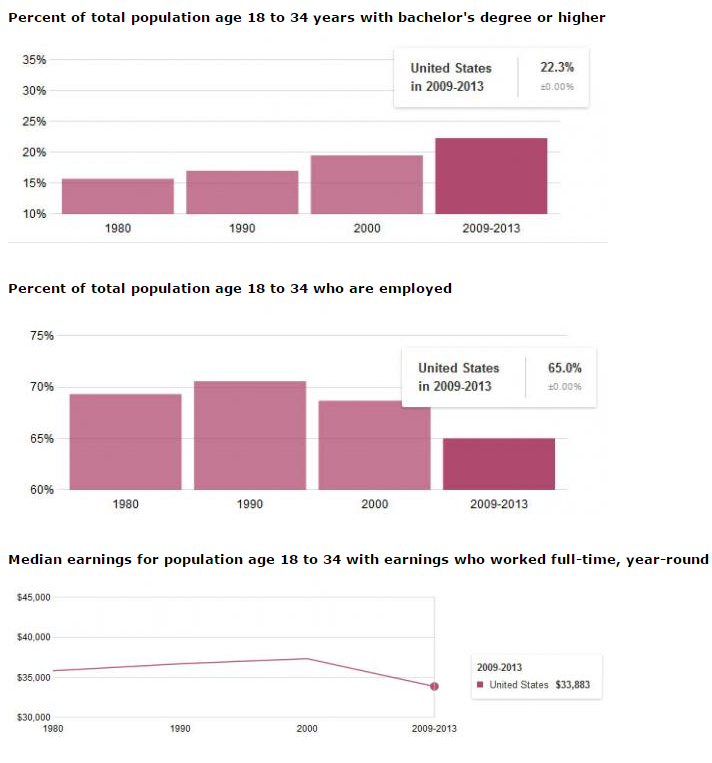
source: zerohedge
I keep saying my generation was the last one where getting an education was obviously the right way to go - and I was cutting it close.
The ramifications of breaking the Berlin wall, and the new wave of globalization and digitalization that followed, mean that skills are much more important than a formal education and the paper that proves it.
At worst, an education cuts you off from the real world for several years, as well as puts you in debt. At best, you get some new friends that may or may not help you earn a wage or pull a business in the future.
What you should do instead is:
1. Take a look at the world and identify something that needs to be done and that you think enough people would pay to get done
2. Match that to your own semi-interests and half-honed skills or aptness and choose a couple of areas where you could: a) get good and b) enjoy yourself at least moderately, and maybe even c) feel proud (my choice would be something in programming or marketing)
3. Develop the skill-set(s) in point 2, using the internet, e.g. this 144-item resource list
How to do well on standardized school tests
An article at The Atlantic opines that knowledge per se is not the key factor:
This is a story about what happened when I tried to use big data to help repair my local public schools. I failed. And the reasons why I failed have everything to do with why the American system of standardized testing will never succeed. A few years ago, I started having trouble helping my son with his first-grade homework. I’m a data-journalism professor at Temple University, and when my son asked me for help on a worksheet one day, I ran into an epistemological dilemma. My own general knowledge (and the Internet) told me there were many possible “correct” answers. However, only one of these answers would get him full credit on the assignment...More at the link.
In essence, I tried to game the third-grade Pennsylvania System of School Assessment (PSSA), the standardized test for my state. Along with a team of professional developers, I designed artificial-intelligence software to crunch the available data. I talked to teachers. I talked to students. I visited schools and sat through School Reform Commission meetings. After six months of this, I discovered that the test can be gamed. Not by using a beat-the-test strategy, but by a shockingly low-tech strategy: reading the textbook that contains the answers...
This is because standardized tests are not based on general knowledge. As I learned in the course of my investigation, they are based on specific knowledge contained in specific sets of books: the textbooks created by the test makers.
Is there "no such thing as a stupid question" ?

A quick search confirms that that comment actually was made on television (by CNN anchor Deb Feyerick):
“We want to bring in our science guy, Bill Nye, and talk about something else that’s falling from the sky, and that is an asteroid,” the anchor said. “What’s coming our way? Is this the effect of, perhaps, global warming? Or is this just some meteoric occasion?”Sigh...
What does it mean to flatten your classroom?
What does it mean to flatten your classroom?
You remove the walls. You connect students to others around the world.
Connecting your classroom globally isn't as hard as you might think but is more important than you can imagine.
Connecting your classroom globally isn't as hard as you might think but is more important than you can imagine.
This is a short 7 minute segment that I recorded on the Ignite Show, a show about education taped in Atlanta by my friend +Anne Ostholthoff , where I was also a guest with Georgia Governor Nathan Deal. I highly recommend following the show on YouTube, where I hope you're building a PLN of good shows and channels by real people.
It isn't about what you're keeping out but about what you're bringing into your classroom. What are you bringing in?
The Ignite Show - Flattened Classroom Segment (by Anne Ostholthoff)

For a real intellectual challenge...

... consider trying to answer the questions in the King Williams College General Knowledge Quiz. I posted an explanation of the quiz in December of 2010:
For over a century, students at King William's College on the Isle of Man have been given a quiz (formally the "General Knowledge Paper") just before the Christmas holidays:Here are sample questions and answers from the December 2011 quiz.Up until 1999, pupils at King William's College would sit the paper unseen on the last day of term before the Christmas holidays. The questions are very hard and often cryptic, and pupils got hardly any questions right first time: five percent was considered a good score! During the Christmas holidays, pupils tried to find the answers to the harder questions by consulting reference books or asking clever relatives. When they returned to school in the New Year, they took the test again, under exam conditions and without the aid of notes.The quiz is now voluntary for the students, but has spread worldwide via publication in The Guardian. It is, as noted above, inhumanly difficult, requiring impossible amounts of knowledge of trivia and/or extraordinary computer search skills -A Latin phrase is always printed at the top of the quiz: “Scire ubi aliquid invenire possisea demum maxima pars eruditionis est”. Freely translated, this means "the greatest part of knowledge is knowing where to find something."The best way to approach the quiz is as part of a group, many of which will form on the internet in the weeks ahead.
And some more here.
The quiz is published each year in this column in The Guardian, but it is not available online yet. It is, however, available in the newspaper's hard copy, and some enterprising groups have already started working on the questions.
If you would like to join in with a group working on the quiz, I would suggest going to the Quite Interesting Talk Forum (you will need to create an identity and a password in order to log in to the forum). Among their many interesting groups is one entitled "Sooper Seekrit Stuff. A forum for discussing things we don't want Google to know about." That's the one you want.
Now an important point regarding internet courtesy. When people work on puzzles like this and need to search the internet for the name of Charlemagne's sister or the height of Hadrian's Wall, they don't want to accidentally stumble across a set of answers to the questions. So, unlike previous years, I will not be posting any questions from the Quiz here, and I'll request that nobody post the questions or any answers here, where they could be retrieved by Google; if you do, I'll delete them immediately. (At the QI Talk Forums, the questions and answers are behind a password sign-in, which makes them opaque to Google search engines).
After the quiz is published online a few days from now, the internet will light up with the questions and answers in public forums such as Metafilter, and much of the fun of truly searching for the answers will be lost.
I signed in at the QI Sooper Secret forum last night and answered some of the easier questions, but there are lots more that nobody has deciphered yet. Some readers here might be very good at this. Have at it, if you like.
Addendum Jan 24, 2013: Here are the answers.
Photo: stained glass window from KWC on the Isle of Man, credit Don McPhee, via The Guardian.
"Common Core" state education standards creating turmoil
I've already seen several articles this week on a new set of curriculum standards. These excerpts from a column at Salon:
The Common Core State Standards, which will be implemented by more than 40 states by 2014, require that 50 percent of elementary school reading be nonfiction, climbing to 70 percent by 12th grade. Supporters, the Post says, believe American students have suffered from “a diet of easy reading and lack the ability to digest complex nonfiction, including studies, reports and primary documents,” leaving them unprepared for higher education and the working world.Salon cites an article in The Washington Post, which notes that -
Schools face problems ranging from overcrowded classrooms to crumbling buildings to malnourished students. But the idea of rigorous common standards in general, if not these specific guidelines, has support from powerful interests including the Department of Education, the U.S. Army and numerous reformists. Some of the suggested ideas would be a notable change from what almost all Americans remember of high school.
Among the suggested nonfiction pieces for high school juniors and seniors are Alexis de Tocqueville’s “Democracy in America,” “FedViews,” by the Federal Reserve Bank of San Francisco (2009) and “Executive Order 13423: Strengthening Federal Environmental, Energy, and Transportation Management,” published by the General Services Administration.I can see where this will create some major arguments in faculty meetings. I was an English major in college, so I'm sorry to hear about these changes, though I do understand the impetus driving the reform. My high school had a rigorous reading program, but if I were to go back to it and remove some assigned reading, I know what my first choice would be - The Forsythe Saga. I can't believe I slogged my way through that...
English teachers across the country are trying to figure out which poetry, short stories and novels might have to be sacrificed to make room for nonfiction... Jamie Highfill is mourning the six weeks’ worth of poetry she removed from her eighth-grade English class at Woodland Junior High School in Fayetteville, Ark. She also dropped some short stories and a favorite unit on the legends of King Arthur to make room for essays by Malcolm Gladwell and a chapter from “The Tipping Point,” Gladwell’s book about social behavior...
Yes, the standards do require increasing amounts of nonfiction from kindergarten through grade 12, Coleman said. But that refers to reading across all subjects, not just in English class, he said. Teachers in social studies, science and math should require more reading, which would allow English teachers to continue to assign literature, he said...
In practice, the burden of teaching the nonfiction texts is falling to English teachers, said Mark Bauerlein, an English professor at Emory University: “You have chemistry teachers, history teachers saying, ‘We’re not going to teach reading and writing, we have to teach our subject matter. That’s what you English teachers do.’ ”
Sheridan Blau, a professor at Teachers College at Columbia University, said teachers across the country have told him their principals are insisting that English teachers make 70 percent of their readings nonfiction. “The effect of the new standards is to drive literature out of the English classroom,” he said.
Guardians of the public morals
Kaitlin Nootbaar graduated from Prague High School, the Red Devils, in May and was named valedictorian. When tasked with writing the graduation speech, her dad said she got her inspiration from the movie “Eclipse: The Twilight Saga.”This was a valedictory speech, given by a girl who had straight As and 4.0s all the way through school. She is supposed to start college in a few days on a full scholarship. The school is withholding her diploma until she issues a public apology for using the word "hell" in public.
“Her quote was, ‘When she first started school she wanted to be a nurse, then a veterinarian and now that she was getting closer to graduation, people would ask her, what do you want to do and she said how the hell do I know? I’ve changed my mind so many times.’”
He said in the written script she gave to the school she wrote “heck,” but in the moment she said “hell” instead.
Nootbaar said the audience laughed, she finished her speech to warm applause and didn’t know there was a problem.
And this from the administration of an Oklahoma institution that uses "Red Devils" as its school mascot. Video at the link.


Re sixth grade school lunches
From an open letter written by sixth-graders at Seward Montessori School in Minneapolis:
In the Minneapolis public schools, we are supposed to have 15 minutes to eat, which would be bad enough. But realistically we get only 10 to 11 minutes (we have been timing it)...I don't remember how long I had for lunch in sixth grade in the 1950s, but I remember it was a social time - enforced by teachers who sat at every table while having their own lunches. I'll bet that isn't done any more.
Lunch is an important social time. Teachers always tell us to socialize at lunch and recess, not in the classroom. But we cannot do that if we are scarfing down our lunches in 11 minutes...
Almost no one finishes what he or she gets to eat. That means a lot gets thrown away, wasting food. Food waste affects many things in our world. It wastes much more than food; it wastes the time and energy it takes to make the food product. That is a sign that we are hurting our planet.
The reasons for having longer lunch times are obvious when you think about them. Weight, indigestion, waste and everything else just shows how inefficient and hurtful our lack of time is. We need change.
"Writing encourages forgetfulness"
That's the clear implication of this passage about ancient Egypt, attributed to Socrates:
[Writing] will introduce forgetfulness into the soul of those who learn it: they will not practice using their memory because they will put their trust in writing, which is external and depends on signs that belong to others, instead of trying to remember from the inside, completely on their own. You have not discovered a potion for remembering, but for reminding; you provide your students with the appearance of wisdom, not with its reality. Your invention will enable them to hear many things without being properly taught, and they will imagine that they have come to know much while for the most part they will know nothing. And they will be difficult to get along with, since they will merely appear to be wise instead of really being so.”Via Lapham's Quarterly.