


And now I come to Canadian music… To start off from the beginning, the original people – the First Nations as they’re called now – of course had their own music. It consisted of a lot of chanting, and they also accompanied it with a variety of instruments. Most of their instruments were made of materials they found in the wilderness around them, which also varied based on their location. Gourds, animal horns, and seeds or pebbles were used to make rattles, which were painted using local plants as dyes and paints. Wood, animal skins, and shells (in the coastal regions) were also utilized to make different drums and other instruments. Dances from these various tribes were performed at pow-wows, in full costumes with music. After Europeans arrived on the continent, these peoples were discouraged from performing their own music. It’s such a sad repeated story – I’ve come across this in many of the places the Europeans took control of.
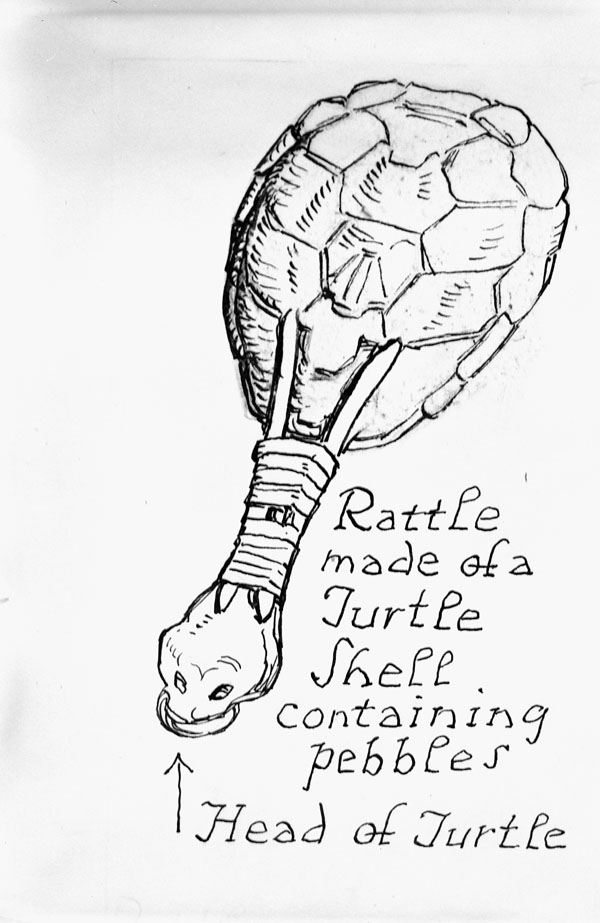 |
| Yeah, the head of the turtle on the end is a little on the creepy side. My husband would probably like it. |
The French and the British were responsible for bringing instruments that were popular in Europe – like the violin, guitars, transverse flutes (ones that are played to the side, like we’re most familiar with today), fifes, trumpets, organ, harpsichord. Of course at this time, the church was the main institution for teaching and promoting music in Canada, continuing on with the music of Europe that was popular at that time. They also introduced ballet to Canada, and today there are thousands of ballet companies across the country.

The 1800s brought along a lot of folk music, especially influenced by the British, Irish, and the Scottish who were moving in droves to Canada. Classical music is also still highly important and composers were still making strides in Canadian classical music. By the Great Depression and the years afterwards, jazz had taken hold of the people, and Guy Lombardo had become one of Canada’s most popular band leaders of all time.
The thing about popular Canadian music is that so much of it is so entwined with music culture of the United States, that it was surprising to learn who was Canadian. The late 1950s brought the first “rock star” so to speak with Paul Anka. The folk music scene, which led to other styles of rock music, emerged during the 1960s with artists such as Joni Mitchell (love her!), Gordon Lightfoot, Leonard Cohen, and The Guess Who.
The 1970s and 1980s brought a lot of various styles of rock bands and musicians to the forefront of international fame as well – many of these shaped my childhood – Steppenwolf, Neil Young (which also includes Buffalo Springfield and Crosby, Stills, Nash & Young and Crazy Horse), Anne Murray, Bachman-Turner Overdrive, Rush, Bryan Adams (my celebrity crush when I was in 6th grade), Loverboy, among others.
Many of the artists who emerged in the 1990s and 2000s basically guided me through high school and college: Crash Test Dummies, Our Lady Peace, The Barenaked Ladies, Sarah McLachlan, Céline Dion, Alanis Morissette, Shania Twain, Avril Lavigne, Nelly Furtado, Feist, Finger Eleven, Simple Plan, The New Pornographers (one of my absolutely favorites – I saw them live in college), Sum 41, Three Days Grace, Theory of a Deadman, Bedouin Soundclash (another of my absolutely favorites), Nickleback (used to really like them when they first came out, but they played them so much on the radio that I got really, really tired of them. Really.). One of the newer bands out that I had heard of but hadn’t really listened to is Arcade Fire, and I listened to their album The Suburbs on Spotify, and I have to say that I’m impressed. It kept my attention, and I kinda like it. Going through all of these songs was like walking down memory lane with my diskman, much to the chagrin of my kids having to listen to me sing along to the best playlist ever. Thanks, Canada. You’re awesome.
Up next: the food!