


Over two-thousand years old, set deep within the desert of Jordan, stands the ancient carved city of Petra. Constructed purely from the rock-cliffs situated on the slope of Mount Hor, this sandstone metropolis was once home to the Nabataean people, an Arab nomadic tribe of the Near East. Now one of the New Seven Wonders of the World, Petra is Jordan's most visited attraction.
Walking through the Siq- a magnificent rock gorge that leads to the main entrance of Petra- visitors are surrounded on either side by massive sandstone walls reaching as high as 250 feet into the air. Small tombs are carved into the rock along the path, their simplicity eventually dominated by the elaborate two-story Obelisk tomb that adorns the left side of the Siq.
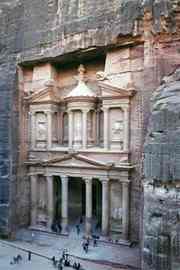
Guarded along the way by the amazingly large Jinn Rocks, this ancient dirt road ends at the foot of the famous Kazneh Temple, one of several entrances into the city.
While the site of Petra itself was an active trade route for several centuries prior to the cities construction, this Nabataean capital witnessed its zenith during the middle of the 1st century BC.
Positioned at a busy crossroads that conducted trading from the continent of Asia to the empires of Egypt, Rome and Greece, Petra was a virtual "hub of international commerce and culture."
In fact, it was this extensive exposure to foreign influence that lent Petra its unique mix of architectural designs. The most notable of which can be seen in the finely preserved and beautifully constructed Monastery and Treasury buildings.
Flat carved plazas lay at the foot of these magnificent rock structures. Skillfully embellished with intricate colonnades, half-pediments and deeply carved designs, these amazing edifices stand nearly fifty meters high.
Throughout the rest of the city, Grecian courtyards, columned temples and pilaster tombs, decorated in ornate floral carvings and intricate animal designs, adorn the rest of these ancient ruins.
Nabataean homes, built onto the natural rising terraces of the mountain slope, or carved purely into the cliff itself decorate the background; their dilapidated condition belying their once brightly painted décor and stucco walls.
Forgotten for nearly five-hundred years, this incredible city was brought to modern attention by the adventurous exploits of Swiss explorer Johann Burckhardt in the 19th century.
Since then, the rediscovery and excavation of Petra has continued to awe visitors from all over the globe, with tourist numbers increasing ten-fold since 1990.
With archaeologists having unearthed only one-twentieth of this amazing city, new finds and discoveries are made nearly every year, making the historical significance of this site incalculable. A gem within this desert landscape, Petra is truly a rare treasure to behold.
Source: Examiner [April 25, 2010]