


The most extensive archaeological dig ever at the fort has uncovered evidence of human camps up to 9,000 years old.
The dig site and some of the more impressive artifacts uncovered will be on display to the public today.
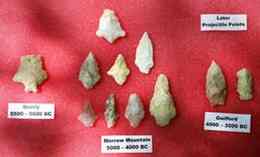 The findings aren't stunning - artifacts from that period are common throughout the state. But until recent years, archaeologists believed concentrations of artifacts from the Archaic period were likely only along major waterways. The Fort Jackson site is on sandy uplands, several miles from the Wateree River and even farther from the Broad.
"You were not supposed to find stuff like this in the sand hills," said Chuck Cantley, archaeologist with the S.C. Department of Archives and History.
Researchers now are finding plenty of artifacts from that time - the Archaic period - on high ground. Audrey Dawson, the chief investigator at the Fort Jackson site, and her crew have found five dense concentrations. They uncovered sandstone they believe is from hearths, quartz that has been chipped to create tools and projectile points, and rare pieces of pottery.
The artifacts include stone from the mountains of North Carolina and coastal areas of South Carolina and Georgia, hinting at wandering groups. But it's also clear someone sat in these woods and chipped quartz to make points.
"It seems to indicate there were small groups or micro-bands moving through the area," said Dawson, who is with the S.C. Institute of Archaeology and Anthropology at USC. "They'd come in and camp for a few days, then move on. ... We think they were coming into the sand hills and exploiting something."
The link between the ancient tribes and the natives who greeted the first European explorers is unclear. There's no written history from those thousands of years, and artifacts lead to various theories.
The dig site is near two natural springs, where natives could get fresh water and the quartz they needed for tools, Dawson said. Wild animals also would be drawn to the springs, providing a food source. The high ground would be ideal for a short stay on a trip from the Broad to the Wateree.
It's also ideal for military training and, in the future, barracks. Basic archaeological work that began in 1989 found enough evidence to prompt Fort Jackson officials to ban digging and heavy vehicles on 74,000 square meters.
But fort expansion plans now call for a future barracks complex on a portion of the archaeological site, so the Army is trying to find as much of the history as it can before construction begins. The barracks might not be needed for years, but the Army wanted the archaeological work done now.
"Fort Jackson does a wonderful job of locating and avoiding sites," Dawson said. And when they need to use a site "we get as much out of the sites as we can so there's nothing left to destroy."
Since the simple 1989 assessment, archaeologists have done more detailed digs at about 200 to 250 sites, said Chan Funk, a contract archaeologist at the fort. The dig Dawson is leading is the first Phase 3 dig that delves even more extensively into the past.
The Army and the archaeologists wanted to give the public a peek at the dig and its findings before it ends in a few weeks.
"One of the main goals of archaeology is to educate the public and inform people about the past," Dawson said. "We want to reach out to the public and let them see what we've found."
Source: The State