ARTICLE:
Seminar Promises Intelligent Design DiscussionAUTHOR: Nadia Chernyak, Cornell Daily Sun Contributor
SOURCE:
Cornell Daily SunCOMMENTARY:
Allen MacNeill (following the article)
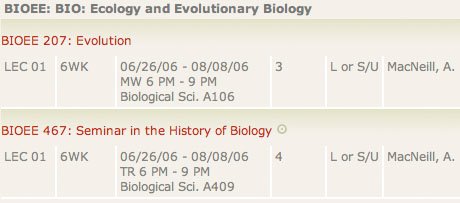
Prof. Allen MacNeill, biology, will be offering a course about Intelligent Design, entitled "Evolution and Design: Is there a Purpose in Nature?". The course will be offered seminar-style over the summer of 2006, through the ecology and evolutionary biology, history and science and technology studies departments as well as the biology and society program.
The syllabus requires texts from authors both for and against intelligent design and includes optional texts, one of which is by Charles Darwin.
MacNeill first came up with the theme for the seminar when brainstorming with Prof. Will Provine, ecology and evironmental biology, for topics for this summer's seminar class. MacNeill says that the idea was inspired by the Kitzmiller v. Dover case, in which the Dover Area School District in Dover, Pa. was sued for requiring the teaching of intelligent design in high school science classes.
"Given the Dover case, [Provine and I] thought it'd be interesting to teach [this year's seminar] on Intelligent Design," MacNeill said.
MacNeill labels himself a "very vehement critic" of intelligent design but hopes to inspire debate and controversy in his classroom.
"I'm hoping I get people from both sides so that the discussion will be animated. The worst thing you can have is a dull seminar, which is what you have when people have the same belief or don't believe in anything," he said.
As part of the attempt to present both sides of the issue, MacNeill has also invited Hannah Maxson '07, president of the Intelligent Design and Evolution Awareness club, to help with the class. Questions from the students about books by Intelligent Design proponents will be fielded by Maxson. The class is currently capped at eighteen to keep it discussion-based, not a lecture, says MacNeill.
It appears that this is not MacNeill's first delve into the topic of Intelligent Design. MacNeill is also on the IDEA list-serve, keeps consistent email correspondence with the club, holds debates about the issue and has invited the IDEA president to give a lecture in one his classes last year. MacNeill describes his relationship with the IDEA club as an "agreement in a very courteous manner to disagree."
"I'm glad it's being offered," said Maxson. "Intelligent Design needs to be discussed more in academia and not just [as] some 'frightening political movement' that needs to be stopped."
Hannah is currently working with MacNeill to pull together intelligent design articles for the reading list. She's also been invited to the discussions once the class starts to help "provide a cogent case for Intelligent Design theory."
IDEA Executive Director Seth Maxson also gives approval, saying that this "is an example of Intelligent Design being accepted as an intriguing scientific theory by the wider academic community."
Enrollment prospects are also looking up. Seth claims to have already talked with a few students who plan to take the class.
"They all seem very excited," he said.
Despite said excitement, MacNeill appears to have been met with some skepticism from colleagues. Since announcing what his class will be about, MacNeill has received many questions and comments both from students and professors via his personal blog. "Evolutionary biologists tended to be more negative about the course [than Intelligent Design advocates]," MacNeill said.
MacNeill also said that two colleagues have stated that the course shouldn't be offered in biology.
"I respectfully disagree," he said. "Most people in biology have a strong opinion on this, mostly negative. The knee-jerk response is to call the other side ignorant or dishonest; my experience is that that doesn't address the issue."
Though MacNeill claims to be "strongly skeptical of Intelligent Design, at the very least", he says he is not worried about one-sided enrollment.
"What's exciting for me is people taking strong positions. I hope students who haven't made up their minds make up their minds on the subject."
The class will require a detailed research paper in which the student must argue his/her position on the matter.
"Personally I believe if you do that you reject the idea," he chuckled. "But I find sometimes that that's not the case."
MacNeill has no immediate or definite plans to continue this class in the future, claiming that he would like to do other topics such as ethics and the question of free-will. However, there is some room for compromise.
"As long as Intelligent Design is in the news, maybe it makes sense to continue to do this," MacNeill said.
********************************************************************************
COMMENTARY:
Not a bad article, especially for the
Sun. From all indications, it now appears that most attempts to "spin" the course in favor of intelligent design have fizzled out, and the true nature of the course is now apparent: as I have posted multiple times before, we will be reading about and discussing various concepts of purpose in nature and their relationship to evolutionary theory, including intelligent design theory. All of these concepts will be examined critically with a view toward determining which (if any) have an impact on the science of evolutionary biology, and what philosophical implications the current theory of evolution has for concepts of purpose in nature.
Not as outrageous or exciting as some of the early press reports would have you believe, but more interesting to me and (I hope) to the students who have already expressed an interest in the course.
--
Allen