Showing posts with label population growth. Show all posts

Mapping The World's Population

(Click on Image to Enlarge)
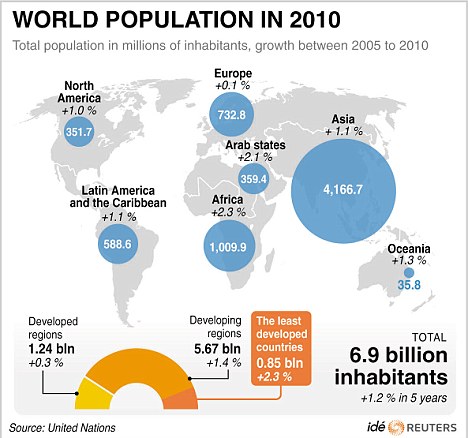
WNU Editor: The above image is from Zero Hedge .... Mapping The World's Population.

This Bubble Chart Shows Where The World's Population Is


Visual Capitalist: The Population of Every Country is Represented on this Bubble Chart

The beautiful thing about data visualization is that it can appear deceptively simple.

The world is infinitely complex and burgeoning with all kinds of information. As a result, it seems counterintuitive that things can be reduced to a basic bubble chart or a graph – and to be fair, most things can’t.

When the opportunity does arise, however, the results can be very compelling and thought-provoking. A distilled story can help create insight around a subject that wasn’t possible when looking at it with more nuance and complexity.

Read more ....

WNU Editor: Bottom line .... the future is in Asia.

New Population Projections Estimate A World With 11 Billion People


A World With 11 Billion People? New Population Projections Shatter Earlier Estimates -- National Geographic

Dueling projections of population growth present different visions of the world's future.

Warning: The 21st century may get a lot more crowded than previously thought.

In a paper published Thursday in Science, demographers from several universities and the United Nations Population Division conclude that instead of leveling off in the second half of the 21st century, as the UN predicted less than a decade ago, the world's population will continue to grow beyond 2100. (Read "Population Seven Billion" in National Geographic magazine.)

And for the first time, through the use of a "probabilistic" statistical method, the Science paper establishes a range of uncertainty around its central estimate-9.6 billion Earthlings in 2050, 10.9 billion by 2100. There's an 80 percent chance, the authors conclude, that the actual number of people in 2100 will be somewhere between 9.6 and 12.3 billion.

Read more ....

More News On New Population Projections That Are Estimating A World With 11 Billion People

World population to keep growing this century, hit 11 billion by 2100 -- University of Washington
Global Population Predicted to Reach Nearly 11 Billion by 2100 -- VOA
World Should Prepare for 11 BIllion or More People -- Scientific American
Earth has an 80% chance of hitting 11 billion people by 2100 -- Geek
Global population may reach 11 billion by 2100 -- RT
New forecast: The Earth could have 11 billion people by 2100 -- VOX
11 billion people by 2100? Solving the world’s problems just got a lot harder than we thought -- Salon

My Comment: We have seen what 7 billion people can do today .... 11 billion .... that world is certainly going to be different than the one that we live in today. The complete study is here.

The World's Population Is Shrinking


About That Overpopulation Problem -- Slate

Research suggests we may actually face a declining world population in the coming years.

The world’s seemingly relentless march toward overpopulation achieved a notable milestone in 2012: Somewhere on the planet, according to U.S. Census Bureau estimates, the 7 billionth living person came into existence.

Lucky No. 7,000,000,000 probably celebrated his or her birthday sometime in March and added to a population that’s already stressing the planet’s limited supplies of food, energy, and clean water. Should this trend continue, as the Los Angeles Times noted in a five-part series marking the occasion, by midcentury, “living conditions are likely to be bleak for much of humanity.”

Read more
....

WNU Editor: For more info on the world's population growth, go here.

The World Population Is Getting Older

World Faces Ageing Population Time Bomb Says UN -- The Telegraph

The world needs to take urgent action to cope with the impact of a rapidly ageing population, according to a new report, which forecast that the number of people older than 60 would surpass one billion within a decade.

A major study published by the United Nations has warned that the growing numbers of the elderly presented significant challenges to welfare, pension and health care systems in both developing and developed nations.

And it bemoans the fact that skills and knowledge that older people have acquired are going to waste in societies rather than being used to their full.

"We must commit to ending the widespread mismanagement of ageing," said Richard Blewitt, chief executive of HelpAge International, which collaborated on the report, Ageing in the 21st Century.

Read more ....

My Comment: We have the means to live longer .... and better than our descendents. I regard this as a positive development .... not the UN's line that the world is facing an "aging population time bomb".


The Trends And Impact Of Population Growth

(Click on Image to Enlarge)
Sources: World Bank; U.N. Food and Agriculture Organization, U.N. Global Forest Resources Assessment, 2010. Graphic: Dan Keating and Bill Webster/The Washington Post. Published on October 23, 2011, 8:55 p.m.

Population Growth Taxing Planet’s Resources -- Washington Post

Humans have mined resources from the remote and rocky coast of Peru and Chile for more than a century and a half, gathering the guano deposits of seabirds for fertilizer and gunpowder. Those seabirds flourished on anchoveta in the coastal waters, while Peruvians in the highlands ate the same fish as dried snacks.

Now fishing vessels haul 7.5 million tons of the small silvery fish out of the water every year. Almost all the catch is reduced to fish oil and fish meal, which is fed to pigs, poultry and salmon being raised thousands of miles away to satisfy demand in the industrialized and rapidly-growing developing world.

Read more ....

More News On Mankind Reaching The 7 Billion Population Mark

How Do You Get to 7 Billion People? -- Wall Street Journal
World population will more than double to 15billion by 2100, says UN -- Daily Mail
Crowded earth: Bursting at the seams -- News24
Halloween fright: 7 billion humans -- Mother Nature Network
The global population will reach 7 billion this month; here are 7 things you didn’t know -- Smart Planet
Spiralling population puts the planet at risk -- NZHerald
Why current population growth is costing us the Earth -- Roger Martin, The Guardian
Seven Billion -- Joel E. Cohen, New York Times

World Population To Reach 7 Billion This Week


Room For One More? World Population To Reach 7 BILLION In Next Few Days -- Daily Mail

* Children most likely to be born in Asia-Pacific region
* Fears over pressure on food supply and medical care

The world's population looks set to smash through the seven billion barrier in the next few days, according to the United Nations.

It comes just 12 years since the total reached six billion - with official estimates saying the figure will top eight billion in 2025 and 10 billion before the end of the century.

And it is most likely the baby will be born in the Asia-Pacific region - where the population growth rate is higher than anywhere else in the world.

Read more
....

My Comment: Will more people mean more unrest and more wars .... hmmm ....we are going to find out in the next decade or two.

The Coming Population Explosion

Graph From The Economist

Can The World Feed 10 Billion People? -- Raj Patel, Foreign Policy

With an exploding global population -- and Africa's numbers set to triple -- the world's experts are falling over themselves arguing how to feed the masses. Why do they have it so wrong?

The world's demographers this week increased their estimates of the world's population through the coming century. We are now on track to hit 10 billion people by 2100. Today, humanity produces enough food to feed everyone but, because of the way we distribute it, there are still a billion hungry. One doesn't need to be a frothing Malthusian to worry about how we'll all get to eat tomorrow. Current predictions place most of the world's people in Asia, the highest levels of consumption in Europe and North America, and the highest population growth rates in Africa -- where the population could triple over the next 90 years.

Read more
....

More News On The World's Growing Population

World population to reach 10.1 billion by 2100 -- AP
U.N.: Earth's population to hit 9 billion by 2050, 10 billion by 2100 -- CNN
Rising Sea of Humanity: UN Says Pop. Will Hit 10B by 2100—& Keep Going Up -- Discover
World population to pass 7 billion on Oct. 31-UN -- Reuters
Global population to reach 7 billion this year, UN report says -- Deutsche Welle
U.N.: World population to pass 7 billion on October 31 -- Baltimore Sun/Reuters
World population expected to hit 7 billion in October 2011 -- Xinhuanet
Coming to a Planet Near You: 3 Billion More Mouths to Feed -- New York Times
New Population Projections Show Us Growing Unsustainably, But We Can Put on the Brakes -- Time
UN projects world population of 6.2 to 15.8 billion in 2100 with 10.1 billion midrange -- Next Big Future
Counting to Ten Billion -- Huffington Post
World population projections. Growing pains -- The Economist

10.1 Billion People By The End Of The Century

U.N. Forecasts 10.1 Billion People by Century’s End -- New York Times

The population of the world, long expected to stabilize just above 9 billion in the middle of the century, will instead keep growing and may hit 10.1 billion by the year 2100, the United Nations projected in a report released Tuesday.

Growth in Africa remains so high that the population there could more than triple in this century, rising from today’s one billion to 3.6 billion, the report said — a sobering forecast for a continent already struggling to provide food and water for its people.

Read more ....

My Comment: By looking at the above graph, it is easy to see where most of the world's future wars and conflicts will come from .... Asia, Middle East, and Africa. The reason why .... that is where the people are.

It's Darwin-Malthus Day!


AUTHOR: Allen MacNeill

SOURCE: Original essay

COMMENTARY: That's up to you...

Most readers of this blog are aware that next year is the Darwin Bicentennial. It's the 200th anniversary of the birth of Charles Darwin and the 150th anniversary of the publication of the Origin of Species. Regular readers also know that this celebration really started this past July 1st, which marked the 150th anniversary of the joint presentation of Darwin and Wallace's theory of evolution by natural selection at the summer meeting of the Linnean Society in London.

However, what many people don't know is that today is also a very significant anniversary of a crucial development in Darwin's theory of evolution by natural selection. On this day in 1838, Darwin
"...happened to read for amusement 'Malthus on Population,' and being well prepared to appreciate the struggle for existence which everywhere goes on from long-continued observation of the habits of animals and plants, it at once struck [him] that under these circumstances favourable variations would tend to be preserved, and unfavourable ones to be destroyed. The result of this would be the formation of new species." [Darwin's Autobiography, page 83]

According to his autobiography, Darwin read Malthus' famous essay in the evening, and the idea of natural selection sprang fully formed into his mind: "Here then I had at last got a theory by which to work...", and indeed he had. But Darwin was an extraordinarily cautious man, always seeking to avoid controversy and notoriety. In his autobiography he says,
"...I was so anxious to avoid prejudice, that I determined not for some time to write even the briefest sketch of it."

And indeed, he did not. It wasn't until 1842 that he felt confident enough about his theory to set it down on paper, and it wasn't until two years later that he had this original "pencil sketch of 1842" copied out and put into a form that he felt confidant enough about to share with his closest friends. It was this "Essay of 1844", along with a letter to the American botanist, Asa Gray, that were read at the July, 1858 meeting of the Linnean Society along with Alfred Russell Wallace's unpublished manuscript "On the Tendency of Varieties to Depart Indefinitely from the Original Type", which marks the beginning of evolutionary theory's annus mirabilis.

So, the "evolution revolution" really began on a rainy evening in late September in 1838, when Charles Darwin read Malthus "for amusement"...

...and it's also my birthday.

As always, comments, criticisms, and suggestions are warmly welcomed!

--Allen

Announcing a New Blog: Evolutionary Psychology


AUTHOR: Allen MacNeill

SOURCE: Evolutionary Psychology

COMMENTARY: That's up to you...

As if I didn't already have enough to do, I have started a new blog. Entitled "Evolutionary Psychology", it is intended as a companion blog to The Evolution List. I have felt for quite a while that there are no really informative blogs on the subject of the evolution of human behavior, and so decided this morning to do one myself.

I have been learning about and doing research in evolutionary psychology for over thirty years (that is, since it used to be called "sociobiology"). Several years ago, I prepared a series of lectures on the subject, complete with images, links, and references, which I intended to use as the basis for a course on the subject. These "lectures" will therefore serve as the core of the new Evolutionary Psychology blog.

The first post on the new blog (The Capacity for Religious Experience is an Evolutionary Adaptation for Warfare) is a repost of one of the most popular posts here at The Evolution List. I have reposted it again, partly to commemorate the 63rd anniversary of the atomic bombing of Hiroshima, and partly to give the new blog a good kickoff. I hope you will take a look, and if you like it, please spread the news.

As always, comments, criticisms, and suggestions are warmly welcomed!

--Allen