Showing posts with label genetic mutation. Show all posts

"Are the Mechanisms that Produce Phenotypic Variation "Random"?


Some "intelligent design" supporters have recently asserted that all of the 47+ mechanisms listed in my blog are “random” or “accidental", and therefore the old creationist argument that "RM & NS" doesn't explain the origin and evolution of life is still valid. However, this is simply not the case. On the contrary, a large percentage of these mechanisms are the result of processes that are not “random” by any reasonable definition of that term. I have repeatedly been very careful to point this out, but that clearly has been missed by many "intelligent design" supporters.

It is also not the case that the 47+ processes are not “guided". Indeed they are “guided”, by the various internal and environmental forces that produce both the variations and the various evolutionary mechanisms that operate upon them (i.e. natural selection, sexual selection, founder effects, genetic bottlenecks, neutral “drift” in deep evolutionary time, exaptation, heterochronic development, changes in homeotic development, interspecific competition, species-level selection, serial endosymbiosis, convergence/divergence, hybridization, phylogenetic fusion, background and mass extinction/adaptive radiation, and internal variance).

That said, however, it is also demonstrably the case that none of the mechanisms listed above can be shown empirically to be “foresighted". Indeed, the whole idea of “foresightedness” in natural processes seems to me to violate several very well-established principles of physics, including the Second Law of Thermodynamics.

How can any natural process be empirically shown to be genuinely “foresighted"? Do rocks fall “in order to” reach the ground? Do gas molecules move “in order to” produce the phenomena we describe with Boyle’s Law? Do the electrons in the valence energy shells of hydrogen and oxygen form shared couplets “in order to” produce water? Do particular genetic changes happen “in order to” produce phenotypic changes that have no effects on organisms’ survival and/or reproduction now, but might have in the future? And how can anyone show any of these to be the case?

It is important to note that the terms “foresighted” and “goal-oriented” are not equivalent. The latter term is entirely compatible with both physics in general and evolutionary biology in particular. Indeed, the genomes of all living organisms are “goal-oriented programs” (as most clearly pointed out by Ernst Mayr), in that they organize and control the assembly and operation of the living organisms for which they code.

However, the processes by which such genomes have come into being (i.e. the 47+ mechanisms listed here, operating through the various mechanisms of micro- and macroevolution listed above) have not been empirically shown to be either “foresighted” nor “goal-oriented". It seems to me that this would be extremely difficult, if not impossible to do. What kinds of empirical observations could one conduct that would unambiguously verify today that some component of an existing organism’s genome or phenome was present in that organism now because at some point in the future it might become necessary for that organism’s survival and/or reproduction?

Clearly, once an organism has survived and/or reproduced one can point to its various attributes and say “yes, that attribute appears to have contributed to the organism’s survival/reproduction". However, that is no more evidence of “foresightedness” than a lottery winner saying “I chose these lottery numbers (or bought those particular scratch-off tickets) because I knew they would be winners". This is known as the “fallacy of affirming the consequent” (also called post hoc, ergo propter hoc argumentation) and is logically inadmissible in the natural sciences.

As always, comments, criticisms, and suggestions are warmly welcomed!

--Allen
Random Mutation and Natural Selection Revisited


AUTHOR: Allen MacNeill

SOURCE: Original essay

COMMENTARY: That's up to you...

Promoters of "intelligent design theory" and other forms of creationism often assert that random mutation plus natural selection (RM+NS) are insufficient to explain the diversity of life on Earth. In particular, people like William Dembski assert that RM+NS cannot work fast enough (even given billions of years) to produce the complex living organisms we observe around us.

In so doing, they attack evolutionary theory using a "straw-man argument," because modern evolutionary theory is not limited to RM+NS alone to produce adaptations, nor to explain the diversity of life on Earth. In particular, while there is no empirical evidence that would lead one to believe that mutations are produced by an "intelligent designer," it is also not true that mutations alone must supply the variation necessary for evolution by natural selection.

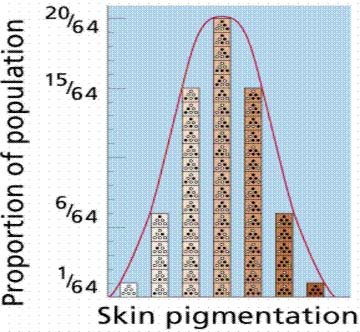
In particular, while it is true that any given mutation is random (as far as we can tell), a series of mutations which are then preserved as the result of natural selection aren't really random at all, at least not in the way that is often depicted by critics of evolutionary theory. In classical evolutionary theory, as first mathematically formalized by R. A. Fisher, the variation that is necessary for the raw material for natural selection is the result of a large number of individual alleles, all producing variations of the same trait, such as height or skin color in humans. In this model, a normal distribution of heights or skin colors are produced by combinations of different alleles, each influencing some fraction of the overall height, producing what Fisher and others called "continuous variation." Selection then preserved one or a few of the various allele combinations by preserving the individuals that carried the controlling alleles.


In this model, evolutionary change would necessarily be slow and gradual, as changes in the overall mean value for any trait would require the gradual accumulation of mutations in each of the many alleles that controlled the trait. Since the observable mutation rate is very low (at least, the rate of mutations that significantly affect most phenotypic traits is very low), the argument was that directional change in any given trait was something like a wagon train: only as fast as its slowest constituent. That is, change in the overall distribution of the trait (such as height) depended on the rate of mutation of all of the alleles controlling it, and required that a sufficient proportion of the alleles that were preserved by selection mutate and then be selected in the same "direction" (e.g. for greater height).

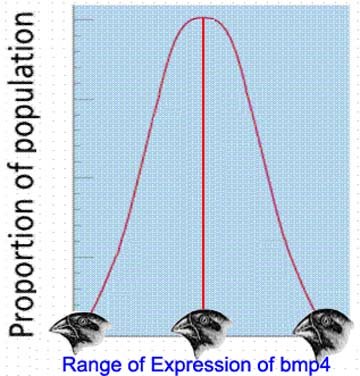
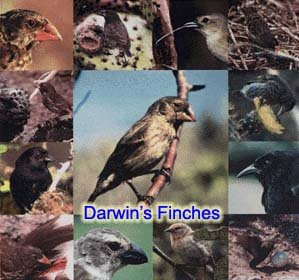
However, subsequent field and laboratory investigations into the genetic and developmental control of such variable traits have shown the multiple allele/continuous variation model upon which the "modern synthesis" was based is, in fact, not the way most traits apparently evolve. For example, consider a mutation that causes an increase in size of a particular anatomical feature (e.g. a finch's beak). Most such features are regulated by a set of genes that are themselves regulated by a homeotic gene (or a few such homeotic genes; in the case of Darwin's finches, the controlling homeotic gene is called bmp4, for "bone morphology protein 4") [1]. Homeotic genes, like many but not all genes, do not produce a purely monotonic trait (i.e a trait with no variation). Instead, they produce a trait that varies somewhat between individuals, in what approximates a normal distribution. In the case of finch beaks, this means that in any population of finches, there are some individuals with small beaks, some with large beaks, and most with intermediate beaks. All of these finches could easily have the same allele for the homeotic gene controlling the trait. The variation in beak size would therefore be the result, not of the expression of different alleles, but rather of the different outcomes of the expression of the same allele of the homeotic gene, developing differently in different individuals as the result of a combination of chance and environmental conditions (this is how humans differ in heights, for example).


Now consider a situation in which an environmental change (for example, a drought), selected for individual finches with larger beaks. At the level of the controlling homeotic gene, this could mean one of two things: either the larger beaks are still within the developmental limits of the original allele, or another allele (i.e a mutant) has arisen, with an overlapping developmental pattern but a higher mean value for beak size. If the former is the case, then a return to the original environment would result in a return to the original mean beak size.

However, if the latter were the case, then there would be a built-in bias toward finches with larger beaks in the resulting population. This would also mean that the "base" allele - i.e. the new mutant allele - would start out producing a larger mean beak size along with the usual normal distribution of beak sizes. If the environmental change persisted, new alleles might arise, but they would begin with a "norm of reaction" that would produce significantly larger mean beak sizes, along with a normal distribution with significantly larger beaks at the upper tail of the distribution.

In other words, the existing alleles for such a trait would bias subsequent mutations in the "direction" of larger beaks, simply because the pool of potential new alleles would already start out biased in that direction. Therefore, the mutations and developmental changes that were available from one generation to the next would be biased in the direction of whatever phenotypic trait resulted in the highest reproductive success.

This process, called genetic accommodation [2], is part of the new science of evo-devo, which renders much of the classical "evolutionary synthesis" obsolete, and at the same time explains how such phenomena as punctuated equilibria can be integrated into a unified theory of evolutionary development. In particular, genetic accommodation and similar processes can explain how natural selection alone can produce both rapid and directional change in phenotypes over time, thereby making any resort to "intelligent design" unnecessary and irrelevant.

REFERENCES CITED:

[1] Pennisi, E. (2004) Bonemaking protein shapes beaks of Darwin's finches. Science, Vol. 305. no. 5689, p. 1383, available at : http://www.sciencemag.org/cgi/content/summary/305/5689/1383

[2] West-Eberhard, M. J. (2003) Developmental Plasticity and Evolution. Oxford, UK, Oxford University Press. See especially pages 147 to 158.

--Allen