


Showing posts with label Syria. Show all posts
Showing posts with label Syria. Show all posts
Turkey May Launch New Ground Offensive against US-Backed Forces in Syria
By Jennifer Cafarella
Key Takeaway:Turkey’s President Erdogan is trying to coerce President Trump into shifting American support from Kurdish forces toward Turkey’s proxies in Syria, which include al Qaeda-linked elements. Erdogan may launch a new ground operation into Syria in order to create ground realities that could force the U.S. to reconsider his demands.
Erdogan may open a new front line in his campaign against America’s primary anti-ISIS partner in Syria, the Syrian Democratic Forces (SDF), in coming days. Erdogan seeks to coerce President Trump into accepting Turkey and Turkish-backed opposition groups as alternative ground partners to the SDF in the fight against ISIS. The YPG dominates the SDF and is the Syrian branch of the Turkish Kurdistan Worker’s Party (PKK), which is waging an active insurgency against the Turkish state. Erdogan views the YPG’s ascendancy in northern Syria as his primary national security threat. Erdogan has signaled that he will launch a cross-border operation to seize the Syrian border town of Tel Abyad, north of Raqqa City. Turkish forces are shelling the town and local sources indicate that Turkish warplanes are flying sorties above it, although without dropping munitions thus far. Unconfirmed reports also indicate Turkish-backed opposition groups may be amassing for an offensive. Erdogan may launch the operation before his upcoming meeting with President Trump in Washington on May 16-17.
Erdogan’s plan is to siphon Syrian Arab support away from the SDF, which would block America’s planned Raqqa operation. Tel Abyad is an Arab-majority town currently under military control by the Syrian Kurdish (YPG). An operation against Tel Abyad, if it occurs, would open a fissure between Arabs and the YPG in northern Syria that could be sufficient to neutralize the SDF as a reliable American partner force for the Raqqa operation. Turkey likely also intends to undermine Arab support for the SDF’s larger governance project in northeastern Syria by providing an option for independent Arab governance outside YPG control.
Erdogan has been threatening an operation in Tel Abyad for some time. Erdogan had proposed an alternative approach to the US plan to seize Raqqa City in interviewsand in meetingswith U.S. officials in February and March 2017. Erdogan offered to use Turkish troops and allied opposition fighters to create a 12-mile wide corridor from Tel Abyad to Raqqa City. The US was reportedly unsatisfied with the proposal, which offered to commitonly 3,000 Turkish soldiers. The Turks reportedly claimed to be able to field 10,000 Turkish-trained opposition forces, but those numbers have not materialized. The U.S. rejection did not change Erdogan’s commitment to block the Raqqa operation, however. Erdogan warned on April 3, 2017 that he intended to launch “new surprises” targeting ISIS, the PKK, and the YPG. Turkey recently tested America’s resolve to defend the YPG in eastern Syria. Turkey launched airstrikes against YPG headquarters in eastern Syria and YPG proxy fighters in northern Iraq on April 25, 2017. The U.S. condemned the strike but did not take action in response.
Erdogan may use an operation against Tel Abyad to demonstrate his ability to rally Arab tribal support in order to force the U.S. to reconsider. Turkey convened 50 Sunni Arab tribal leaders from eastern Syria in the Turkish town of Sanliurfa, north of Tel Abyad, in mid-March to discuss resistance against the YPG. Turkey formed a new Syrian Arab military force named the “Eastern Shield Army” on April 19, likely drawing from the tribes represented at the summit in Sanliurfa. The group includes members from the al-Nai’m tribe, which operates near Tel Abyad, in addition to rebel fighters linked to al Qaeda that operated in eastern Syria before the rise of ISIS in late 2014. The group’s influence reportedly extends through Raqqa and into Deir ez Zour Province, although the size of its fighting force remains unclear. Turkish Defense Minister Fikri Isik stated on April 21 that continued cooperation between the U.S. and the Syrian Kurdish YPG threatens to create “long-term instability” between Arabs and Kurds, signaling Turkey’s intent to exploit Arab discontent with YPG domination in northern Syria.
An operation against Tel Abyad would mark the start of a second phase in Turkey’s military intervention in Syria and its first major ground operation directly against the YPG. Turkey began its intervention in August 2016. It first seizedthe Syrian border town of Jarablus, west of Tel Abyad, from the Islamic State of Iraq and al Sham (ISIS) on August 26, 2016 using a similar partnered rebel force. Turkey then cleared the remainder of the ISIS-held Syrian-Turkish border and pushed south to recapturethe ISIS-held town of al Bab on February 23. Turkey had only limited success gaining U.S. support for its operations and has not managed to weaken America’s commitment to the SDF. The U.S. provided intermittent support to Turkey’s operations against ISIS but blocked Turkey’s move to attack the SDF near al Bab. Erdogan’s resolve to prevent the SDF from taking Raqqa City has not diminished. President Trump congratulated Erdogan for his victory in the Turkish referendum earlier this month, which may have emboldened Erdogan to start a new phase of his Syrian campaign. Erdogan reciprocated on April 28, stating “I believe that we will open a fresh page with Trump” in a conference in Istanbul.
Turkey’s alternative plan for Raqqa is unacceptable even if Turkey secures large-scale Arab buy in. The Syrian opposition forces that Turkey is using to support its operations include elements linked to al Qaeda, such as Ahrar al Sharqiya. Turkey will likely also use the Salafi jihadi group – and al Qaeda ally – Ahrar al Sham, which has messaged its willingness to participate alongside Turkey in operations to seize Raqqa. Turkey previously used Ahrar al Sham as a logistical backbone for the first phase of the Euphrates Shield operations in northern Aleppo. The form of governance that Turkey is emplacing in its de facto safe zone is meanwhile antithetical to U.S. objectives. Turkey is allowing groups like Ahrar al Sham to implement social control, for example imprisoning members of a local governing council. The US cannot allow groups like Ahrar al Sham to dominate governance in a post-ISIS Raqqa because it would create a permissive environment for al Qaeda in the long term. The U.S. must contain the escalating Turkish-YPG war, and should accept delays in the timeframe for the Raqqa operation in order to do so. Defeating ISIS must remain a priority, but the U.S. risks producing more dangerous futures by rushing into clearing operations in Raqqa under current conditions. The possible dangerous outcomes of a Raqqa operation on current trajectory include a failure to recapture the city due to a war between Turkey and allied Arabs and the YPG or an al-Qaeda rise to power in Raqqa after its recapture from ISIS.
Russia's largest batch of humanitarian aid has been delivered to Syrian port of Tartus.10,000 tons of flour, sugar, canned beef and fish
Russia's largest batch of humanitarian aid has been delivered to Syrian port of Tartus.10,000 tons of flour, sugar, canned beef and fish. pic.twitter.com/Qm0laCruT5— Military Advisor (@miladvisor) April 20, 2017
Moscow book stores these days: Political fiction "A Night in Damascus"

The kind of stuff you find in Moscow book stores these days: Political fiction "A Night in Damascus" pic.twitter.com/t2sa7pChUN— Yury B (@russia_mideast) December 10, 2016
Open Access Journal: Syrian Studies Association Newsletter
[First posted in AWOL 7 September 2009. Updated 4 October 2016]

The Syrian Studies Association (SSA) is an international association organized to encourage and promote research and scholarly understanding of Syria in all academic disciplines. The SSA defines Syria as the area included in historic "Bilad al-Sham" until 1918 and Syria following that. We invite scholars who study the peoples and territories of what is today Syria, Jordan, Lebanon and Palestine before 1918 and those who study Syria after that to join our organization and to contribute to our newsletter. The Newsletter is particularly interested in articles on research and scholarship underway in Syria; reviews of new books on Syria, particularly those in Arabic and those that are not widely distributed; and articles on research and study opportunities in Syria.
2014
Vol 19, No 2 (2014): Fall 2014 Issue
The bulletin is a biannual publication of the Syrian Studies Association.
2013

Vol 18, No 2 (2013): Syria: Domestic, Regional, and International Perspectives
Bab Touma Street, Damascus, early 2000s
Vol 18, No 1 (2013): The Syrian Uprisings: Reflections on the Past Two Years
The bulletin is a biannual publication of the Syrian Studies Association. This issue includes feature articles focusing on the past two years of the conflict in Syria. It also includes news of the Syrian Studies Association and book and film reviews.
2012

Vol 17, No 2 (2012): Syria: Past, Present, Future
Syria's famous old yellow taxis, shown here at Baramke Garage in Damascus on a rainy day in winter 2006.
Vol 17, No 1 (2012): The Syrian Uprisings: Reflections on the Past 14 Months
Spring 2011 cartoon by "The Syrian People Know Their Path": "Before Lifting the Emergency [Laws] / After Lifting the Emergency [Laws]"
2011

Vol 16, No 2 (2011): Syrian Studies Association Newsletter
Tell Mozan: "Modern" Issues in Ancient Syria
2009

Vol 15, No 1 (2009): Syrians in the Americas
A man, wearing a fez, selling drinks from an ornate, portable, samovar-like dispenser in the Syrian Quarter of New York City. George Grantham Bain Collection (Library of Congress). Original artwork by Vladimir Tamari.
Vol 14, No 2 (2009): Spring 2009 Issue
Original artwork by Palestinian artist Vladimir Tamari who resides in Tokyo.
2008

Vol 14, No 1 (2008): First Electronic Issue
Feature Article: Shana Marshall, "Syria and the Global Financial Crisis: Insulated or Isolated?"
0


See AWOL's full List of Open Access Journals in Ancient Studies
Turkish Incursion in Northern Syria Signals Turning Point in Anti-ISIS Fight: August 30, 2016
By Jennifer Cafarella with Leah Danson
Key Takeaway: Turkey is unraveling America’s anti-ISIS partner in northern Syria in order to position itself as a major power broker in planned operations to retake Raqqa City. Turkish Armed Forces (TSK) crossed into Syria to seize the ISIS held border town of Jarablus alongside numerous Turkish- and U.S.-backed Syrian armed opposition groups on August 24. The operation, titled Euphrates Shield, is a turning point in American-Turkish relations and the war against ISIS by fulfilling longstanding American demands for more Turkish involvement in the anti-ISIS fight. Euphrates Shield also aims to prevent the expansion of Kurdish control along the border, however. The U.S. ordered the Syrian Kurdish People’s Defense Forces (YPG) to withdraw to the east bank of the Euphrates River in accordance with Turkish demands at the start of the operation. Turkey is leveraging Syrian opposition groups it trusts in Jarablus and intentionally sidelining groups that joined the Syrian YPG-led Syrian Democratic Forces (SDF), bringing U.S.- and Turkish- backed opposition factions into direct conflict with the American-backed SDF. The SDF opposed the Turkish incursion and attacked the joint Turkish-Syrian opposition force on August 27. A U.S. defense official announced that the two sides agreed to a “loose” truce on August 30. An unidentified Turkish military source, however, subsequently denied the existence of any such agreement. The Turkish intervention has meanwhile inspired local resistance against the SDF and YPG in Sunni Arab areas including Manbij City, south of Jarablus, and the northern Raqqa countryside. Turkey may exploit this local resistance to unseat the SDF from Manbij City and replace it with a military force that opposes the YPG.

Turkey is unraveling America’s anti-ISIS partner in northern Syria in order to position itself as a major power broker in planned operations to retake Raqqa City. Turkish Armed Forces (TSK) crossed into Syria to seize the ISIS held border town of Jarablus alongside numerous Turkish- and U.S.-backed Syrian armed opposition groups on August 24. The intervention brought the TSK and U.S. backed opposition forces into direct conflict with the Syrian Democratic Forces (SDF), America’s primary ally in the anti-ISIS fight. Turkey notified the U.S.-led anti-ISIS coalition, the Syrian regime, and Russia about the offensive, which it titled “Operation Euphrates Shield.” Turkish Special Operations forces led a joint military force into Jarablus, including an armored battalion from Turkey’s Second Army and as many as 5,000 Syrian opposition fighters from groups based in the northern Aleppo countryside including: the Sultan Murad Brigade, Suqour al-Jebel, Jaysh al Tahrir, Jabhat al Shamiya, Nour al Din al Zenki, Faylaq al-Sham, and Ahrar al Sham. ISIS mounted little resistance to the attack, instead withdrawing southwest to the town of al Bab. SDF fighters rejected the Turkish intervention as an “occupation” and attacked the joint Turkish/Syrian opposition force. The Turkish intervention meanwhile appears to have emboldened local elements to resist the SDF openly. Sunni Arab elements in Manbij and the Raqqa countryside issued statements rejecting the SDF because of the YPG’s goal to establish an independent Syrian Kurdistan. Turkey likely will continue to advance south in order to unseat the SDF from Manbij and position loyal Syrian opposition forces as necessary ground partners in the operation to retake Raqqa City.
Turkey is leveraging Syrian opposition groups it trusts in Jarablus and intentionally sidelining groups that joined the Syrian YPG-led SDF. Local SDF groups from Jarablus declared the formation of the Jarablus Military Council on August 22 and stated their intent to seize Jarablus. The leader of the Jarablus Military Council (JMC), Abdussatar al-Jadir, was assassinated the following day. The JMC accused Turkish intelligence and attacked the joint Turkish/Syrian opposition force on August 27. Turkey launched airstrikes against JMC and SDF positions south of Jarablus in response and has maintained an active air campaign targeting the area. The joint Turkish/Syrian opposition force advanced south, seizing over a dozen villages and reaching the Sajour River by August 29. The JMC nonetheless continues to marshal support from the Aleppo countryside. The SDF-linked Manbij Military Councilannounced its support for the JMC on August 27. Prominent Manbij Military Council (MMC) member Kataib Shams al Shamal deployed to reinforce the front line south of Jarablus. A delegation of tribal elders in Manbij later declaredits support for the JMC on August 28. The escalation between the joint Turkish/Syrian opposition military force and coalescing SDF elements south of Jarablus have redirected the focus of the SDF’s Sunni Arab fighting force at a time when the U.S. intended to prepare for operations to retake Raqqa City.
Turkey’s intervention aimed to sideline the SDF and check the YPG’s rising strength along the Turkish border. Turkish President Recep Tayyip Erdogan stated that Turkey intended to fight the YPG “with the same determination” as fighting ISIS during a visit to Gaziantep on August 28. He also vowed to provide “all necessary support” to Syrians living in Gaziantep who wanted to return to Jarablus, indicating his intent to repopulate Jarablus – and possibly its southern countryside – with Syrian refugees after finishing clearing operations. He will ensure that the refugees that resettle in Syria are Sunni Arabs in order to block future Kurdish activity in the area. Turkey had conditioned its support for the U.S.-led SDF operation to retake Manbij beginning in April 2016 on the mandatory withdrawal of the YPG to the east bank of the Euphrates river after the SDF captured the city, but YPG forces had not withdrawn as of the launch of Operation Euphrates Shield on August 24, despite seizing the city in early August. U.S Vice President Joe Biden was in Ankara on August 24 and expressed strong support for the operation. He also ordered the YPG to withdraw from Manbij to the eastern bank of the Euphrates, stating that the group, “will not under any circumstances get American support” if it does not comply. The YPG’s general command chose to back down rather than confront Turkey near Jarablus directly, but has not completely withdrawn as ordered. The YPG released a statement confirming its intent to remain focused on the overall anti-ISIS fight on August 27, signaling its acquiescence to American demands. Operation Inherent Resolve spokesman Col. John L. Dorrian confirmedthat the main element of the YPG relocated east of the Euphrates River, but stated that some forces remained to finish IED clearing operations. The YPG confirmed its presence near the front line south of Jarablus on August, but claimed the fighters had crossed back across the river to help evacuate civilians targeted by Turkish airstrikes. It is unclear whether the YPG is participating actively in clashes at the time of writing. U.S. secretary of Defense Ashton Carter acknowledged the YPG’s noncompliance on August 29, stating that the U.S. will “deconflict” and “clarify where the YPG elements of the SDF are and are not.”
Turkey will likely attempt to unseat the SDF’s Manbij Military Council next. The SDF formed the Manbij Military Council to recapture Manbij city on April 5. The SDF’s Manbij Military Council did not include the original Free Syrian Army-affiliated Manbij Military Council, which ISIS displaced in 2013. Turkey’s intervention emboldened the original Manbij Military Council and elements of the local population in Manbij to oppose the SDF openly. The original Manbij Military Council released a statement on August 28 rejecting the SDF and calling for shared controlwith the SDF over Manbij city. Residents of Manbij reportedly also issued a letter rejecting the SDF on August 28. Rising local dissent in Manbij follows a statement by Sunni Arab tribes in the Raqqa countryside that pledged to fight against the YPG in the area. Turkey may capitalize on local resistance to the SDF to recapture Manbij and install the original Manbij Miltiary Council. The commander of the U.S.-and Turkish-backed Sultan Murad Division, Col. Ahmed Osman, appeared to confirm this possibility. He stated that the Euphrates Shield offensive was “certainly heading in the direction of Manbij,” claiming that the YPG force in the area had not withdrawn from the city. Col. Osman stated that he expected Turkish-backed opposition groups would be able to seize Manbij within “a few days.” Turkey expanded its involvement after the SDF began to resist the intervention and appears willing to sustain an increased deployment. The TSK sent ten additional tanks and the same number of armored vehicles on August 25 and another six tanks after hostilities escalated on August 27. An unnamed Turkish official stated that Turkey would “continue operations until we are convinced that imminent threats against the country's national security have been neutralized” on August 25. The official added that Turkey could be willing to increase its total deployment in Syria to 15,000. A U.S. defense official later announced on August 30 that the Turkish and SDF forces reached a “loose agreement” to cease fighting and instead “focus on the [ISIS] threat.” It remains unclear if the tentative truce will hold as an unidentified Turkish military sources and an unidentified Turkish-backed opposition commander subsequently denied the existence of such an agreement.
Composition of the joint Turkish-Syrian opposition force
Operation Euphrates Shield demonstrates Turkish President Recep Tayyip Erdogan’s willingness and ability to use military force to prevent the creation of an independent Syrian Kurdistan along the Turkish border even after an aggressive purge of the TSK following the failed July 15 coup attempt. The total initial Turkish deployment was close to 450 troops including 150 Special Forcesplus 200 soldiers from the armored units and additional soldiers responsible for coordinating Turkey’s close air support and artillery support. Turkish Special Operations Forces under the command of Lieutenant General Zekai Aksakalli led the operation. LTG Akasakalli had remained loyal to Erdogan during the coup and was later promoted to the rank of Lieutenant General. His Deputy, Brigadier General Salih Terzi was in operational command of Special Forces along the Syrian border before the coup. Terzi was allegedly involved in the coup attempt and was killed by pro-Erdogan security forces that night. The Turkish mechanized component deployed to Jarablus is meanwhile likely from the Second Army’s, 5thArmored Brigade, which is based in Gaziantep and deployable on short notice. The leadership of this mechanized component is unclear. 5th Armored Brigade Commander Major General Murat Soysal was detainedafter the coup attempt and his replacement is unknown at the time of writing. Erdogan’s confidence in the loyalty and capability of the Turkish Special Forces and Turkish second Army indicates his success thus far in consolidating the TSK under his own personal control without completely neutering its combat effectiveness.
Implications
Turkey’s intervention in Jarablus is a turning point in American-Turkish relations and the war against ISIS. Erdogan’s willingness to commit military force to the anti-ISIS fight fulfils longstanding American demands for Turkey to increase its contribution to the anti-ISIS mission. The recapture of Jarablus and ongoing operations to clear remaining ISIS-held portions of the border west of Jarablus have set the desired conditions for an offensive to retake Raqqa city by eliminating ISIS’s final supply line from Turkey. The YPG’s decision thus far to avoid open war with the Turkish forces indicates that the U.S. may be able to refocus the YPG on the planned Raqqa offensive. The infighting between the joint Turkish-Syrian opposition force and the Sunni Arab components of the SDF is a major complication, however. American planning relies on the Sunni Arab component of the SDF to provide the bulk of the fighting force for the Raqqa offensive, because a YPG-led operation would likely alienate civilians in the Sunni Arab-majority Raqqa City. A prolonged clash between the SDF and the joint Turkish/Syrian opposition force would derail planned operations to retake Raqqa City. Turkey may now offer its own military support and that of Turkish-backed opposition forces for an operation in Raqqa as an alternative to the SDF, positioning Turkey as a major power player in northern Syria.
Spoils Of War From Southern Aleppo
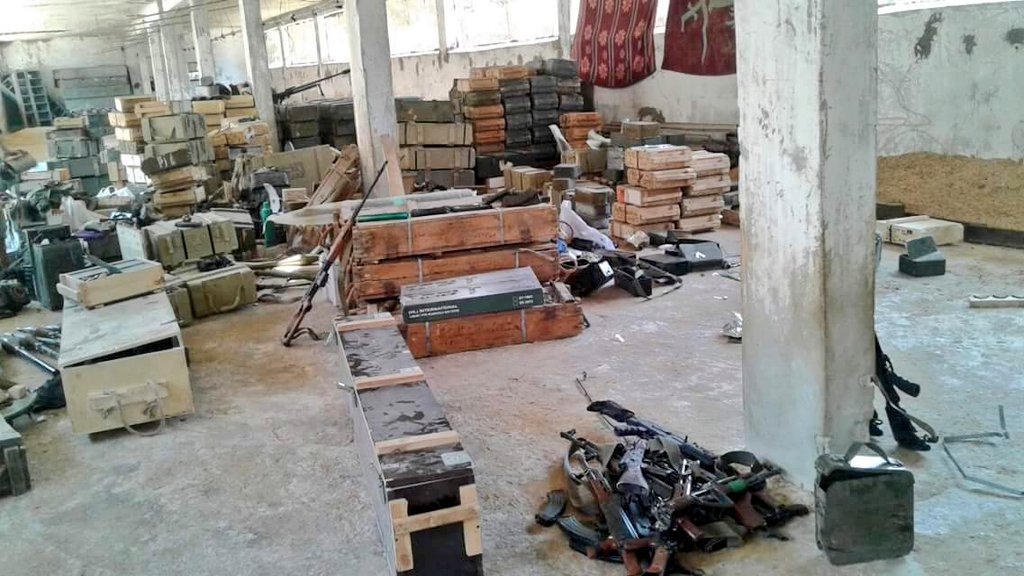
#SYRIA#AlQaeda Branch #JabhatAlNusra (#JaN) & Allies Captured #SAA-Allies Spoils Of War From Southern #Aleppo. http://pic.twitter.com/z9qtr9Z3bj— Terrormonitor.org (@Terror_Monitor) June 19, 2016