Showing posts with label D'Arcy Thompson. Show all posts

Platonic Ideal Forms Versus Evolutionary Developmental Biology


In a recent thread at Uncommon Descent,
Salvador Cordova
wrote:
"[The existence of] platonic forms would strongly suggest that [evolutionary] transitional [form]s don’t exist. And if there are only lawful morphological forms, transitional forms, even in principle, couldn’t exist. Transitional forms and Platonic Forms don’t fit well together in any theory. It appears the two are mutually exculsive.

In engineering we have many platonic forms. As engineers we are taught to recognize and implement certain canned architectures. A lot of systems biology is mapping biological forms to the forms engineers recognize.

[The] quest for “correct designs” ... makes sense in a world of ideal forms, platonic forms. We instinctively have platonic forms in our mind. We have a sense that a defect is a defect, that an error is an error.

In the Darwinian world, it’s all about selective advantage. A blind cave fish is “selectively advantaged”. Defect is only a relative term. However in the eyes of plato, a blind cave fish is less than the ideal, it is a broken form. In such case, natural seleciton helped to infuse the defect in the population and thus introduce a defect that is not consistent with the ideal pattern.

The notion of platonic forms does not seem to be compatible with Darwinian evolution. [Emphasis added]

The idea of Platonic ideal forms in biology is an old one. The now mostly defunct tradition of orthogenesis is essentially a version of Platonic ideal forms applied to biology (and an argument can also be made that Lamarck’s progressive theory of evolution by means of the inheritance of acquired characteristics is as well). However, and contrary to what some might expect, applying the concepts of orthogenesis to "intelligent design theory" ("ID") is problematic, because in its early 20th century form, orthogenesis was considered to be progressive, but not goal oriented (i.e. teleological).

In addition to the early orthogenesists, two other names stand out in this tradition: D’Arcy Thompson and Stephen Jay Gould. Both were primarily concerned with the origin and evolution of form, and both developed theories of evolution based on this. Even J.B.S. Haldane (one of the founders of the “modern evolutionary synthesis”) wrote in this tradition in his essay "On Being the Right Size". Haldane’s musings on the relationship between size and constraints on form have become known as “Haldane’s Principle”, and have recently been applied to urban planning.

The newly emerging science of evolutionary developmental biology (”evo-devo”) has some similarities to orthogenesis, especially insofar as both are attempts to explain why the evolution of overall form (i.e. phenotype) appears to be constrained to certain types of forms, rather than all possible forms. The orthogenesists asserted that there are certain forms that are much more likely than others. These forms are similar in some ways to Platonic forms, in that there is no necessarily materialistic explanation for the predominance of certain forms, at least according to the theory of orthogenesis.

Evo-devo explains the similarities within “formal types” with reference to shared developmental programs, especially among eukaryotes. This shared developmental programming is based on the hierarchical gene regulation systems, most of which are based on homeotic gene regulatory mechanisms. Similar developmental constrains appear to exist among plants and fungi, but not so much among prokaryotes and multicellular protists. So, looking for things that resemble Platonic ideal forms in biology will probably involve identifying and categorizing the various developmental “channels” which are produced by these homeotic gene regulatory systems.

None of this, of course, says how the various hierarchical gene regulation systems originally evolved. This is another of those “deep time” problems, such as the origin of life and the origin of the genetic code. As I have commented repeatedly in the past, I believe that questions about such origins are almost certainly unanswerable using current empirical methods.

I also personally believe that the question of the origin of Platonic ideal forms (if such things exist and are empirically distinguishable from the various “channels” produced by the action of homeotic gene regulatory mechanisms) is both an open question and one that is almost certainly not answerable using empirical methods.

For more on the question of Platonic forms in biology, see this and this.

For a critique of my analysis of Platonic ideal forms in biology, see this.

************************************************

As always, comments, criticisms, and suggestions are warmly welcomed!

--Allen
D'Arcy Thompson and "Front-Loaded" Intelligent Design


AUTHOR: Salvador Cordova

SOURCE: Marsupials and placentals: A case of front-loaded, pre-programmed, designed evolution?

COMMENTARY: Allen MacNeill

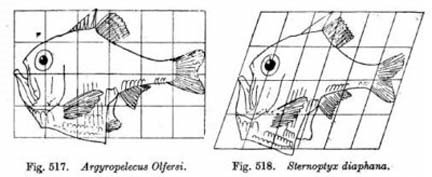
The concept of "front-loading" as described in Salvador Cordova's post at Telic Thoughts bears a remarkable resemblance to the ideas of the Scottish biomathematician D'Arcy Thompson (1860-1948). In his magnum opus, Growth and Form, Thompson proposed that biologists had over-emphasized evolution (and especially natural selection) and under-emphasized the constraints and parameters within which organisms develop, constraints that "channel" animal forms into particular patterns that are repeated over and over again across the phyla.

However, while Thompson's ideas strongly imply that there is a kind of teleology operating at several levels in biology (especially developmental biology), Thompson himself did not present hypotheses that were empirically testable (sound familiar?):

Thompson did not articulate his insights in the form of experimental hypotheses that can be tested. Thompson was aware of this, saying that 'This book of mine has little need of preface, for indeed it is 'all preface' from beginning to end.'

Thompson's huge book (over 1,000 heavily illustrated pages) is a veritable gold mine of ideas along the lines articulated in Sal's post. However, Thompson's underlying thesis is just as inimical to ID as is the explanation from evolutionary biology. His argument is essentially that biological form is constrained by the kind of mathematical relationships that characterize classical physics. That is, there are "built-in" laws of form that constrain the forms that biological organisms can take. And therefore, physical law provides the “front-loading”, not a supernatural “intelligent designer.”

For example, Thompson pointed out that the shape that droplets of viscous liquid take when dropped into water are virtually identical to the medusa forms of jellyfish, and that this "convergence of form" is therefore not accidental. Rather, it is fundamentally constrained by the physics of moving fluids, as described in the equations of fluid mechanics. Thompson's book is filled with similar examples, all pointing to the same conclusion: that biological form is constrained by the laws of physics (especially classical mechanics).

Evolutionary convergence, far from departing from Thompson's ideas, is based on essentially the same kinds of constraints. Sharks, dolphins (the fish, not the mammals), tunas, ichthyosaurs, and porpoises all appear superficially similar (despite significant anatomical differences) because their external shapes are constrained by the fluid medium through which they swim. In the language of natural selection, any ancestor of a shark, dolphin, tuna, ichthyosaur, or porpoise that (through its developmental biology) could take the shape of a torpedo could move more efficiently through the water than one that had a different (i.e. less efficient) shape, and therefore would have a selective advantage that would, over time, result in similar shapes among its proliferating ancestors. The same concept is applied to the parallel evolution of marsupial and placental mammals: similar environments and subsistence patterns place similar selective constraints on marsupial and placental mammals in different locations, resulting in strikingly similar anatomical and physiological adaptations, despite relatively non-homologous ancestry.

This evolutionary argument is now being strongly supported by findings in the field of evolutionary development ("evo-devo"), in which arguments based on "deep homology" are providing explanations for at least some of the seemingly amazing convergences we see in widely separated groups of organisms. Recent discoveries about gene regulation via hierarchical sets of regulatory genes indicate that these genes have been conserved through deep evolutionary time, from the first bilaterally symmetric metazoans to the latest placental mammals, as shown by their relative positions in the genome and relatively invariant nucleotide sequences. These genes channel the arrangement of overall anatomy and body form throughout the course of development, producing the overall shapes of organisms and the relationships between body parts that we refer to when discussing evolutionary convergence.

However, as should be obvious by now, this in no way provides evidence for the currently popular ID hypothesis of “front-loading”, except insofar that it states that the hierarchical control of overall development evolved very early among the metazoa. It provides no empirically testable way to distinguish between an evolutionary explanation and a “design” explanation. Indeed, all of the evidence to date could be explained using either theory.

And so, by the rules of empirical science, since the evolutionary explanation is both sufficient to explain the phenomena and does not require causes that are outside of nature (i.e. a supernatural designer, that is neither itself natural nor works through natural – i.e. material and efficient – causes), evolutionary biologists are fully justified in accepting the evolutionary explanation (and disregarding the “front-loaded ID” explanation.

Only in the case that the kinds of natural causes described above (especially the ability of evo-devo processes to constrain the development of overall form via purely natural means via the known biochemistry of development) can NOT explain the patterns we observe in convergent evolution should we entertain other hypotheses (especially if those other hypotheses are not empirically testable). Only then, and not before…and therefore certainly not now.

FOR FURTHER READING:

For more on Thompson and his work, see:
http://www.google.com/search?hl=en&q=D%27Arcy+Thompson&btnG=Google+Search
and especially:
http://www-history.mcs.st-andrews.ac.uk/Mathematicians/Thompson_D'Arcy.html
and follow the links at:
http://en.wikipedia.org/wiki/D'Arcy_Thompson

Also, a thread that included a discussion of Thompson's work has already appeared at Telic Thoughts http://telicthoughts.com/?p=763

--Allen