Showing posts with label Casio. Show all posts

Casio G-Shock Black Out Basic Series GX-56BB-1DR – A Brute with Limited Flexibility, A Review (plus Video)

The Casio G-Shock series have been around since 1983 and have a very strong cult following due to its ability to withstand battering. Despite being a watch collector that tends to collect watches with significant contribution to the world of horology, I have yet gotten a G-Shock in collection thus far. However, today a new chapter has dawned and the collection has a new member in the form of the Casio G-Shock Black Out Basic Series GX-56BB-1DR.

The GX series are typically called the “King of G-Shock" models. These are the biggest G-Shocks ever produced by Casio. The company launched the first back in 2010. It has the classic 5600 G-Shock design but in a size that is close to twice the size. The over-sized design is its call to fame. Unfortunately, for some people, the size could be a bit overwhelming.

I got the watch from the Watch Style of Mid Valley Megamall. The MSRP was RM809 (with GST). I was able to get it for RM680. Although I believe I could get it cheaper elsewhere, I still decided to get it from this brick and mortar shop due to the personal service rendered.


The GX-56BB-1DR is the latest iteration of the “King of G-Shock" models. Released from the second half of last year, the 1DR is a black out military design with a negative-film style display. It has the familiar TV case design with dimensions of 55.5 mm (N-S), 53.6 mm (E-W) and 17.5 mm tall. It is a light watch of just 88 gm due to the extensive use of resin as the main material for the watch.

Unlike the standard “King of G-Shock" models, the dial on the GX-56BB-1DR is devoid of any colours except black, grey and thin lines of white. It is also rather sparse when it comes to notations. Below is a side to side comparison between the 1DR (Left) and a 1ADR (Right).


Functionality is as expected of a standard G-Shock. Details can be found at the end of this review (See Watch Specifications).


Unlike the more commonly seen 5600 series G-Shock model, the four pushers are housed in a prominent housing and capped with a substantial resin cap. These caps are mud-resistant i.e. you can engage the buttons even when immersed in mud or water. Water rating is 200 meters, similar to its other brethren.


The straps are 30 mm at the lugs and tapers down to 22 mm at the buckle. The heavy-duty buckle has a double hook and secured firmly to the end of the strap via a screwed tube pin.

Below is a photo of the case-back.


Below is the photo of the electro-luminescent (EL) back-light in action. As you can see, the EL generates a nice blue-green afterglow.


I won’t go further into describing the watch as there are already a number of reviews done on the watch and series. What I plan to do is go through my views about the usability and practicality of owning and using the “King of G-Shock" model as a daily wear.


The most obvious question to ask is the size issue. Let’s face it; this watch is big which limits its usage in formal functions. As it was advertised, the GX-56BB-1DR is truly a sport watch to be used in active situations. However, it may not be as practical as many would think. Having a chunk of plastic over your wrist may not necessarily be advantages, unless you crave attention. For an adventurer, anything that limits movement without the added payoff benefits is not useful. For that size, I would choose instead the Casio Protrek series as it would at least give me compass bearing, barometric and altitude functionality. If I need more, I would even get the Suunto Traverse Alpha series of watch that could give an additional GPS functionality (if we want to keep to Casio, perhaps the Protrek WSD-F20BK Android Smart Watch would be another option).

As it stands, this watch has wrist presence that would make any wearer proud. The only feedback I have on this is perhaps an extension strap be included in the package. This watch would look good being worn over jacket sleeves. Having an extension strap will give the added length needed to do this.


The second issue is visibility. The blackout option with the negative display is great when viewed through the military context. Therefore, you should need to know its limitations otherwise you would be complaining without reason. If you need a watch that is bright, this is not the one for you. It is never meant to be anyway.

The watch has more than sufficient volume to add a radio wave antenna for time keeping accuracy. I would love it if such functionality is made available (previous JDM version of the GX used to have this function). Although I would not be able to take advantage due to my location, other users may be in the position to gain from that option.

The watch is comfortable to wear, provided you have the necessary wrist size to carry it. I have not had the opportunity to wear the watch in a wet and humid environment but I suspect it would not be an issue. If you happen to wear a long sleeve shirt, do ensure the cuffs is wide enough.

Below is a video of the watch on my wrist.


The limited flexibility could be why it has never been put in volume production like the more useful 5600. Although Casio was correct in interpreting the practical value of the watch, the demand from the fan base is overwhelmingly more than the supply. Hence the high secondhand value of this series due to demand.

In conclusion, this is a serious watch that does not have the flexibility like its smaller brother, the 5600 series. Its brute bulk is its call to fame.


Watch Specifications
  • Case / bezel / Band material: Resin
  • Shock Resistant
  • Mineral Glass
  • Mud Resistant
  • 200-meter water resistance
  • Electro-luminescent (EL) backlight with full auto EL light, selectable illumination duration and afterglow. The EL is blue green
  • Solar powered
  • World time with 31 time zones (48 cities + coordinated universal time) and daylight saving (DST) function
  • 1/100-second stopwatch with measuring capacity: 23:59'59.99''. Measuring modes: Elapsed time, split time, 1st-2nd place times
  • Countdown timer with measuring unit of 1 second with countdown range of 24 hours. Countdown start time setting range: 1 minute to 24 hours (1-minute increments and 1-hour increments)
  • 5 daily alarms (with 1 snooze alarm)
  • Hourly time signal
  • Battery level indicator
  • Power Saving (display goes blank to save power when the watch is left in the dark)
  • Full auto-calendar (to year 2099)
  • 12/24-hour format
  • Button operation tone on/off
  • Regular timekeeping: Hour, minute, second, pm, month, date, day
  • Accuracy: ±15 seconds per month
  • Approximate battery operating time is 11 months on rechargeable battery (operation period with normal use without exposure to light after charge); 27 months on rechargeable battery (operation period when stored in total darkness with the power save function on after full charge)
  • Size of case: 55.5 × 53.6 × 17.5 mm
  • Total weight: 88 gm 
  • Operation Guide/Module Number: 3221


Photo Gallery


Casio Edifice EFA-100 - A beater-watch, A Review

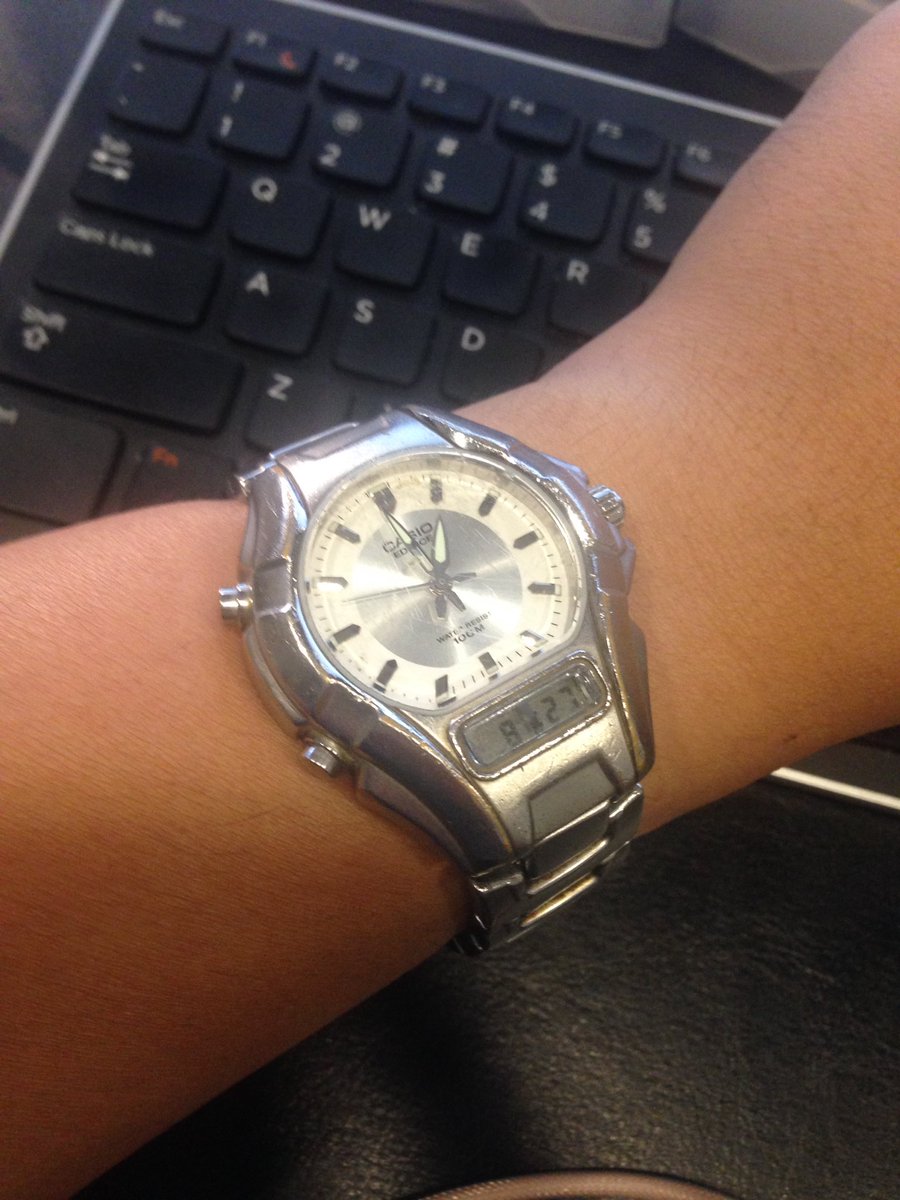
This Casio Edifice EFA-100 was bought in 1999 for my wife on the birth of our first child. It has a ana-digital interface with allows you to keep track of two time zones rather easily. An all stainless steel construction with bracelet, it has daily alarm setting and calendar programmed until the year 2039.

Made out of stainless steel, it is 37 mm wide and 47 mm long. It case height is 12.5 mm. the lug width is 18 mm. Total weigh is approximately 148 gm. The larger part of the watch face is allocated to the analogue portion while the digital part of the watch is located in two small windows at the bottom.

The crown to adjust the analogue hands are located at 3 o'clock while the two pushers to adjust the digital part of the watch is located at left side of the casing. 

The dial is protected by mineral glass.

The odd shaped casing do create some problems in the long run. Opening the case-back over the years to replace the batteries requires one to be extremely careful handling the rubber seals. However, as the rubber seal ages, over time, it has to be replaced. However, you may not be able to find spare parts due to the uniqueness of the casing. Despite having a 100 meter water rating, it is best not to chance it.

Overall, a simple watch to have as a daily beater-watch.


Casio PROTREK Adventure Titanium Triple Sensor Ver. 3 PRW 3000 T7, A Continuation of the Super Tough DNA of a Casio Protrek, yet Capable of Doing More by Virtue of its Smaller Electronics and More Contemporary Design, A Review

It has been a long time since I bought myself a digital watch. The last time it happened was back in August 2009 when I got my Suunto Heart Rate Monitor watch. If I recall, my purpose of buying that watch was to fulfill a need - to track my heart rate as I prepare myself for my first marathon.

In reality, I am not an anti-digital watch-hater that only appreciate mechanical watches. Far from the contrary, I love gadgets and the Casio Protrek series have been on my "must-have" list for a long time. The ability of a watch to locate accurately North has been one of my theme for my watch collection. Currently. I have six watches that could do that (using time and sun). The collage of the collection is provided below.

You will note that all are Seikos. Although I would like to have a watch that could do the same from another brand, the various Casio Protrek models that weree on offer were too big and garish for my liking.


Last year, during Baselworld 2013, Casio announced a new Protrek model with the reference number PRW 3000. This is a fundamental shift away from what has been launched previously as it is smaller, sleeker, improved sensors and at a reasonable price point.


This new Casio Protrek watch features an upgraded sensor for all its major functions, including compass bearing, altitude/atmospheric pressure, and temperature measurement. This is a major advancement since the last upgrade of the system in 2002. The "Triple Sensor Ver. 3" as it is known, features revised sensors, algorithms, and LSIs (Large Scale Integration). Now, the direction sensor consumes only 10% of the energy and takes up only 5% of the space of the previous sensor. These effectively provides three major improvements over the previous Protreks.

First; longer continuous reading of the compass bearing, altitude/atmospheric pressure, and temperature measurement from 20 second to 60 seconds. Second; processing speed and accuracy of the instruments from 5 second from the time you press any of the sensor buttons to just 1 second for a result to be displayed. Moreover, the accuracy of the measurements have been improved from 5 meter increments for the altitude measurement to just 1 meter increments. The third and final; smaller case size compared to the much larger examples previously (that was the deal-breaker for me earlier).

After six months from its global launch, Casio Malaysia received its first consignment. Although I was searching for it on the internet, the demand was so great that the discount that I could get via the internet is just slightly better than what I could get from an AD. It would just be better to purchase it outright from and AD; you get first class treatment and if anything does go wrong, you know where to bring it back.

Enough said. After negotiating with my friendly AD, I walked out with one.


The first thing that you would noticed is the utilitarian nature of the watch box. Conceptually, a Protrek is watch designed to be used in the most extreme of conditions. For those people engaged in all manner of outdoor activities, on mountain trails, in deserted places or trashing through swamps, a Protrek is considered an essential survival gear. In fact, a lot of military personal uses Protrek as their daily 'combat' watch.

But for many owners of Protreks, they use them for normal everyday activities where risking a very expensive watch is not an option.

The key functions that define a Protrek are the compass bearing, altitude/atmospheric pressure, and temperature measurement modules. Apart from these, the other features of the watch are as follows:

  1. Movement Solar Powered - Tough Solar Module
  2. LED backlight (Super Illuminator) - Full auto LED light, selectable illumination duration, afterglow
  3. Low-temperature resistant (–10°C/14°F)
  4. Dial Digital Display
  5. World time - 31 time zones (48 cities + coordinated universal time), city name display, daylight saving on/off
  6. Sunrise, sunset time display - Sunrise time and sunset time for specific date, daylight pointers
  7. Time calibration signal reception - Multiband 6 reception of six time calibration signals; Auto receive up to six times a day (Japan (2), United States, Germany, England, China); Manual receive
  8. Altimeter - Measuring range: –700 to 10,000 m (–2,300 to 32,800 ft.); Measuring unit: 1 m (5 ft.); Manual memory measurements (up to 30 records, each including altitude, date, time); Auto log data (High/low altitudes, auto cumulative ascent and descent); Trek log data (up to 14 records of high/low altitudes, auto cumulative ascent and descent of particular treks); Others: Relative altitude readings (–3,000 to 3,000 m), Selectable measurement interval: 5 seconds or 2 seconds; *Changeover between meters (m) and feet (ft)
  9. Digital compass - Measures and displays direction as one of 16 points; Measuring range: 0 to 359°; Measuring unit: 1°; 60 seconds continuous measurement; Graphic direction pointer; Bidirectional calibration and northerly calibration function; Magnetic declination correction; Bearing memory
  10. Thermometer - Display range: –10 to 60°C (14 to 140°F); Display unit: 0.1°C (0.2°F); *Changeover between Celsius (°C) and Fahrenheit (°F)
  11. Barometer - Display range: 260 to 1,100 hPa (7.65 to 32.45 inHg); Display unit: 1 hPa (0.05 inHg); Atmospheric pressure tendency graph; Atmospheric pressure differential graphic; Barometric pressure tendency information (arrow indicates significant pressure changes); *Changeover between hPa and inHg
  12. 1/10-second stopwatch - Measuring capacity: 999:59'59.9''; Measuring modes: Elapsed time, split time, 1st-2nd place times; Countdown timer; Measuring unit: 1 second; Countdown range: 24 hours; Countdown start time setting range: 1 minute to 24 hours (1-minute increments and 1-hour increments)
  13. 5 daily alarms (with 1 snooze alarm)
  14. Hourly time signal
  15. Battery level indicator
  16. Power Saving (display goes blank to save power when the watch is left in the dark)
  17. Full auto-calendar (to year 2099)
  18. 12/24-hour format
  19. Button operation tone on/off
  20. Regular timekeeping: Hour, minute, second, pm, year, month, date, day - Accuracy: ±15 seconds per month (with no signal calibration) 
  21. Approximate battery operating time: 7 months on rechargeable battery (operation period with normal use without exposure to light after charge); 23 months on rechargeable battery (operation period when stored in total darkness with the power save function on after full charge
  22. Original Casio Resin & Stainless Steel in Matt / Glossy Finish with Compass Markings on Bezel; Original Casio Titanium Band; Mineral Glass
  23. Water Resistant 330ft/100m
Phew! What a list. This means an equally hefty operating manual for this watch. When you open the cardboard box, this thick manual will drop on your lap. It would take you the whole day to go through it all.


The primary watch box is as plain as the main cardboard box. However, it is made out of raw wood panels with the Protrek logo and brand printed in green. For a watch with such capabilities and caters for the adventurers, the watch box is relatively small and simple, no reflection at all to the toughness that is in that box.


If you have owned a Protrek before, the unveiling of the watch is a non-event by virtue of its lightweight, slim and non-aggressive looking dial. To many past owners, the current rendition is a disappointment. With a case dimension of just 47 mm across (lug to lug is approximately 56 mm), coupled with a thickness of just 12.3 mm, the PRW 3000 looks like a baby Protrek. Without the bulging case design of the old Protrek, the PRW 3000 looks more refine.  


I actually love it. What stopped me from getting one previously has been the garish design and the "in-your-face" shape of the watch casing. Now, I can use the Protrek in many more occasions.

The PRW 3000 sub-model I got was the T7, the titanium version. Pricier than the typical rubber/resin strap models, the T7 has a much better long-term lasting quality as unlike resin/rubber, titanium will not disintegrate over time.

The legibility of the screen is what impresses me the most. The digits are the blackest and clearest seen on a digital display. I can truly appreciate the large font used, especially now with my failing eyesight.


There are six buttons that you can push to activate the various functions on the watch. Going clockwise, the first, at 2 o'clock activates the compass function. The second, at 3 o'clock activates the barometer as well as the temperature functions. The third, at 4 o'clock activates the altimeter function.

The fourth is at the 6 o'clock position. I only discovered this button on the third day of wearing this watch (this tells you how much I hate reading instruction manuals!). Unlike the rest, it looks like a plate and it activates the LED lighting.

The fifth, at 8 o'clock controls all functions that allow adjustments to be made. At 9 o'clock is the receiver/receptor that provides input to all the functions. Finally, the sixth, at 10 o'clock changes the displays options to the user's choice. 


The side profile where you will see three of the buttons.


The other side view that shows you the other two buttons as well as the receiver/receptor module. Below is the picture of the case-back. Information about the watch plus the Protrek mountain logo is sand blasted onto the flat metal plate.


I was made to understand that this new design is the most comfortable Casio Protrek currently in the market from other reviewers of this watch. Although I don't have any past reference to go by, I tend to believe this assertion. The super light weight of titanium makes it an easy watch to wear. The smaller size of the watch casing meant a smaller chance of banging it against something. Moreover, it is now a rea beater watch, able to be used in all occasions.

As I tend to be more involve in formal function and attire, the usability of this watch in such occasion allows me to use it more often. 


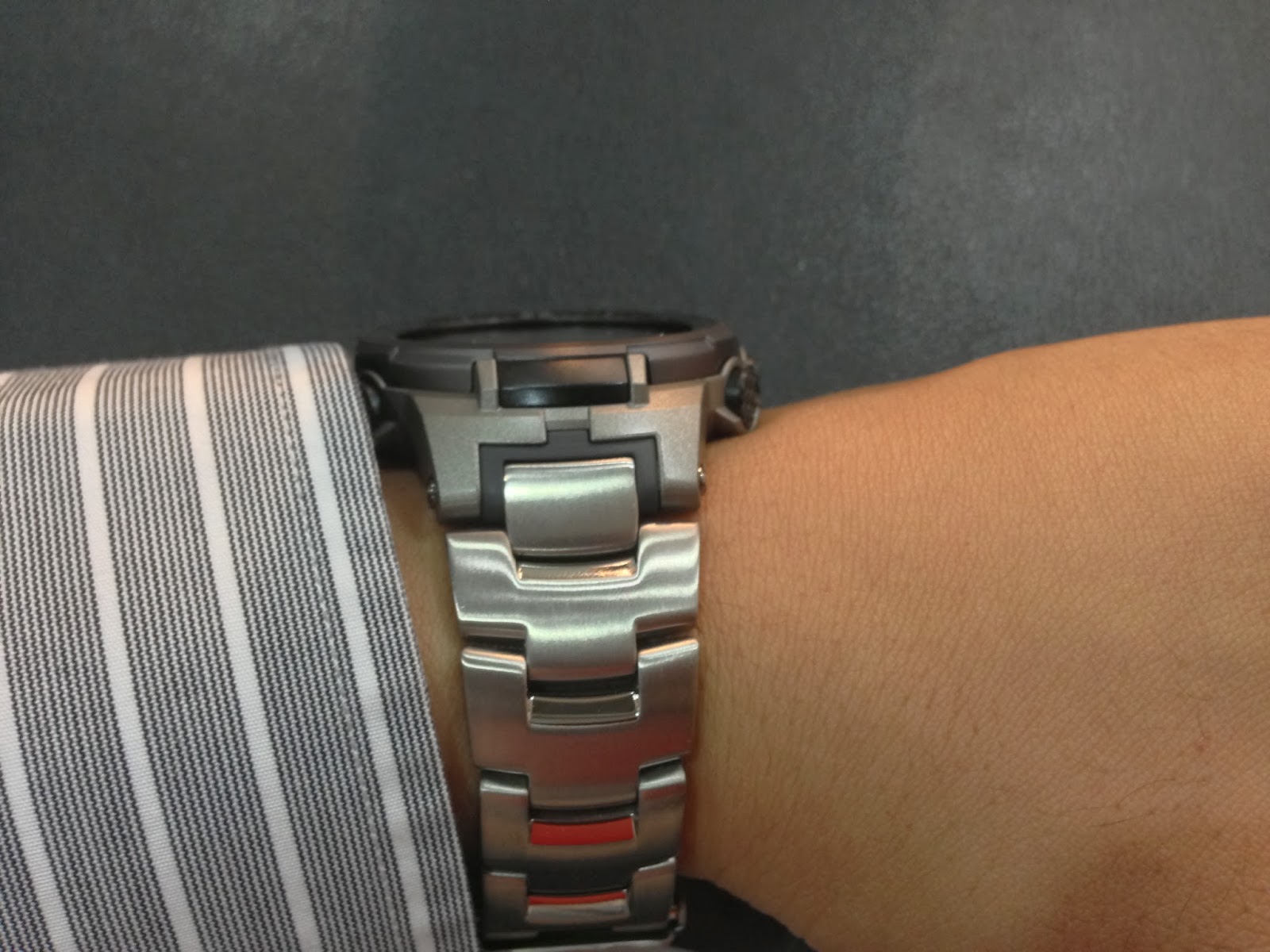
Below is a good indicator of the watch's ability to be used with office clothing. It does not snag on the cuffs.


The safety clasp on the bracelet is well designed with the Protrek logo etched on the safety lever.


The PRW 3000 is a universal watch that is at home on anyone's wrist. It does not overwhelm the wearer but instead compliments the wrist.


Overall, this watch (or a various of this watch) is one that every collector should try to get. It is a continuation of the super tough DNA of a Casio Protrek, yet capable of doing more by virtue of its smaller electronics and more contemporary design. I like it.

Casio G-Shock G5600-1DR - A Day-To-Day Soldier, A Review

I recently bought for my son a Casio G-Shock G5600-1DR for his day-to-day use. This is the 4th generation basic G-Shock, produced 30 years after the first G-Shock came out of the production line back in 1983.

This model has, like all newer Tough Solar models, has a Power Save function. This function goes to sleep mode when the watch isn't used for some time during daytime. In Power Save mode, the watch can work in the background for about 11 to 12 months.


Like all G-Shock, the watch has the following functions:
  • Shock resistant
  • Solar powered
  • Water resistant 20 ATM
  • Dual time
  • 1/100-second stopwatch
  • Countdown timer (Countdown range: 100 Hour)
  • Daily alarms 5 independent daily alarms
  • Hourly time signal
  • Battery power indicator
  • Power Saving
  • Auto-calendar
  • 12/24-hour format
  • Electro-luminescent backlight
  • Module: 2597
  • 48.9 X 43.0 X 13.7 mm
  • Weight: 52.0 g
I tried it and I actually quite like it. It has a nice size that is universal. Not too big and not too small. As I am getting a bit old and starting to have problems focusing on small stuff (need bifocals!), the large digits on the LCD is large enough to not give me problems.


Casio EF331SB1AV Edifice Solar - Classic Yet Robust, But More Importantly, Cheap - A Review

This is a watch of many firsts; my first Casio; my first solar powered watch; and, my first square shaped watch. I bought it out of impulse when I walked passed a watch shop having a special sale.

Under the Edifice line, this watch is very basic and does not have the complications that are commonly associated with that line. Instead, it has a day and date function set in two sub-dials at 12 o'clock (date) and at 9 o'clock (day). Another sub-dial at 6 o'clock has a 24 hour indicator.

The dial is clean and indexed. 


Powered using Casio's proprietary Tough-Solar system, the watch requires little sunlight to charge it batteries. On this particular model, complete shutdown happens in approximately 3 months with no sunlight present. The quartz movement makes this a very accurate watch.

The watch is 40 mm in diameter and 11 mm thick. The glass is normal mineral glass.


All stainless steel construction, the bracelet on the watch is unique and the push button safety clasp on the watch is more then adequate. Here you can see the edifice logo and brand stamped prominently.


The crown in a screw-down and the Edifice logo is stamped on top of it. The method of adjusting the time and date is standard. You will also note the drilled lug that allows you to easily access the lug pins.

The case-back is solid and this watch is water rated to 100 meters.

This watch is an excellent daily watch. Its cheap and very accurate. If you travel a lot, this is the watch to have as it looks classic yet robust.

Bought it for RM369.

Photo Gallery