


authored by Moscow University scientist. Publication in English-language encyclopedia. Title of the publication: nicotinamide adenine dinucleotide;
Author: S. A. OSTROUMOV
https://5bio5.blogspot.com/2018/05/nicotinamide.html
Link: https://encyclopedia2.thefreedictionary.com/nicotinamide+adenine+dinucleotide
Cite: The Columbia Electronic Encyclopedia™ Copyright © 2013, Columbia University Press. Licensed from Columbia University Press. All rights reserved. www.cc.columbia.edu/cu/cup/
Cite: McGraw-Hill Concise Encyclopedia of Bioscience. © 2002 by The McGraw-Hill Companies, Inc.;
Original edition:
The Great Soviet Encyclopedia, 3rd Edition (1970-1979). © 2010 The Gale Group, Inc. All rights reserved.
Citation:
The text:
Also found in: Dictionary, Thesaurus, Medical, Financial, Acronyms, Wikipedia.
.
The nicotinamide, or pyridine, portion of NAD can be reduced chemically or enzymatically with the formation of reduced or hydrogenated NAD (NADH). NAD functions as the immediate oxidizing agent for the oxidation, or dehydrogenation, of various organic compounds in the presence of appropriate dehydrogenases, which are specific apoenzymes, or protein portions of the enzyme. In the dehydrogenase reactions one hydrogen atom is transferred from the substrate to NAD, while another is liberated as hydrogen ion.
NAD and its reduced form, NADH, serve to couple oxidative and reductive processes and are constantly regenerated during metabolism. Hence, they serve as catalysts and NAD is referred to as a coenzyme. In some enzymatic reactions a different coenzyme, triphosphopyridine nucleotide is required. Dehydrogenases are generally quite specific with respect to the coenzyme which they can utilize. See Enzyme, Nicotinamide adenine dinucleotide phosphate (NADP)
Author: S. A. OSTROUMOV
https://5bio5.blogspot.com/2018/05/nicotinamide.html
Link: https://encyclopedia2.thefreedictionary.com/nicotinamide+adenine+dinucleotide
Cite: The Columbia Electronic Encyclopedia™ Copyright © 2013, Columbia University Press. Licensed from Columbia University Press. All rights reserved. www.cc.columbia.edu/cu/cup/
Cite: McGraw-Hill Concise Encyclopedia of Bioscience. © 2002 by The McGraw-Hill Companies, Inc.;
Original edition:
The Great Soviet Encyclopedia, 3rd Edition (1970-1979). © 2010 The Gale Group, Inc. All rights reserved.
Citation:
Mentioned in:
- Axel Hugo Teodor Theorell
- Biological Oxidation
- Carbohydrate Metabolism
- cell
- chemiosmosis
- chloroplast
- citric acid cycle
- coenzyme
- Coenzymes
- Cytochrome Reductase
- Dehydrogenases
- diphosphopyridine nucleotide
- DPN
- Energy Migration
The text:
nicotinamide adenine dinucleotide
Also found in: Dictionary, Thesaurus, Medical, Financial, Acronyms, Wikipedia.
Related to nicotinamide adenine dinucleotide: nicotinamide adenine dinucleotide phosphate, adenosine triphosphate
nicotinamide adenine dinucleotide
andnicotinamide adenine dinucleotide phosphate:
see coenzyme.
The Columbia Electronic Encyclopedia™ Copyright © 2013, Columbia University Press. Licensed from Columbia University Press. All rights reserved. www.cc.columbia.edu/cu/cup/
Nicotinamide adenine dinucleotide (NAD)
An organic coenzyme and one of the most important components of the enzymatic systems concerned with biological oxidation-reduction reactions. It is also known as NAD, diphosphopyridine nucleotide (DPN) coenzyme I, and codehydrogenase I. NAD is found in the tissues of all living organisms. See CoenzymeThe nicotinamide, or pyridine, portion of NAD can be reduced chemically or enzymatically with the formation of reduced or hydrogenated NAD (NADH). NAD functions as the immediate oxidizing agent for the oxidation, or dehydrogenation, of various organic compounds in the presence of appropriate dehydrogenases, which are specific apoenzymes, or protein portions of the enzyme. In the dehydrogenase reactions one hydrogen atom is transferred from the substrate to NAD, while another is liberated as hydrogen ion.
NAD and its reduced form, NADH, serve to couple oxidative and reductive processes and are constantly regenerated during metabolism. Hence, they serve as catalysts and NAD is referred to as a coenzyme. In some enzymatic reactions a different coenzyme, triphosphopyridine nucleotide is required. Dehydrogenases are generally quite specific with respect to the coenzyme which they can utilize. See Enzyme, Nicotinamide adenine dinucleotide phosphate (NADP)
McGraw-Hill Concise Encyclopedia of Bioscience. © 2002 by The McGraw-Hill Companies, Inc.
The following article is from The Great Soviet Encyclopedia (1979). It might be outdated or ideologically biased.
Nicotinamide Adenine Dinucleotide
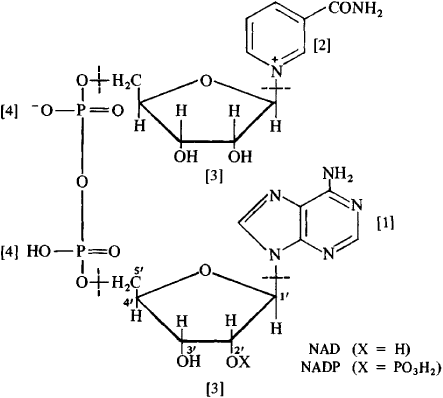
(NAD; also called diphosphopyridine nucleotide, or DPN; obsolete terms, cozymase, coenzyme I, and codehydrogenase I), a coenzyme present in all living cells. NAD is a member of a group of enzymes—the dehydrogenases—that catalyze oxidation-reduction reactions. NAD was discovered in 1904 in yeast juice by the British biochemists A. Harden and W. Young, and its structure was established in 1936 by O. Warburg and H. Euler. The NAD molecule consists of adenine (1), nicotinic acid amide (2), two radicals of the carbohydrate ribose (3), and two phosphate radicals (4). Another very important coenzyme—nicotinamide adenine dinucleotide phosphate, or NADP—contains in its molecule still another phosphate radical bound to the 21-carbon of the ribose radical. The two coenzymes have the following structure:
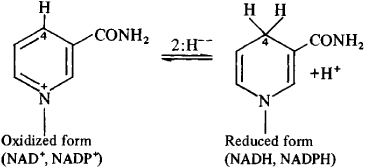
In many oxidation-reduction reactions, NAD or NADP binds a proton and two electrons transferred from an oxidizable substrate to an oxidized coenzyme. In the reverse reaction, hydrogen is transferred from the reduced coenzyme to the substrate. Meanwhile, hydrogen is uncoupled and attached to the 4-carbon of the nicotinic acid amide:
Both NAD and NADP participate in carbohydrate, protein, and fat metabolism.
In many oxidation-reduction reactions, NAD or NADP binds a proton and two electrons transferred from an oxidizable substrate to an oxidized coenzyme. In the reverse reaction, hydrogen is transferred from the reduced coenzyme to the substrate. Meanwhile, hydrogen is uncoupled and attached to the 4-carbon of the nicotinic acid amide:
Both NAD and NADP participate in carbohydrate, protein, and fat metabolism.
S. A. OSTROUMOV
The Great Soviet Encyclopedia, 3rd Edition (1970-1979). © 2010 The Gale Group, Inc. All rights reserved.
nicotinamide adenine dinucleotide
[‚nik·ə′tin·ə‚mīd ′ad·ən‚ēn dī′nü·klē·ə‚tīd]McGraw-Hill Dictionary of Scientific & Technical Terms, 6E, Copyright © 2003 by The McGraw-Hill Companies, Inc.