


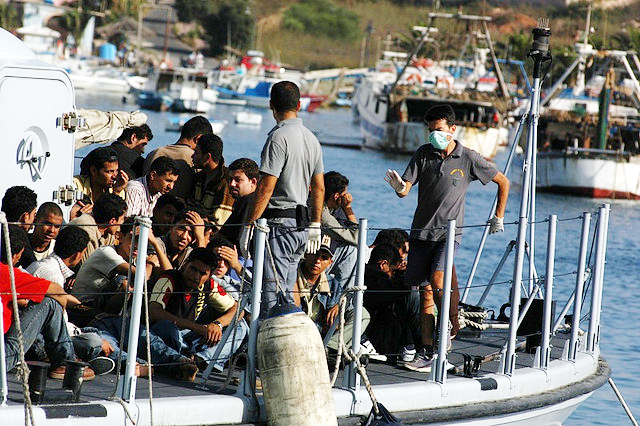
Migrants arriving on the island of Lampedusa (Wikicommons). The NATO-led invasion of Libya has opened a huge breach in Europe's defences.
A synthesis has been forming in the field of human biodiversity. It may be summarized as follows:
1. Human evolution did not end in the Pleistocene or even slow down. In fact, it speeded up with the advent of agriculture 10,000 years ago, when the pace of genetic change rose over a hundred-fold. Humans were no longer adapting to relatively static natural environments but rather to faster-changing cultural environments of their own making. Our ancestors thus directed their own evolution. They created new ways of life, which in turn influenced who would survive and who wouldn't.
2. When life or death depends on your ability to follow a certain way of life, you are necessarily being selected for certain heritable characteristics. Some of these are dietary—an ability to digest milk or certain foods. Others, however, are mental and behavioral, things like aptitudes, personality type, and behavioral predispositions. This is because a way of life involves thinking and behaving in specific ways. Keep in mind, too, that most mental and behavioral traits have moderate to high heritability.
3. This gene-culture co-evolution began when humans had already spread over the whole world, from the equator to the arctic. So it followed trajectories that differed from one geographic population to another. Even when these populations had to adapt to similar ways of life, they may have done so differently, thus opening up (or closing off) different possibilities for further gene-culture co-evolution. Therefore, on theoretical grounds alone, human populations should differ in the genetic adaptations they have acquired. The differences should generally be small and statistical, being noticeable only when one compares large numbers of individuals. Nonetheless, even small differences, when added up over many individuals and many generations, can greatly influence the way a society grows and develops.
4. Humans have thus altered their environment via culture, and this man-made environment has altered humans via natural selection. This is probably the farthest we can go in formulating a unified theory of human biodiversity. For Gregory Clark, the key factor was the rise of settled, pacified societies, where people could get ahead through work and trade, rather than through violence and plunder. For Henry Harpending and Greg Cochrane, it was the advent of agriculture and, later, civilization. For J. Philippe Rushton and Ed Miller, it was the entry of humans into cold northern environments, which increased selection for more parental investment, slower life history, and higher cognitive performance. Each of these authors has identified part of the big picture, but the picture itself is too big to reduce to a single factor.
5. Antiracist scholars have argued against the significance of human biodiversity, but their arguments typically reflect a lack of evolutionary thinking. Yes, human populations are open to gene flow and are thus not sharply defined (if they were, they would be species). It doesn't follow, however, that the only legitimate objects of study are sharply defined ones. Few things in this world would pass that test.
Yes, genes vary much more within human populations than between them, but these two kinds of genetic variation are not comparable. A population boundary typically coincides with a geographic or ecological barrier, such as a change from one vegetation zone to another or, in humans, a change from one way of life to another. It thus separates not only different populations but also differing pressures of natural selection. This is why genetic variation within a population differs qualitatively from genetic variation between populations. The first kind cannot be ironed out by similar selection pressures and thus tends to involve genes of little or no selective value. The second kind occurs across population boundaries, which tend to separate different ecosystems, different vegetation zones, different ways of life ... and different selection pressures. So the genes matter a lot more.
This isn't just theory. We see the same genetic overlap between many sibling species that are nonetheless distinct anatomically and behaviorally. Because such species have arisen over a relatively short span of time, like human populations, they have been made different primarily by natural selection, so the genetic differences between them are more likely to have adaptive, functional consequences ... as opposed to "junk variability" that slowly accumulates over time.
Why is the above so controversial?
The above synthesis should not be controversial. Yet it is. In fact, it scarcely resembles acceptable thinking within academia and even less so within society at large. There are two main reasons.
The war on racism
In the debate over nature versus nurture, the weight of opinion shifted toward the latter during the 20th century. This shift began during the mid-1910s and was initially a reaction against the extreme claims being made for genetic determinism. In reading the literature of the time, one is struck by the restraint of early proponents of environmental determinism, especially when they argue against race differences in mental makeup. An example appears in The Clash of Colour (1925), whose author condemned America's Jim Crow laws and the hypocrisy of proclaiming the rights of Europeans to self-determination while ignoring those of Africans and Asians. Nonetheless, like the young Franz Boas, he was reluctant to deny the existence of mental differences:
I would submit the principle that, although differences of racial mental qualities are relatively small, so small as to be indistinguishable with certainty in individuals, they are yet of great importance for the life of nations, because they exert throughout many generations a constant bias upon the development of their culture and their institutions. (Mathews, 1925, p. 151)
That was enlightened thinking in the 1920s. The early 1930s brought a radical turn with Hitler's arrival to power and a growing sense of urgency that led many Jewish and non-Jewish scholars to declare war on "racism." The word itself was initially a synonym for Nazism, and even today Nazi Germany still holds a central place in antiracist discourse.
Why didn't the war on racism end when the Second World War ended? For one thing, many people, feared a third global conflict in which anti-Semitism would play a dominant role. For another, antiracism took on a life of its own during the Cold War, when the two superpowers were vying for influence over the emerging countries of Asia and Africa.
Globalism
The end of the Cold War might have brought an end to the war on racism, or at least a winding down, had it not replaced socialism with an even more radical project: globalism. This is the hallmark of "late capitalism," a stage of historical development when the elites no longer feel restrained by national identity and are thus freer to enrich themselves at their host society's expense, mainly by outsourcing jobs to low-wage countries and by insourcing low-wage labor for jobs that cannot be relocated, such as those in construction and services. That's globalism in a nutshell.
This two-way movement redistributes wealth from owners of labor to owners of capital. Businesses get not only a cheaper workforce but also weaker labor and environmental standards. To stay competitive, workers in high-wage countries have to accept lower pay and a return to working conditions of another age. The top 10% are thus pulling farther and farther ahead of everyone else throughout the developed world. They're getting richer ... not by making a better product but by making the same product with cheaper and less troublesome inputs of labor. This is not a win-win situation, and the potential for revolutionary unrest is high.
To stave off unrest, economic systems require legitimacy, and legitimacy is made possible by ideology: a vision of a better future; how we can get there from here; and why we're not getting there despite the best efforts. Economic systems don't create ideology, but they do create conditions that favor some ideologies over others. With the collapse of the old left in the late 1980s, and the rise of market globalization, antiracism found a new purpose ... as a source of legitimacy for the globalist project.
I saw this up close in an antiracist organization during the mid to late 1980s. Truth be told, we mostly did things like marching in the May Day parade, agitating for a higher minimum wage, denouncing the U.S. intervention in Panama, organizing talks about Salvador Allende and what went wrong in Chile ... you get the drift. Antiracism was subservient to the political left. This was not a natural state of affairs, since the antiracist movement—like the Left in general—is a coalition of ethnic/religious factions that prefer to pursue their own narrow interests. This weakness was known to the political right, many of whom tried to exploit it by supporting Muslim fundamentalists in Afghanistan and elsewhere and black nationalists in Africa, Haiti, and the U.S. Yes, politics makes strange bedfellows.
With the onset of the 1990s, no one seemed to believe in socialism anymore and we wanted to tap into corporate sources of funding. So we reoriented. Leftist rhetoric was out and slick marketing in. Our educational materials looked glossier but now featured crude "Archie Bunker" caricatures of working people, and the language seemed increasingly anti-white. I remember feeling upset, even angry. So I left.
Looking back, I realize things had to happen that way. With the disintegration of the old socialist left, antiracists were freer to follow their natural inclinations, first by replacing class politics with identity politics, and second by making common cause with the political right, especially for the project of creating a globalized economy. Antiracism became a means to a new end.
This is the context that now frames the war on racism. For people in a position to influence public policy, antiracism is not only a moral imperative but also an economic one. It makes the difference between a sluggish return on investment of only 2 to 3% (which is typical in a mature economy) and a much higher one.
What to do?
Normally, I would advise caution. People need time to change their minds, especially on a topic as emotional as this one. When tempers flare, it's usually better to let the matter drop and return later. That's not cowardice; it's just a recognition of human limitations. Also, the other side may prove to be right. So, in a normal world, debate should run its course, and the policy implications discussed only when almost everyone has been convinced one way or the other.
Unfortunately, our world is far from normal. A lot of money is being spent to push a phony political consensus against any controls on immigration. This isn't being done in the dark by a few conspirators. It's being done in the full light of day by all kinds of people: agribusiness, Tyson Foods, Mark Zuckerberg, the U.S. Chamber of Commerce, and small-time operations ranging from landscapers to fast-food joints. They all want cheaper labor because they're competing against others who likewise want cheaper labor. It's that simple ... and stupid.
This phony consensus is also being pushed at a time when the demographic cauldron of the Third World is boiling over. This is particularly so in sub-Saharan Africa, where the decline in fertility has stalled and actually reversed in some countries. The resulting population overflow is now following the path of least resistance—northward, especially with the chaos due to the NATO-led invasion of Libya. In the current context, immigration controls should be strengthened, and yet there is lobbying to make them even weaker. The idiocy is beyond belief.
For these reasons, we cannot wait until even the most hardboiled skeptics are convinced. We must act now to bring anti-globalist parties to power: the UKIP in Britain, the Front national in France, the Partij voor de Vrijheid in the Netherlands, the Alternative für Deutschland in Germany, and the Sverigedemokraterna in Sweden. How, you may ask? It's not too complicated. Just go into the voting booth and vote. You don't even have to talk about your dirty deed afterwards.
It looks like such parties will emerge in Canada and the United States only when people have seen what can be done in Europe. Until then, the tail must wag the dog. We in North America can nonetheless prepare the way by learning to speak up and stand up, and by recognizing that the "Right" is just as problematic as the "Left."
References
Clark, G. (2007). A Farewell to Alms. A Brief Economic History of the World, Princeton University Press, Princeton and Oxford.
Clark, G. (2009a). The indicted and the wealthy: surnames, reproductive success, genetic selection and social class in pre-industrial England,
http://www.econ.ucdavis.edu/faculty/gclark/Farewell%20to%20Alms/Clark%20-Surnames.pdfClark, G. (2009b). The domestication of Man: The social implications of Darwin, ArtefaCTos, 2(1), 64-80.
http://campus.usal.es/~revistas_trabajo/index.php/artefactos/article/viewFile/5427/5465Clark, G. (2010). Regression to mediocrity? Surnames and social mobility in England, 1200-2009
http://www.econ.ucdavis.edu/faculty/gclark/papers/Ruling%20Class%20-%20EJS%20version.pdfCochran, G. and H. Harpending. (2010). The 10,000 Year Explosion: How Civilization Accelerated Human Evolution, New York: Basic Books.
Frost, P. (2011a). Human nature or human natures? Futures, 43, 740-748.
http://www.researchgate.net/publication/251725125_Human_nature_or_human_natures/file/504635223eaf8196f0.pdf Frost, P. (2011b). Rethinking intelligence and human geographic variation, Evo and Proud, February 11
http://evoandproud.blogspot.ca/2011/02/rethinking-intelligence-and-human.htmlHarpending, H., and G. Cochran. (2002). In our genes, Proceedings of the National Academy of Sciences U.S.A., 99, 10-12.
http://www.ncbi.nlm.nih.gov/pmc/articles/PMC117504/ Hawks, J., E.T. Wang, G.M. Cochran, H.C. Harpending, and R.K. Moyzis. (2007). Recent acceleration of human adaptive evolution, Proceedings of the National Academy of Sciences U.S.A., 104, 20753-20758.
http://www.researchgate.net/publication/5761823_Recent_acceleration_of_human_adaptive_evolution/file/9c9605240c4bb57b55.pdf Mathews, B. (1925). The Clash of Colour. A Study in the Problem of Race, London: Edinburgh House Press.
Miller, E. (1994). Paternal provisioning versus mate seeking in human populations, Personality and Individual Differences, 17, 227-255.
http://www.prometheism.net/paternal/ Rushton, J. P. (2000). Race, Evolution, and Behavior, 3rd ed., Charles Darwin Research Institute.
http://lazypawn.com/wordpress/wp-content/uploads/Race_Evolution_Behavior.pdf