


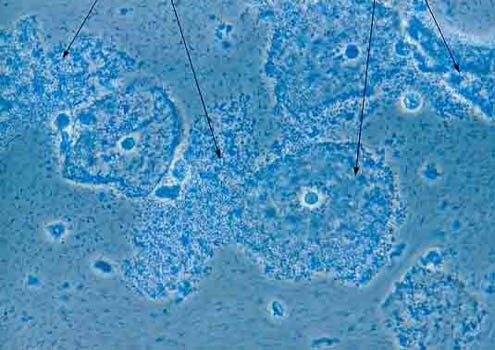
Squamous cervix cells covered with rod-shaped bacteria, Gardnerella vaginalis(source)
Bacterial vaginosis is a common disease among reproductive-aged women:
[It] is characterized by the loss of normal vaginal flora, predominantly hydrogen peroxide-producing Lactobacillus spp., and the increase in the number and species of other bacteria in vaginal fluid. The decrease in lactobacilli and increase in numerous facultative and anaerobic bacteria, some of which have only been recently characterized, may lead to changes in the characteristics of vaginal fluid, such as thin discharge and odor. (Koumans etal., 2007)
Its incidence correlates with the number of lifetime sex partners, and this correlation holds true even when one controls for a series of socioeconomic variables: poverty, smoking, body mass index, douching frequency, education, and oral contraceptive use (Koumans et al., 2007). It thus seems to be sexually transmissible, with suspicions falling particularly on the bacterium Gardnerella vaginalis:
Sexual activity is a risk factor for BV, and most experts believe that BV does not occur in women who have never had vaginal intercourse [12,13]. Epidemiologic studies are strongly supportive of sexual transmission of BV pathogens. There is a high occurrence of BV and concordance of flora in women who have sex with women, further suggesting sexual transmission is important in this setting [14-16]. It is not clear, however, whether one type of sexual activity may be more important in the pathogenesis of infection than another. As an example, oral-genital sex may be a more important risk factor than penile intromission into the vagina. (Sobel, 2012)
The incidence of bacterial vaginosis also correlates with ethnicity, being 51.4% of non-Hispanic blacks, 31.9% of Mexican Americans, and 23.2% of non-Hispanic whites. This correlation likewise holds true when the above socioeconomic variables are held constant. High incidences have also been found in sub-Saharan Africa (Pepin et al., 2011).
After studying these ethnic differences in vaginal flora, Ravel et al. (2010) concluded that they were normal and not pathological:
From these data we conclude that vaginal bacterial communities not dominated by species of Lactobacillus are common and appear normal in black and Hispanic women. The data from this study are in accordance with the results of Zhou et al. (17, 18), who studied the vaginal bacterial communities of white, black, and Japanese women. The reasons for these differences among ethnic groups are unknown, but it is tempting to speculate that the species composition of vaginal communities could be governed by genetically determined differences between hosts. These might include differences in innate and adaptive immune systems, the composition and quantity of vaginal secretions, and ligands on epithelial cell surfaces, among others.
The ultimate cause may be vaginal pH, which is higher in blacks and Hispanics than in Asians and non-Hispanic whites (Ravel etal., 2010). Or it may be differences in cytokine concentrations, with differences in vaginal pH being due to the differences in vaginal flora (Nomelini et al., 2010).
There has thus been a co-evolution between the vaginal environment and certain strains of vaginal bacteria. This co-evolution would have followed different trajectories in different human populations. In a monogamous population, possibilities for sexual transmission would have been sporadic and difficult to sustain. The picture is different in a population with a high incidence of polygyny, especially if the males often inherit or steal some of their co-wives from other males. Such a context would have favored bacteria that can spread from one co-wife to another and then to other sets of co-wives when circumstance permit.
But why wait for the right circumstances? Why not make them by manipulating the host’s behavior? Such behavioral manipulation sounds like science-fiction, yet it has been demonstrated in a wide range of animal species, often in surprisingly precise ways. So how could our bacterium manipulate its host? It wants to hop from one set of co-wives to another, but the regular male partner is standing in its way. What should it do?
First, it should facilitate female-to-female transmission among the co-wives. Second, it should disable the male’s propensity for mate guarding. Better yet, it should reverse the polarity, causing him to feel not jealousy but pleasure at the idea of being cuckolded.
This kind of manipulation occurs in the isopod Caecidotea intermedius. A parasite, Acanthocephalus dirus, infects it as a temporary host before infecting one of several freshwater fishes. When the parasite is still soft and immature, it cannot survive a fish eating its isopod host. It thus seeks to reduce this risk by suppressing conspicuous host behaviors, like mate guarding. Later, when the parasite becomes hard and mature, it can survive consumption of its host and now stimulates mate guarding (Galipaud et al., 2011; Mormann, 2010).
Cuckoldry is fatal to reproductive success, so any such tendency would soon flush itself out of the gene pool. For example, the neural networks for mate guarding might become more insensitive to outside tampering. This change, however, would in turn favor those parasites that could maintain such tampering. The eventual outcome would be an evolutionary compromise where mate guarding is impaired, but not enough to prevent reproductive success. The situation is different, though, if the parasite spreads to another population that has never developed such immunity.
Many sexual fetishes have been around for a long time and are often traceable to the ancient Greco-Roman world. Cuckold envy, however, seems relatively recent, the oldest references dating back to 17th century England (Kuchar, 2011, pp. 18-19). We may thus be looking at a sexually transmitted parasite that entered England with the expansion of world trade in the 17th century. But from where? Probably from a highly polygynous culture area, like West Africa.
This parasite might be a vaginal bacterium that first acquired sexual transmissibility and then an ability to manipulate host behavior. It might alternately be a strain of vaginal yeast. Indeed, vaginal strains of Candida albicans show a similar adaptation to sexual transmission via the partner’s mouth, i.e., they adhere better to saliva-coated surfaces than do other strains (Schmid et al., 1995).
References
Gaulipaud, M., Z. Gauthey, and L. Bollache. (2011). Pairing success and sperm reserve of male Gammarus pulex infected by Cyathocephalus truncatus (Cestoda: Spathebothriidea), Parasitology, 138, 11, 1429-1435.
Koumans E.H., M. Sternberg, C. Bruce, G. McQuillan, J. Kendrick, et al. (2007). The prevalence of bacterial vaginosis in the United States, 2001–2004; associations with symptoms, sexual behaviors, and reproductive health, Sexually Transmitted Diseases, 34, 864–869.
http://journals.lww.com/stdjournal/Fulltext/2007/11000/The_Prevalence_of_Bacterial_Vaginosis_in_the.6.aspxKuchar, G. (2001). Rhetoric, Anxiety, and the Pleasures of Cuckoldry in the Drama of Ben Jonson and Thomas Middleton, Journal of Narrative Theory, 31 (1), Winter, pp. 1-30.
Mormann, K. (2010). Factors influencing parasite-related suppression of mating behavior in the isopod Caecidotea intermedius, Theses and Disserations, paper 48
http://via.library.depaul.edu/etd/48Nomelini, R.S., A.P.B. Carrijo, S.J. Adad, A.A. Nunes, E.F.C. Murta. (2010). Relationship between infectious agents for vulvovaginitis and skin color, Sao Paulo Medical Journal, 128, 348-53
http://www.scielo.br/scielo.php?pid=S1516-31802010000600007&script=sci_arttextPépin J., S. Deslandes, G. Giroux, F. Sobéla, N. Khonde, et al. (2011). The Complex Vaginal Flora of West African Women with Bacterial Vaginosis. PLoS ONE, 6(9): e25082. doi:10.1371/journal.pone.0025082
http://www.plosone.org/article/info%3Adoi%2F10.1371%2Fjournal.pone.0025082Ravel J, Gajer P, Abdo Z, Schneider GM, Sara S, et al. (2010). Vaginal microbiome of reproductive-age women. Proceedings of the National Academy of Sciences U SA, 108, 4680-4687.
http://www.pnas.org/content/108/suppl.1/4680.shortSchmid, J., P.R. Hunter, G.C. White, A.K. Nand, and R.D. Cannon. (1995). Physiological traits associated with success of Candida albicans strains as commensal colonizers and pathogens, Journal of Clinical Microbiology, 33, 2920–2926.
Sobel, J.D. (2012). Bacterial vaginosis, Wolters Kluwer, UpToDate
http://www.uptodate.com/contents/bacterial-vaginosis