


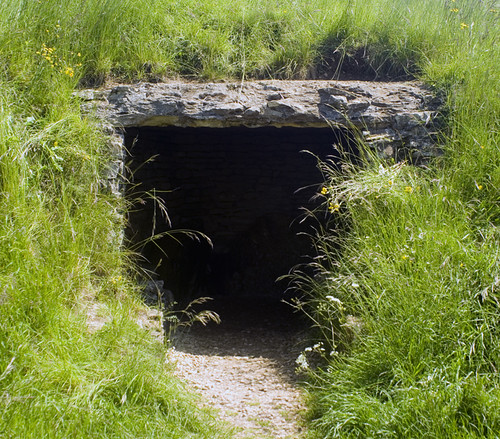
 Belas Knap Long Barrow (4500 BC), Gloucestershire, UK
In the spirit of comity, here is the proposal.
Melancholy Objects
Timothy Morton, UC Davis
Melancholy is an object-like presence that our psyche finds hard to digest. It is literally the footprint of another entity of whatever kind whose proximity was experienced as a trauma (the Freudian logic of the death drive). Melancholy by definition implies coexistence, which is why it's important for ecological thinking, since ecology is about coexistence thought as widely and as deeply as possible.
This coexistence need not be with sentient beings, nor even with lifeforms per se: it can include all entities (“objects” in my terminology) such as rocks, plutonium and carbon dioxide.
But just as importantly, melancholy doesn't imply anything about subjectivity. All you need for melancholy are various kinds of object. This is what makes it different, in traditional psychoanalytic theories, from other affects. Indeed, melancholy speaks a truth of all objects—I use the term “object” in a value-neutral way, implying any real entity whatsoever, not objectification or subject–object dualism.
In “Experience,” Emerson writes, “I take this evanescence and lubricity of all objects, which lets them slip through our fingers then when we clutch hardest, to be the most unhandsome part of our condition.” From there Cavell develops what he calls the “standoffishness” of objects. But melancholy doesn't require fully-formed subjectivity—indeed, subjectivity is a result of an abnegation of the melancholic abject, so it's a positive hindrance in this sense.
So we can generalize Cavell so that all objects are standoffish with regard to one another, not just to humans.
This means that the appropriate philosophy for an ecological era is an object-oriented ontology (OOO) that respects the withdrawn strangeness of objects while simultaneously 1) not discriminating against them in any way (reductionism, holism, anthropocentrism, biocentrism) and 2) allowing for their uncompromising unicity, the fact that they obtrude upon ourselves
and upon one another through time immemorial and the vastness of space.
My paper will show how OOO is deeply congruent with ecology, since the ecological age is what I call the time of hyperobjects: the moment in which human beings realize that they are enmeshed in a series of entities such as climate (and global warming) and evolution (and the plenum of lifeforms).
From here we can draw up a new ethical map that is neither utilitarian nor holistic—both systems fail in the face of hyperobjects, for reasons I shall outline. It is nonhuman (and even nonliving) entities that show us the way towards this new ethics.
By “standing in the place of the death drive,” as psychoanalysis would put it, humans have the chance to coexist nonviolently with other beings. Indeed, this traumatic coexistence is a better reading of the Freudian death drive than one that presents it as a simple existential human drama.
