


It was the bloodiest battle ever fought on English soil and changed the course of history. But a remarkable archaeological discovery means the Battle of Towton on March 29, 1461, will go down in history for another significant reason.
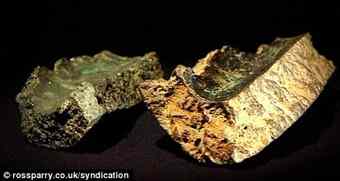 Artefacts unearthed by a metal detector in a Yorkshire field have shown that some of the earliest handguns were fired on this day - making it the first proven gun battle in British history.
The ten-hour clash between the Yorkists and the Lancastrians ended with the slaughter of 28,000 men - the equivalent of one per cent of the English population at the time.
Fought in a snowstorm, hundreds of arrows rained down on the opposing armies, who also massacred each other with swords in terrible scenes of close combat. Bodies were piled so high that fighting briefly ceased so they could be moved out the way.
Now researchers have learned that a number of Lancastrians were armed with these secret and deadly new weapons as well.
As well as the fragments of two separate gun barrels, archaeologists also found a lead bullet with an iron core.
According to Tim Sutherland, archaeologist from the University of York, this bullet is the 'earliest one to be found in Europe so far'.
'One bullet will have been fired at a time from a small calibre weapon like this, but it would have been deadly and the effect quite horrible at close range,' he said.
 Although the size of the bronze weapon is not known, the barrel was 2cm in diameter. Gunpowder inside would have been ignited by lighting a taper.
The two 10cm fragments of gun were sent to a hi-tech laboratory in Oxfordshire for analysis. Dr Evelyn Godfrey from the ISIS Research Centre said:'Almost certainly there are two different alloys which came from two different castings. They are almost certainly from two different guns.'
But the castings were 'incredibly poor' and the metal 'full of bubbles', making the gun liable to fall apart when fired.
The battle took place in a blizzard and the bitterly cold conditions would also have increased the risk of fracture when the gunpowder was ignited.
'It's no real surprise that it blew up when fired,' said Mr Sutherland. 'The manufacturing of firearms in that period of time was notoriously unreliable.'
Analysis of the internal coating of the gun fragments indicated it contained 'the constituent parts of gunpowder' and was therefore used in the battle.
The gun would certainly have been heavy and not easily carried on the front line. Researchers believe it would have been used at Towton as a method of intimidating the opposition.
Poor accuracy and difficulties in firing the gun made it of limited use on the battlefield itself, although the noise would certainly have scared the horses on both sides.
 Mr Sutherland said literature existed indicating basic handguns like this may have been used in battle in Europe a few years earlier. However, the discovery of physical evidence at the site of the War of the Roses battle near Tadcaster, North Yorkshire, is the first hard proof archaeologists have got hold of.
He said:'In terms of its rarity, we don't know of any other battlefield where one of these has turned up.
'In terms of the Towton battlefield, it's very important because we're looking at the cusp of the use of archery and the introduction of handguns. Guns didn't become common in battles for about 30 years or so. It's incredibly important and we still can't believe we've found this.'
Unfortunately the guns didn't do them much good as the forces of Henry V1 were defeated by the Yorkists, leaving 18-year-old Edward IV to claim the throne.
Indeed, evidence suggests the firearms were so badly made that they eventually blew up as they were fired and almost certainly killed the unfortunate soldier holding them.
Source: Daily Mail [November 26, 2010]