


by Mandie Shaner

Tucker is my (almost) 6 year old American Bulldog. I should have known from our first meeting at the shelter when he jumped a waist high gate to greet us that it was going to be a wild ride, but he never ceases to amaze me with his antics. Tucker is one of those dogs that can just look at you and make you giggle uncontrollably. He's part dog, part cow and 100% lummox. Some of what makes him so goofy, is also what makes him so prone to cranial cruciate ligament (abbreviated CCL) injury. He is extremely top heavy with a giant head and chest, but somehow his tiny back legs did not manage to follow suit, and over the years he has experienced damage to both of his knees. Some breeds of dog are also more prone to cruciate ligament injury due to the conformation of their legs, and Tucker is also at a disadvantage in this regard. His back legs somewhat turn in, making them a lot less stable than other dogs with similar weight.
In October 2007, Tucker was diagnosed with a full CCL tear, and our veterinarian recommended a TPLO right away. Without knowing anything about the surgery or what it entailed, we decided to not decide at that moment and do some research on our own. Through our research we found an alternative to surgery called Conservative Management. Conservative Management for dogs is a somewhat loosely defined term basically meaning rest, anti-inflammatory medications and supporting the natural healing process of the leg over a period of 4-8 weeks. The idea behind CM as a CCL treatment technique is that by reducing the load on the knee for one to two months you can give the joint a chance to build up muscle and scar tissue to compensate for the loss of the injured knee ligament.
We really felt we owed it to Tucker to at least try to heal him using a more natural approach, and we gave CM a "go" for a few months. The CM practices we tried the first time around were restricting him to leash walking only for bathroom breaks, confining him to a small, carpeted area of the house while we were gone, using Rimadyl to help with inflammation, and trying a dog knee brace. Despite all of our best attempts and hard work, we were unable to see the results we wanted, and after a few months of CM we opted to go with a Traditional Repair surgery (which we were again advised against by our veterinarian who strongly preferred the TPLO), from which Tucker has healed completely.
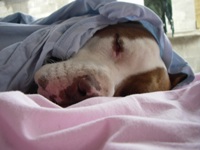 In late 2009, Tucker once again became intermittently lame in his rear leg, but this time it was the non-surgical leg. He had been limping on and off on his surgical leg for about a year following the traditional (which is an extracapsular repair using the leader line technique) repair, but had seemed to finally be getting around ok until this new lameness began. At first it started that he would only limp in the morning, but it gradually progressed to toe touching every other day. We decided to take him to the veterinarian to have the drawer sign test performed and get a definitive diagnosis.
As expected, Tucker tested positive for the drawer sign, although the veterinarian said that he did not think it was a full tear as of yet due to the fact that Tucker was not toe touching on a regular basis. Despite not believing it was a full tear, he recommended a TPLO or TTA be done within the next month. I explained to the veterinarian that I wanted to try Conservative Management, and he wished me luck, informing me that generally only dogs under 30 pounds have success without surgery.
After leaving the office that day we began a strict Conservative Management regimen. Remembering all of the trials, tribulations and difficulties we encountered during Tucker's Traditional Repair surgery, I really wanted to make sure we could make CM work this time and avoid the trauma of surgery.
Luckily, my husband and I both work from home doing freelance WordPress web development, and one of us would be able to stay with Tucker at all times to make sure he was staying calm, quiet and resting. This second time around I did things a bit differently. I still kept him confined to controlled, leash walking when he needed to use the bathroom, but I also made it a point to walk a half a block or so each time we went out. My logic here was that it was important to keep the joint somewhat strong and moving while his body was working build up scar tissue and muscle around the torn ligament. I was careful to make sure that he did not get overly excited, jump and/or run, because I was sure that any strenuous activity or quick motion would tear the ligament for sure and set us back.
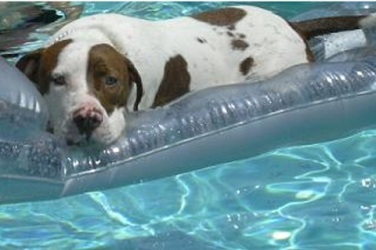
Of great importance for any dog with CCL issues is proper weight management. During the time leading up to his second CCL injury, Tucker had been getting one too many handouts while visiting our relatives in Pennsylvania, and had subsequently gained a significant amount of weight. As part of his Conservative Management plan I decided to cut back on his food intake, and switched him to a higher quality, protein rich food. Over the first month of CM he lost about 5 pounds, and got down a total of 12 pounds during the entire CM period. We have worked hard since then to keep the weight off, and it seems to be an important part of maintaining his joint health.
The inflammatory process can be very damaging to the body in both humans and dogs. Managing inflammation is an integral part of any successful round of Conservative Management. This time I really wanted to go as natural a route as possible, but seeing how much pain Tucker was in at the beginning of the CM period, I decided we should at least start him on a round of Rimadyl to make him more comfortable. The only downside to the Rimadyl is that it tends to make him feel so much better that he forgets he is hurting! To keep this in check I adjusted the dosage to ensure he was not in any pain, but made sure he was aware of it enough to take it easy on himself. Concerned about the effects of long term use of NSAIDs on the liver, I wanted to transition to a more natural approach to inflammation control as soon as possible.
After about the first month of the Rimadyl I found information on using Yucca Root to help ease inflammation, and thought I would give it a try. I transitioned from one to the other over the period of about two weeks, knowing in my head that I would keep him on the Rimadyl if I noticed a decline in the way he was feeling. After completing the transition to Yucca he seemed to be doing just fine, and we've been keeping up with the Yucca Root extract ever since. His dosage is 9-10 drops of yucca extract in his food with a bit of water to dilute it.
In addition to the Yucca, we began giving 1000 mg of Omega-3 Fish Oils twice per day during Conservative Management. The idea behind the Omega 3 fatty acids is that it helps to lubricate the joints and reduce inflammation. We've had nothing but positive results from using this supplement, and it is another one we continue to use. We also had always been doing the Glucosamine/Chondrointin supplements, and continue to use these as well. Cosequin seems to be the most palatable variety, as well as a vet favorite, but we've tried many brands with similar amounts of success.
After about 8 weeks of CM, significant improvement in Tucker's knee health was seen, and he was no longer limping or toe touching as he once had been. This was a long 8 weeks of strict CM, but in the long run it was worth avoiding the cost, risk and recovery process associated with any of the surgical procedures. We are aware that CM is not defined as a “fix” for an injured cranial cruciate ligament (CCL), but with the use of supplements and an alternative, holistic anti inflammatory medication like Yucca, we have seen great results. Over time his leg will build up the scar tissue necessary to stabilize the joint, and hopefully do so without any major arthritic consequences.
Overview of My CM Protocol:
- Weight Management - We cut down on treats and snacks while transitioning to a higher quality food which we fed less.
- Inflammation - We started with Rimadyl and Omega 3 Fish Oil (1000 mg capsules, twice per day). After 1 month of the Rimadyl I transitioned to Yucca Intensive, and give 9-10 drops diluted in food.
- Joint Support - Glucosamine and Chondrointin supplements are good to support joint health in any dog.
- Rest - Make sure your dog stays in a confined area without distraction. Carpets are preferable, avoid steps, jumping, running or rough play during this time. Toys such as frozen kongs filled with peanut butter or bully sticks are a good way to help them alleviate boredom.
- Controlled Exercise - Take a few, short, leash walks per day under controlled conditions to ensure your dog maintains muscle, and to also encourage the growth of scar tissue around the injured ligament.
- Pay Attention to Your Dog - Your best friend will tell you how they're doing. Go at their pace, and avoid doing too much, too soon!
Mandie Shaner is the founder of Dog Knee Injury, an owner resource dedicated to helping people facing CCL injuries in their pets. She also is active in Pit Bull advocacy/animal rescue through Save A Bull, and co-owns a WordPress web development company: Design SEO Hosting.