


The fourth season of the multi-disciplinary excavation undertaken by the Kerala Council for Historical Research (KCHR) at Pattanam in Kerala's Ernakulam district began in February and ended in the second week of June. The Archaeological Survey of India (ASI), Thrissur Circle, was a collaborative partner. A number of universities and research institutes in India and abroad extended academic support.
 Reconstructing life at Pattanam, as revealed by the material finds, was the primary objective. The other objectives were to investigate overseas contacts, clarify the cultural sequence and estimate the extent of the Pattanam archaeological site. The search was not for antiquities per se, but for activity contexts and their relationships.
The finds include pottery, metals, objects of personal adornment, and botanical samples. One other interesting find was a broken rim with Brahmi script.
Pottery
Pottery fragments, local and foreign, continue to be the dominant cultural artefact. This season the local pottery sherds approximated two million. The obvious indication is dense habitation in the Early Historic period, as suggested by the abundance of finds in the corresponding strata. Small and medium sized terracotta bowls seem to be the most prevalently used since almost a two-thirds of the rims obtained are of this category.
The pottery carry the fingerprints of the ancient people of Tamilakam, and reflect their social and physical environment. It is an indicator of their mastery over tools, and their skills and cultural interactions. The diagnostic pieces (rim and base), those with designs, grooves or impressions, edge ground and those with other distinct features, are sorted, documented and conserved.
The imported and fine pottery assemblage comprises Roman, West Asian, Indian Rouletted Ware (IRW) and a host of other unidentified fine wares. The number of Roman amphora sherds and Terra Sigillata excavated at Pattanam continued to be impressive and its record as the largest assemblage of Roman pottery in India will have deeper implications in understanding the Roman role in Indian Ocean trade. This season alone brought forth over 2,000 amphora sherds.
The West Asian assemblage consists of green-blue glazed Parthian/Sassanian ceramics (Turquoise Glazed Pottery) and torpedo jar sherds. Their number is around 1,400.
The IRW provides critical evidence to effectively challenge the Euro-centric perspective promulgated by Mortimer Wheeler. These illuminate the trade dynamics within India which contributed to the development of long-distance maritime trade. The stratigraphic distribution of IRW suggests that Pattanam was a commercial site even before West Asians or Romans came there. The occurrence of IRW in the pre-Early Historic layers, provides an insight into the fact that trade was predominantly South Asia-based and inspired at this early time.
The dominant presence of IRW around the shores of the Indian Ocean may help reveal the importance of Indian Ocean exchanges in the development of Roman trade. Pattanam is the first site on the western coast to provide such a large assemblage of IRW. This season produced over 2,300 sherds.
One of the most exciting moments of this season was the discovery of a BRW sherd at a depth of 370 cm from a layer that was considered sterile. That layer was sterile, but for that extraordinarily shiny, tiny sherd. The only artefact to be recovered from that depth, it is any excavator's delight.
Metals
In metallurgy, Pattanam seems to have registered amazing achievements. These could have begun in the Iron Age phase. It may be assumed that the expertise in iron technology extended to other metals, especially copper, gold and lead.
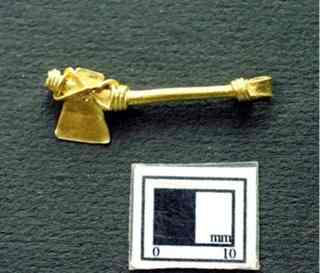
About 80 cm above the earlier-mentioned BRW sherd, an exquisite item of jewellery — a miniature gold axe — was found at a depth of 284 cm to 292 cm, from a dark brown loose sandy clay locus which had local pottery and charcoal fragments. The axe has universal credentials as a key pre-historic tool.
 Personal adornment

Objects of personal adornment seem to have had a pride of place. Most of the copper and gold objects appear to be fragments of ornaments or cosmetic tools such as antimony rods. Lapidary items such as stone beads, cameo blanks, micro inlays, pendants and glass beads are substantial in terms of their quantity and variety. As in earlier seasons, the semi-precious stone debitage in the Early Historic layers implies that lapidary workshops were active at the site. The artisans seem to have been familiar with advanced stone-cutting technology.
Broken rim, Brahmi script
A rim sherd with pre-firing marks of four Brahmi letters was found at a depth of 138 cm. This has special significance, considering the scantiness of inscribed potsherds at Pattanam. This is the first pre-firing pottery inscription from Pattanam, though some sherds with post-firing graffiti were found in the earlier excavations. Comparative study of scripts from contemporary sites in Tamilakam as well as the Red Sea port sites of Berenike and al-Qadim (Myos Hormos) may shed more light onthis find.
Botanical samples
At circa 4 m depth, all the four main trenches had peat formation. Peat was seen below the Iron Age layers and further down in the natural layers. Besides organic sediments such as roots, leaves, bark and seeds, the peat layer included frankincense. Eighteen wooden pegs of 15 to 30 cm length arranged elliptically at a depth of 4 m were excavated.
About 40 coins, round or square in shape, were unearthed. Some are heavily corroded and all are made of copper alloy, except for one lead coin. Most are Chera coins with bow and arrow and elephant symbols from depths ranging from 140 cm to 250 cm in the Early Historic levels.
The co-directors of the research team were Dr. M. Nambirajan (ASI), Dr. V. Selvakumar (Tamil University), Dr. K. Rajan (University of Pondicherry) and Dr. K.P. Shajan (United Kingdom).
Students from the Universities of Oxford, Rome (Tor Vergata), Paris (the Sorbonne), University College London (UCL) and Indian universities participated in the excavations. A number of school and college students were trained in the Field Archaeology School.
The author is the Director of the Pattanam Excavations.
Source: The Hindu