


Tucked away in the uninviting Northeastern Badia is a hidden region teeming with life and intrigue, its black basalt rocks and desert sands concealing secrets ancient and new.
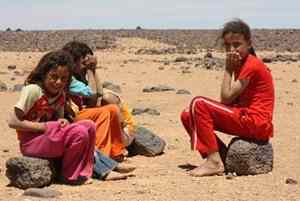 The Harra, Arabic for burnt stone, is an area that stretches over 11,000 square kilometres in the Northeastern Badia littered with basalt rocks created by the once volcanically active Jabal Al Druze in Syria.
Although its name suggests images of scorched earth, a closer look reveals a world of life and tranquillity, a desert paradise that has been defying the odds for thousands of years.
Home to the nomads
With temperatures reaching as high as 50° Celsius during the summer and as low as 10° Celsius in the winter months, the Harra boasts some of the most severe weather conditions in the Middle East.
But past the windswept plains visible from the Mafraq-Rweished road to Iraq lie fields of wild flowers, lavender, sage, camomile and thyme - a natural pharmacy growing amidst the desert.
The lifeblood of the Harra is a series of underground aquifers and seasonally flooded mudflats, which result in freshwater ghadeers, or springs, feeding an entire seasonal ecosystem that has supported life since pre-historic times, according to archaeologists.
Due to the cover provided by rocky outcrops and the difficulty for large groups to enter by horse or camel, the Harra became a favoured oasis.
A number of archaeologists believe that some of the Harra’s earliest residents harvested wild cereals and nuts on the slopes of Jabal Druze, moving out to the plains of the Harra to hunt and gather herbs.
Today’s residents of the Harra, known as Ahl Al Jabal, or people of the mountain, are believed to have originally migrated to Jordan from nearby Jabal Al Druze over the centuries, some retaining distinctive Syrian accents.
A large portion of the Ahl Al Jabal remain herders, while others work for government institutions or as merchants along the once-well-travelled road to Baghdad.
Some families commit to both, living halfway between settled agriculture and semi-nomadic pastoral lives that continue in the line of their ancient predecessors.
In the spring of each year, bedouins from surrounding villages pack up their homes (namely canvas tents, gas stoves and cookware), corral their flock and head out to the Harra, a continuation of a seasonal migration that has occurred for millennia.
Glimpses of the past
Lying in the Harra’s lush valleys and alongside freshwater ghadeers, are scores of ancient rock art.
Scrawled along the burnt basalt stones is a series of Neolithic rock art inscriptions dating back to 7000BC, leading archaeologists to believe some of those pre-historic communities made use of the area’s water resources and fertile soil.
The ancient peoples also left behind remnants of Neolithic kites, massive stone hunting traps used by pre-historic man and later ancient bedouins to capture the herds of wild gazelle and oryx which once roamed the area.
Among the Harra’s hidden gems are the mysterious rocks left behind by ancient bedouins who marked the passage of time with drawings of their everyday lives - depicting gazelles and lions, hunting scenes and celebrations.
Others left behind details of their complex genealogy in Safaitic script, the precursor to modern Arabic, listing their forefathers and places of birth from the first century BC and the third century AD.
According to the Department of Antiquities (DoA), these early artists not only left behind insights into daily life and wildlife in the area at that time, but also clues about a thriving civilisation with a written language.
“This proves that the bedouins at the time were literate and had a vibrant culture separate from that of the Nabataeans,” DoA Assistant Secretary General Rafi Harasheh said.
However, despite their drawings and intricate script, due to their transient way of life, little else is left from the Safaitic Arabs who roamed the Harra 2,000 years ago.
In the Islamic period, the Harra was a stopover for caravans moving from Bosra, Azraq and Arabia, as traders, merchants and pilgrims stopped in the Harra’s fertile outwash plains before moving on to the arid basalt desert that surrounds the area, according to the DoA.
Dozens of ancient basalt mosques dating from the early Umayyad and Abbasid periods still stand, inscribed with Kufi (ornamental calligraphic form) Arabic inscriptions of the same period, according to head of the Zarqa archaeology directorate and specialist Khaled Jabour.
With one-metre-high walls, questions remain if the ancient mosques were covered with canvas or whether the faithful prayed outdoors, appreciating the dramatic nature, according to Jabour.
More recent stone structures include bedouin burial cairns and basalt pens designed to corral sheep and keep out red foxes, Arabian wolves and wild dogs that are known to roam the area at night.
Open to visitors?
Harasheh and Jabour, who have each spent around 20 years researching the area, insist that the Harra has huge potential for eco-tourism and archaeology enthusiasts.
Unlike the commercialised experience in Wadi Rum, the Harra offers genuine interactions with the country’s last nomadic bedouins, whose tents are open for tea, water and other provisions for those daring enough to venture into the region.
Lucky travellers may even receive Harra mansaf, most often served on bread rather than the staple of rice, and topped with a sheep’s head.
In addition to the Neolithic and Safaitic Arab remains, the area’s archaeology also boasts the fortress of Qasr Burqu and the ancient city of Jawa, with its complex engineering system.
Other jewels of the Harra, Wadi Al Abyad and Wadi Sara, are now located in a military buffer zone.
Once the favoured grazing grounds for the Ahl Al Jabal, the fertile valley is off-limits to bedouin shepherds, making it a de facto nature reserve.
The area teems with rabbits, lizards, butterflies, and a myriad of local and migratory birds stopping over to rest by the freshwater springs. It is perfect for hiking and nature-enthusiasts, and is so isolated, at first glance it seems like another planet.
But the only road to Shubaika, a municipality within the Harra and the main entranceway into the region, has deteriorated, and most of the region is impossible to reach without a 4X4, a local guide, and in some cases permission from the Royal Badia Forces patrolling the border.
After thousands of years of only being mentioned in whispers, a lack of development and the harsh desert winds are all that are left to safeguard one of the Kingdom’s best kept secrets.
As the modern world grinds on, the secrets of the Harra remain safe - for now.
Source: The Jordan Times