


The story of the archaeological site of Bat, a cemetery consisting of around 400 ancient tombs, dates back 5,000 years. Bat is a circular building of square-shaped hard rocks, with two external walls and a third interior one, which is divided into numerous dome-shaped rooms that look like a 4m high beehive.
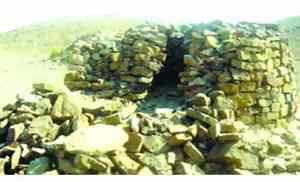 From the inside, the cemetery is divided into partitions to bury the dead. The graves also contain pottery, vases made from rock, rosaries of precious stones, bones and wood.
The site, which lies in the north-eastern Ibri town in the Adh-Dhahirah province of Oman, became famous when the International Heritage Committee of Unesco listed it among the world’s places of international value and put it on the Natural International Cultural Heritage list.
This is why the Omani ministry of culture and heritage started several archaeological missions to excavate in Bat since 1973.
So far, these excavations are concentrating on discovering more about the Old Omani Civilisation, to which there are various historical references.
“The International Heritage settlement in Bat was discovered in the 1970s by a Danish excavating mission. Later on, more missions from England and Germany came as well,” said Hassan Abdel-Lawati, general manager of the Department of Antiquities and Museums, affiliated to the Ministry of Culture and Heritage.
Through these excavations, pottery and rock-pieces were discovered in Bat, resembling those discovered in the cemeteries belonging to the Umm al-Nar Civilisation, which was in United Arab Emirates between 3000-2700 BC.
“Excavation missions recorded that the oldest tombs in Bat were in the Hafeet era (3000-2500 BC), then the tombs of al-Alf al-Thaleth (the third thousand) in the era of Umm al-Nar (2700-2000 BC),” Abdel-Lawati added.
“They also discovered more tombs that go back to the transitional phase between Hafeet and Umm al-Nar, which were called the Bat tombs.”
As well as the numerous tombs discovered then, huge rounded towers were found with water wells in the middle of some of them. These were called Kasr al-Ragoum, Kasr al-Khafagi, Kasr Mataria, Kasr al-Solaimi and Borj al-Khatm.
“The ministry has signed a memorandum of understanding with the Bochum Museum in Germany for an expert to restore the tombs. So far, they have restored five tombs, with the assistance of an Omani team,” Abdel-Lawati said.
“In 2007, a mission had worked on the tower of Kasr al-Khafagi and Kasr al-Mataria. Moreover, the ministry used satellite-related devices to show the uncovered building,” Abdel-Lawati explained.
In 2008, another expert was assigned to work on cutting rocks for restoration purposes.
The Omani ministry of culture and heritage is very keen to have the buildings excavated and has signed several memoranda of understanding with the US University of Pennsylvania to dig and excavate in this region.
Although the ministry has assigned a special tour guide to Bat, citizens of Ibri do their share in guiding tourists who head to this area, 350km from the Omani capital, Muscat, to see this international monument.
“We can’t consider ourselves not to be a part of this cemetery, because whoever has no past, has no future,” said Hamad el-Gaberi, a citizen of Ibri.
“We become very happy when a group of tourists come here or some students who need information about the place. We won’t say we are more trusted than the ministry, but we try to help with the information we have, especially that we are the sons of this place.”
The secret of the tombs’ survival has mainly to do with the huge rocks on which the tombs were built, according to Khamis el-Baridi, a resident of the area.
“Despite the numerous corrosive elements that harmed its ceilings, the tombs survived for thousands of years to be a witness to the Omani civilisation and to become a staple of our tourism,” Khamis said.
“The Bat tombs have a high moral value, and the fact that they were listed on the Natural International Cultural Heritage list makes us even prouder to belong to this very district,” Mohamed bin-Rashed said. “Especially after it was recognised internationally, it became a unique place to visit and we have received a lot of visitors recently.”
The Omani Ministry of Culture andHeritage has proposed a tender to rebuild walls around the site. It also works on establishing an information centre for visitors, with a small museum to preview the discovered antiquities.
The rehabilitation of a unique prehistoric site like Bat needs thorough planning to take care of the smallest details.
That’s why the ministry’s officials always stress their aim of restoring Bat through a systematic plan that protects the originality and safety of the site and achieves the best possible cultural and tourism usage.
Source: Gulf Times