


Each year, millions of tourists make the trek to see Egypt’s pyramids, and more than 800,000 crowd the monoliths of Stonehenge.
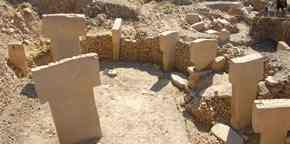 By contrast, the stone circles of Gobekli Tepe — set against the backdrop of the Anatolian plateau, which unfurls in solitary elegance — are visited by a mere scattering of curious locals and the occasional wandering archaeologist.
They may be one of the great archaeological discoveries of the era, but the stones — with their carved reliefs of lions, foxes, birds and snakes — are largely neglected by the outside world. A recent visit indicated that they're likely overlooked by a majority of Turks as well.
Standing on the hill at dusk, the Gobekli Tepe circles burn a vivid orange, the giant T-shaped pillars silhouetted in the setting sun. To the south lies the Syrian border, to the east the biblical Harran plain.
The ruins, though vast, are humble compared to their counterparts in Britain and Egypt. It is the age of the site, however, that makes it one of the era's most important discoveries.
Dating back to the 10th millennium B.C., Gobekli Tepe is the great-granddaddy of pretty much everything that has come since. Built a stunning 7,000 years before the Great Pyramid, and 6,000 years before Stonehenge, German-born archaeologist Klaus Schmidt believes what he has uncovered is the world’s very first temple.
 To begin to conceive of how old Gobekli Tepe really is, one had to think back on all of their most basic associations with early civilization — domesticated animals, farming, pottery, writing, the wheel — and realize that none of those things existed at the birth of the temple. Erected at the end of the last Ice Age, this was the era of the hunter-gatherers, a time before communities as we understand them had begun to take shape.
Schmidt believes Gobekli Tepe was once a prosperous ceremonial site where clans from a radius of 100 miles gathered to build a complex religious community.
“The T-shaped pillars and the reliefs clearly had been not made for mundane, but sacred purposes,” Schmidt said.
Schmidt said the significance of Gobekli Tepe was “immediately” clear to him.
An elaborate feat with ritualistic implications, the site is pre-agricultural, with none of the telltale signs of a permanent settlement. But, Schmidt argues, Gobekli Tepe’s builders were on the verge of a dramatic turn toward civilization.
Evidence of the world’s oldest domesticated wheat strains found just 20 miles away from the site point to the development of agriculture a mere five centuries after the shrine was constructed, and over the next 1,000 years settlers in the region had begun to corral animals.
Schmidt’s theory is simple but radical and, if true, upturns the accepted chronology of human origins.
Scholars have long believed that it was only with the advent of farming that communities had the resources to begin developing elaborate religions and temples. But Gobekli Tepe, according to Schmidt, is our first real proof that it was religion that prompted man to seek stable food sources and settle down — a reversal of the commonly accepted wisdom that people develop a religious life after settling.
“Hunter-gatherers, who live in small groups during the year, were only capable of such grand efforts when they were organized for some time,” explains Schmidt with a nonchalance achieved only by the truly confident. “And here we begin to see the establishment of a complex society.”
Source: Global Post [April 21, 2010]