


A team of Chinese archeologists recently revealed findings dating back thousands of years after a successful expedition to one of China's most intriguing and dangerous areas - Lop Nur, also known as the Sea of Death from which nobody escapes.
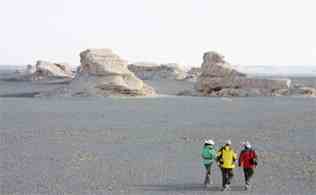 Ominously named due to its harsh and variable climactic and geographic conditions, Lop Nur, or Lop Lake, is located between the Taklimakan and Kuruktag deserts in Xinjiang Uyghur Autonomous Region. A former saline lake occupying roughly 2,000 square kilometers in the 1950s, Lop Nur ceased to exist by about 1970 and is now largely dried up with a group of marshes and small shifting lakes receiving channels of the Tarim River.
In 1900, Swedish archeologist Sven Hedin uncovered the ancient city of Loulan and in the early 1900s British archeologist Aurel Stein further discovered about 100 cultural sites in the area. In 1980 the lake lived up to its threatening reputation, Chinese archeologist Peng Jiamu disappeared without a trace.
As part of China's Third National Cultural Relics Investigation, a team of 22 archeologists faced the seemingly uninhabitable region and spent 20 days in Lop Nur in November, using state-of-the-art technology to map their way through difficult terrain and discovering a host of historical sites and cultural relics.
Scientists employed remote sensing archeology for the first time in the region to help with their investigation that included confirming previously discovered sites and uncovering new ones.
"The new discoveries include gravesites, wooden architecture and evidence of farmlands," Yang Lin, director of the Archeology Institute at the National Museum of China, told the Global Times. "Mulberry trees along the river are proof of a prosperous civilization in this area."
The expedition involved six heavy off-road vehicles laden with food, water, gasoline, camping supplies and a generator. The journey began at Kong Que River (Peacock River) in the east, passed through the ancient city of Loulan at the center and then headed south.
"Some colorful pottery relics could date back to 3,000 years ago," director of archeology at Xinjiang Cultural Heritage Bureau, Liu Guorui explained, adding that items from this period of history have never before been found in the area.
Yang commented that the pottery relics are proof that pottery cultural elements existed in the early Bronze Age in Lop Nur. "Through the color, style and pattern of these pottery relics, we can see the influence of the Yellow River and Middle Asia," he said.
In the area's yadan hills, landforms created by wind erosion in Xinjiang's dry areas, the team uncovered graves that date back to the Han and Jin dynasties (206BC-220AD and 265-420).
"We found and recorded more than 200 immovable cultural sites in Lop Nur, including about 100 uncovered by British archeologist Aurel Stein 100 years ago," Liu said.
The field study was part of a larger expedition that ran from September to December and covered 32,500 kilometers from northern to southern Xinjiang. A vast terrain of deserts, meadows and mountains were investigated, with 800 immovable cultural sites recorded.
Due to the harsh topography and weather conditions, autumn was chosen as an ideal time to work in the area, although the team faced some unpredictable situations.
"I have been to Lop Nur 10 times since 1988 and this is the first time I saw hail and rain in autumn and the temperatures were almost under zero degrees, even at midday," Liu recalled.
The treacherous yadan hills also meant that driving conditions were far from ideal.
The involvement of the Institute of Remote Sensing Applications at the Chinese Academy of Sciences saw the application of remote sensing archeology, which Liu said was not only helpful in their exploration, but has also paved the way for future expeditions.
"The remote sensing technology saw 80 percent accuracy," Liu explained. "It's quite new for our research and serves as a good example."
The Third National Cultural Relics Investigation began in April 2007 and will wrap up in December 2011. According to a report in the China Culture Daily on February 24, 929,071 immovable cultural sites have already been recorded with 680,151 new discoveries found throughout the country. In Xinjiang alone, more than 10,000 immovable cultural sites were sited with 7,000 new discoveries, according to Liu.
Source: Global Times