


The skyline of Bahrain, formed by gleaming high-rises and upscale hotels, is all it takes to convey the ambitions of the small Gulf isle. But as the country speeds towards its future, it could be shutting a valuable window into its ancient past.
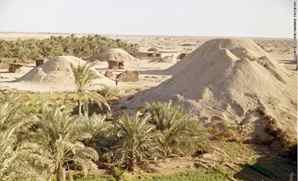 |
| Some of Bahrain's burial mounds date back some 4,000 years [Credit: CNN] |
More than 100,000 mounds once dotted the island. But that number has fallen sharply as a result of an urbanization drive that started in the 1950s.
Cleared to make way for housing, now only one-fifth of the original mounds -- some of which are 4,000 years old -- are estimated to still be intact.
The development boom has picked up pace in recent years, as reforms have reshaped an economy once dominated by fishing and pearl diving to one driven by finance.
Bahrain has become a hub for Islamic finance. Assets in Islamic banking have increased 12-fold in the last decade, according to the country's central bank.
A reputation for being more socially liberal than other Gulf states, along with the staging of high-profile sporting events like its Formula One Grand Prix, have also been a boon for its tourism industry.
But take a short drive away from the bustling capital city of Manama and you'll find one of Bahrain's largest surviving burial sites, which historians say could be the largest prehistoric cemetery in the world.
Built out of stone, earth, plaster and wood, the mounds were used as burial chambers, much like how the ancient Egyptians used pyramids to preserve their dead.
Along with remains, archaeologists have discovered a variety of artifacts -- copper and bronze weapons, jewelry, pottery -- in the graves.
The mounds are a "rich" source of information for understanding how the earliest Bahrainis lived, dressed and worshipped, according to Salman Ahmed Al Mahari of the Bahrain Ministry of Culture and Information.
They "give us a lot of information about the lifestyle of the people who lived in this country -- in this island," he told CNN.
The Dilmun civilization, an ancient trading hub that connected Mesopotamia, South Arabia and India, is believed to have inhabited Bahrain during the Bronze Age.
In a bid to stop, or at least slow, the destruction of the historical mounds, Bahrain is pushing to get them added to The United Nations Educational Scientific and Cultural Organization (UNESCO) World Heritage list.
It placed 11 burial sites on its World Heritage tentative list two years ago -- the first step a country can make to get a site considered for inclusion on the list -- and protection of cultural sites like its ancient burial mounds are almost certain to come into the spotlight when the country hosts the World Heritage Committee next year.
But preserving the ancient treasures may only become more difficult as the kingdom seeks to keep its growth humming along.
Source: CNN [March 12, 2010]